

orchestrator is a MySQL high availability and replication management tool, runs as a service and provides command line access, HTTP API and Web interface.
It requires its own MySQL database as a backend server to store all information related to the Orchestrator managed database cluster topologies.
Orchestrator only needs a MySQL user with limited privileges (SUPER, PROCESS, REPLICATION SLAVE, RELOAD) to connect to the database servers.
Key Features
- Discovery – actively crawls through your topologies and maps them. It reads basic MySQL info such as replication status and configuration.
- Refactoring – understands replication rules. It knows about binlog file:position, GTID, Pseudo GTID, Binlog Servers.
- Recovery – uses a holistic approach to detect master and intermediate master failures. Based on information gained from the topology itself, it recognizes a variety of failure scenarios.
- Interface that supports:
- Command line interface.
- Web API (HTTP GET access).
- Web interface.
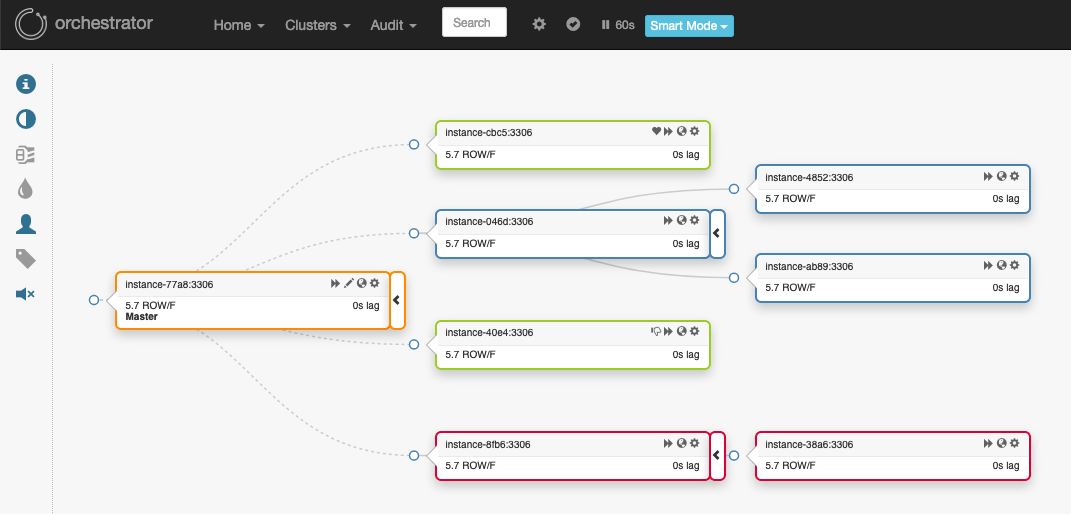
- Topology and status of the replication tree is automatically detected and monitored
- Highly available.
- Supports many different types of topologies, from a single master -> slave to complex multi-layered replication trees consisting of hundreds of servers
- Controlled master takeovers.
- Supports automatic failover of the master, and the replication tree can be fixed when servers in the tree fail – either manually or automatically.
- Manual failovers.
- Failover auditing.
- Audited operations.
- Pseudo-GTID.
- Datacenter/physical location awareness.
- MySQL-Pool association.
- HTTP security/authentication methods.
- An orchestrator-mysql Google groups forum to discuss topics related to orchestrator.
Website: github.com/openark/orchestrator
Support: Documentation
Developer: Shlomi Noach and many contributors
License: Apache License 2.0
orchestrator is written in Go. Learn Go with our recommended free books and free tutorials.
Related Software
| MySQL Tools | |
|---|---|
| DBeaver | Universal database tool |
| phpMyAdmin | MySQL web administration tool |
| NocoDB | Build databases as spreadsheets |
| MySQL Workbench | Complete visual database design tool |
| mycli | Command line interface for MySQL, MariaDB, and Percona |
| gh-ost | GitHub's Online Schema Migrations for MySQL |
| Beekeeper Studio | Cross-platform SQL editor and database manager |
| usql | Command-line database client |
| sqlit | lazygit of SQL databases |
| Harlequin | Easy, fast, and beautiful database client for the terminal |
| DbGate | Database manager for MySQL, PostgreSQL, MongoDB |
| Percona Toolkit | Essential command-line utilities for MySQL |
| SQuirreL SQL Client | Graphical SQL client written in Java |
| Adminer | Full-featured tool for managing content in MySQL database |
| dblab | Interactive client for PostgreSQL, MySQL, SQLite3, and more |
| Antares | SQL client based on Electron.js and Vue.js |
| XtraBackup | Backup utility for MySQL |
| innotop | Real-time, advanced investigation tool |
| SQLCheck | Detects common SQL anti-patterns |
| Skeema | Manage MySQL and MariaDB schema changes |
| Sequeler | Native Linux SQL client built in Vala and Gtk |
| orchestrator | High availability and replication management tool |
| OmniDB | Collaborative environment For database management |
Read our verdict in the software roundup.
 Explore our comprehensive directory of recommended free and open source software. Our carefully curated collection spans every major software category. Explore our comprehensive directory of recommended free and open source software. Our carefully curated collection spans every major software category.This directory is part of our ongoing series of informative articles for Linux enthusiasts. It features hundreds of detailed reviews, along with open source alternatives to proprietary solutions from major corporations such as Google, Microsoft, Apple, Adobe, IBM, Cisco, Oracle, and Autodesk. You’ll also find interesting projects to try, hardware coverage, free programming books and tutorials, and much more. Discovered a useful open source Linux program that we haven’t covered yet? Let us know by completing this form. |
Please read our Comment Policy before commenting.