

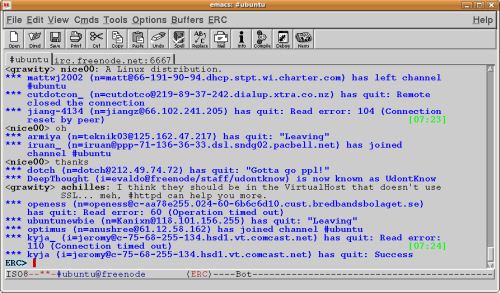
ERC is a powerful, modular, and extensible IRC client for Emacs. It supports multiple channel-buffers, nick completion, keyword highlighting, and more.
The software is written in Emacs Lisp. This makes it very easy to extend, customise and adapt ERC to your own personal style. A useful feature of ERC is that you can extend the set of commands available on your IRC prompt by writing your own short Emacs Lisp functions.
ERC maintains a separate buffer for each open IRC channel and direct conversation. A sophisticated mechanism is used to indicate activity in currently hidden buffers in the mode-line, called Channel Tracking.
Key Features
- Works with both Emacs and XEmacs.
- Multi channels / multi servers: every channel is put in a separate buffer; several IRC servers can be used simultaneously.
- Queries: private conversations are treated as channels, and are put into private buffers.
- Flood control.
- Timestamps.
- Join channels automatically.
- Buttonize URLs, nicknames, and other text.
- Wrap long lines.
- Highlight or remove IRC control characters.
- Highlight pals, fools, and other keywords.
- Detect netsplits.
- Complete nicknames and commands in a programmable fashion.
- Make displayed lines read-only.
- Input history.
- Track channel activity in the mode-line.
- Highlighting: some occurrences of words can be highlighted, therefore easing conversation tracking.
- Notification: ERC can notify you that users are online.
- Channel tracking: channels can be hidden and conversation continue in the background. You are notified when something is said in such a hidden channel.
- Nick completion: ERC can complete words so as to ease the writing of nicknames.
- History: past actions are kept in history rings for future use.
- Multi languages: messages are multilingual and can be customized.
- User scripting: users can load scripts (e.g. auto greeting scripts) at ERC startup.
Website: www.emacswiki.org/emacs/ERC
Support: Manual
Developer: Gergely Nagy, Adrian Aichner, Andreas Fuchs, Benjamin Drieu, and many others
License: GNU General Public License v3.0
Related Software
| Console IRC Clients | |
|---|---|
| WeeChat | Wee Enhanced Environment for Chat; very light and extensible |
| Irssi | Console based client supporting SILC and ICB protocols |
| glirc | Advanced client maintaining a model of the IRC connection state |
| tiny | Rust based IRC client |
| ERC | Powerful, modular, and extensible IRC client for Emacs |
| ScrollZ | Advanced ircII-based IRC client |
| ircc | A single C file which implements a usable IRC client |
| senpai | IRC client that works best with bouncers |
| EPIC | Based on ircII, EPIC excels at scripting |
| catgirl | Targets FreeBSD, OpenBSD, macOS and Linux |
| zuse | Sleek, minimal IRC client for your terminal. |
| rirc | Minimalistic IRC client |
| kirc | Tiny IRC client |
| Swirc | Console based ICB and IRC client |
| Xaric | irc client similar to (and forked from) BitchX and ircII |
| insomnia | Frontend for the hii IRC client |
| ii | Minimalist FIFO and filesystem-based IRC client |
| hii | File-based IRC client |
| Circada | Comes with two modes, normal chat mode and the navigation mode |
| BarnOwl | Forked from the ktools owl project |
Read our verdict in the software roundup.
 Explore our comprehensive directory of recommended free and open source software. Our carefully curated collection spans every major software category. Explore our comprehensive directory of recommended free and open source software. Our carefully curated collection spans every major software category.This directory is part of our ongoing series of informative articles for Linux enthusiasts. It features hundreds of detailed reviews, along with open source alternatives to proprietary solutions from major corporations such as Google, Microsoft, Apple, Adobe, IBM, Cisco, Oracle, and Autodesk. You’ll also find interesting projects to try, hardware coverage, free programming books and tutorials, and much more. Discovered a useful open source Linux program that we haven’t covered yet? Let us know by completing this form. |
Please read our Comment Policy before commenting.