

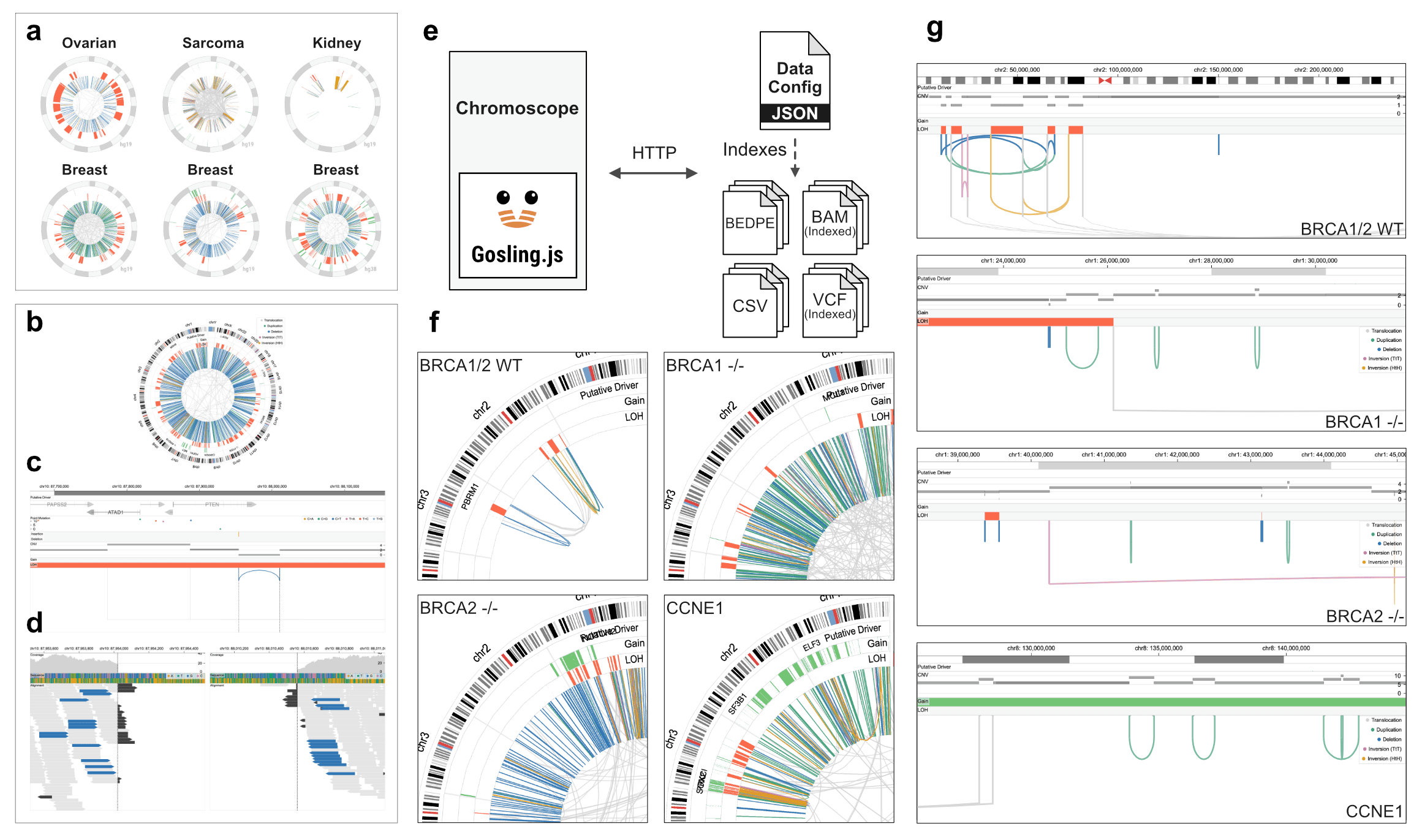
Chromoscope is an interactive web-based genome browser designed for investigating structural variation in human genomes. Its interface combines several coordinated views so researchers can move between different genomic scales while examining rearrangements and their relationship with copy-number changes.
The application is particularly geared towards cancer genomics, where large and complex structural alterations can be difficult to understand using a conventional linear genome browser. Chromoscope loads datasets through HTTP requests using configuration files, which means genomic data can reside on public servers, private infrastructure or cloud storage without requiring a dedicated Chromoscope backend.
This is free and open source software.
Key Features
- Provides four coordinated views for examining structural variation at multiple genomic scales.
- Visualizes structural variants together with their copy-number footprint.
- Supports analysis of chromosomal instability patterns including chromothripsis.
- Can display cohorts containing multiple samples.
- Provides interactive filtering of samples using clinical and other metadata.
- Supports categorical and continuous cohort filters.
- Displays clinical information associated with individual samples.
- Supports externally hosted data configuration files.
- Can load datasets from cloud buckets or local web servers.
- Does not require a dedicated application server for data visualization.
- Supports direct file upload and cohort selection.
- Provides linked navigation between genome views.
- Can preserve selected cohorts and genomic regions through URL parameters.
- Includes facilities for visualizing structural variants alongside sequencing-read data.
Website: github.com/hms-dbmi/chromoscope
Support:
Developer: Harvard Medical School Department of Biomedical Informatics
License: MIT License
Chromoscope is written in TypeScript. Learn TypeScript with our recommended free books and free tutorials.
Related Software
| Web-Based Desktop Genome Browsers | |
|---|---|
| Ensembl | Resource for geneticists, molecular biologists and other researchers |
| Genome Browser | Interactively visualize genomic data |
| GDV | Exploration and analysis of eukaryotic RefSeq genome assemblies |
| HiGlass | Explore and compare genomic contact matrices and tracks |
| igv.js | Embeddable genomic visualization |
| NGB | Web-based NGS data viewer |
| JBrowse 2 | Modern React-based genome browser |
| trackplot | Visualize various next-generation sequencing data |
| GIVE | Genomic Interactive Visualization Engine |
| Genoverse | HTML5 scrollable genome browser |
| Epigenome Browser | Visualization, integration and analysis tools for epigenomic datasets |
Read our verdict in the software roundup.
 Explore our carefully curated directory of recommended free and open source software, covering every major software category. Explore our carefully curated directory of recommended free and open source software, covering every major software category.The directory forms part of our extensive collection of articles for Linux enthusiasts. It includes hundreds of detailed reviews, together with free and open source alternatives to proprietary software from companies such as Google, Microsoft, Apple, Adobe, IBM, Cisco, Oracle, and Autodesk. LinuxLinks also covers interesting projects worth exploring, Linux-compatible hardware, free programming books and tutorials, and much more. Know a useful free and open source Linux application that we haven’t covered? Tell us about it using our submission form. |
Please read our Comment Policy before commenting.