

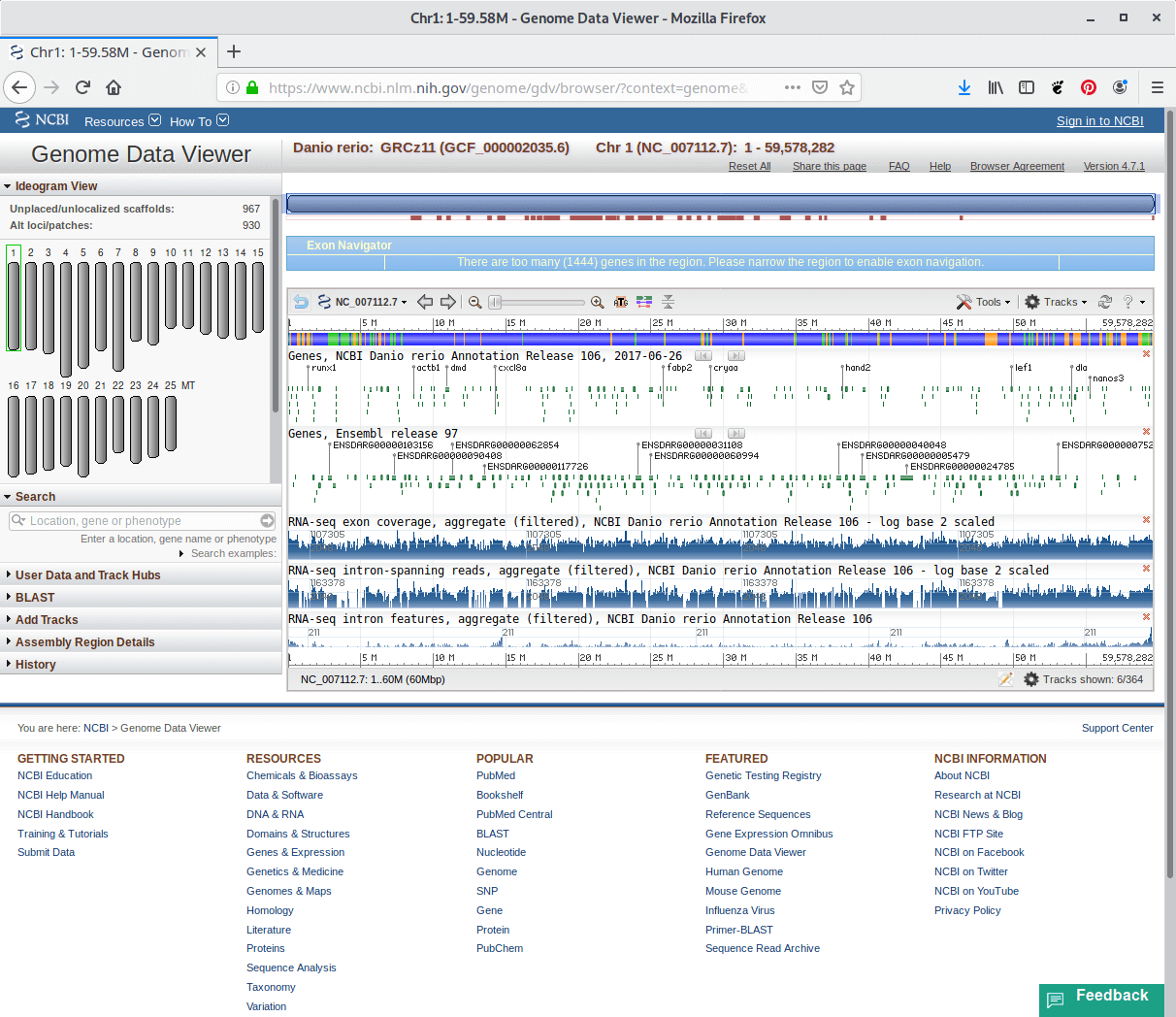
The NCBI Genome Data Viewer (GDV) is a genome browser supporting the exploration and analysis of eukaryotic RefSeq genome assemblies. It supports the exploration and analysis of more than 730 eukaryotic RefSeq genome assemblies.
It allows users to visualize different types of sequence-associated data in a genomic context. Genome Data Viewer is also used by different NCBI resources, such as GEO, to display datasets associated with specified experiments or samples in a genome browser context.
GDV is comprised of a series of ‘widgets’ that are used for different types of interactions with the browser, such as genome searches, analysis of BLAST results, data uploads or changing the display. The widgets communicate with one another such that an action in one widget causes other widgets on the page to update.
Website: www.ncbi.nlm.nih.gov/gdv
Support: Help, GitHub Code Repository
Developer: National Center for Biotechnology Information
License: –
Related Software
| Web-Based Desktop Genome Browsers | |
|---|---|
| Ensembl | Resource for geneticists, molecular biologists and other researchers |
| Genome Browser | Interactively visualize genomic data |
| GDV | Exploration and analysis of eukaryotic RefSeq genome assemblies |
| HiGlass | Explore and compare genomic contact matrices and tracks |
| igv.js | Embeddable genomic visualization |
| NGB | Web-based NGS data viewer |
| JBrowse 2 | Modern React-based genome browser |
| trackplot | Visualize various next-generation sequencing data |
| GIVE | Genomic Interactive Visualization Engine |
| Genoverse | HTML5 scrollable genome browser |
| Epigenome Browser | Visualization, integration and analysis tools for epigenomic datasets |
Read our verdict in the software roundup.
 Explore our comprehensive directory of recommended free and open source software. Our carefully curated collection spans every major software category. Explore our comprehensive directory of recommended free and open source software. Our carefully curated collection spans every major software category.This directory is part of our ongoing series of informative articles for Linux enthusiasts. It features hundreds of detailed reviews, along with open source alternatives to proprietary solutions from major corporations such as Google, Microsoft, Apple, Adobe, IBM, Cisco, Oracle, and Autodesk. You’ll also find interesting projects to try, hardware coverage, free programming books and tutorials, and much more. Discovered a useful open source Linux program that we haven’t covered yet? Let us know by completing this form. |
Please read our Comment Policy before commenting.