

HiGlass is a web-based visualisation tool designed for exploring large genomic datasets. It is particularly useful for investigating chromatin interactions, where the amount of information can make conventional genome browsers difficult to use.
The application supports coordinated exploration of multiple datasets. Researchers can compare experimental conditions, investigate patterns at different resolutions and examine relationships between genomic regions without losing their place in the data.
HiGlass is also a platform for building specialised visualisation environments. Its configurable tracks and views make it suitable for integrating different kinds of genomic information into a single interactive display.
This is free and open source software.
Key Features
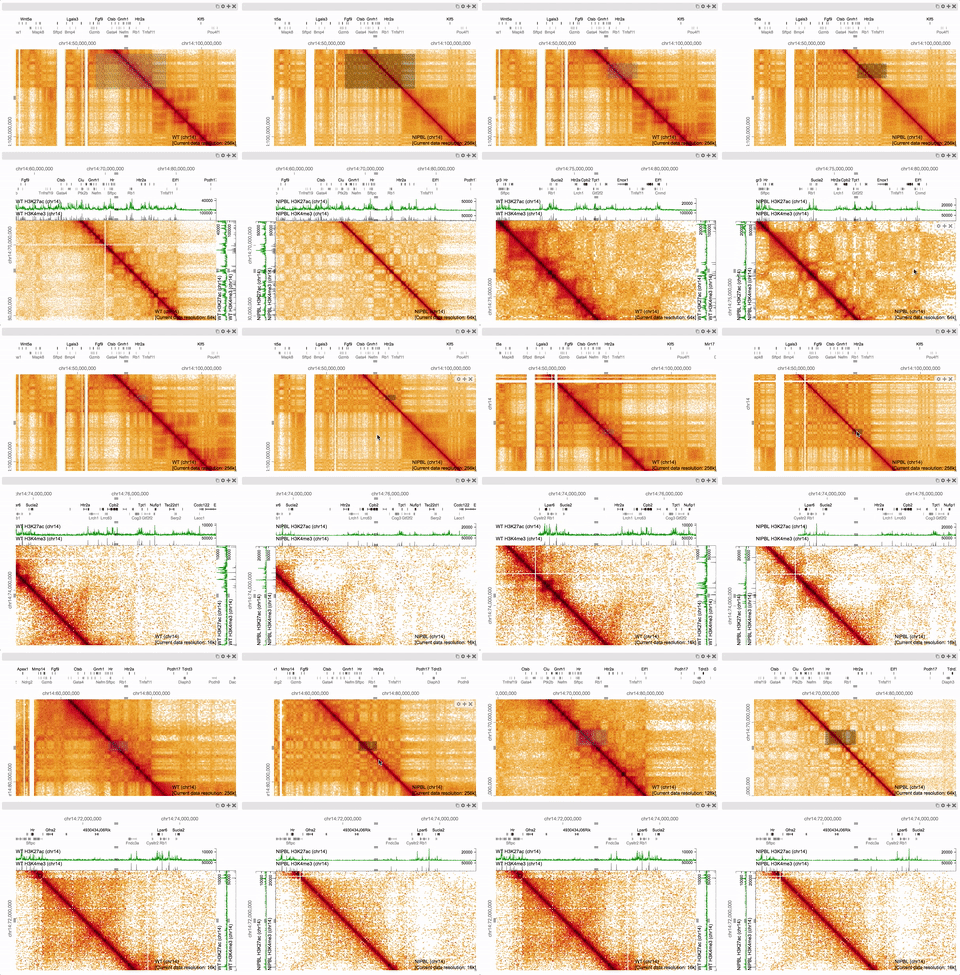
- Visualises genomic contact matrices, including Hi-C data, as interactive two-dimensional heatmaps.
- Supports one-dimensional genomic tracks alongside two-dimensional contact maps, enabling different data types to be examined together.
- Provides continuous zooming and panning across genomic regions and resolutions.
- Allows multiple views to be displayed simultaneously, with independent or synchronised navigation.
- Supports locking the zoom level, genomic position or both across related views.
- Offers configurable track placement at the top, bottom, left, right or centre of a view.
- Supports different heatmap colour scales and adjustable value ranges for examining contact intensity.
- Loads multiresolution data through tiled datasets, avoiding the need to retrieve entire large genomic files at once.
- Uses JSON-based view configurations to describe tracks, data sources, layout and interaction settings.
- Allows view configurations to be edited directly, saved and shared with other researchers.
- Provides a JavaScript API for embedding HiGlass in other web applications and controlling its behaviour programmatically.
- Supports locally hosted installations and data servers for working with research datasets.
- Offers integration with related tools for preparing tiled data and using HiGlass inside Python and Jupyter workflows.
Website: github.com/higlass/higlass
Support:
Developer: Harvard Medical School – Department of Biomedical Informatics
License: MIT License
HiGlass is written in JavaScript and HTML. Learn JavaScript with our recommended free books and free tutorials.
Related Software
| Web-Based Desktop Genome Browsers | |
|---|---|
| Ensembl | Resource for geneticists, molecular biologists and other researchers |
| GDV | Exploration and analysis of eukaryotic RefSeq genome assemblies |
| HiGlass | Explore and compare genomic contact matrices and tracks |
| igv.js | Embeddable genomic visualization |
| NGB | Web-based NGS data viewer |
| JBrowse 2 | Modern React-based genome browser |
| trackplot | Visualize various next-generation sequencing data |
| Gosling.js | Builds interactive genomic visualisations from declarative specifications |
| D-Genies | Compares genome assemblies using interactive dot plots |
| IGV-Web App | Explores genomic alignments, sequence variants and gene annotations |
| Chromoscope | Explores structural variants and copy-number changes across genomes |
| CGView.js | Creates interactive circular and linear genome maps |
| Synflow | Visualises synteny and structural rearrangements across genomes |
| Genoverse | HTML5 scrollable genome browser |
Read our verdict in the software roundup.
 Explore our carefully curated directory of recommended free and open source software, covering every major software category. Explore our carefully curated directory of recommended free and open source software, covering every major software category.The directory forms part of our extensive collection of articles for Linux enthusiasts. It includes hundreds of detailed reviews, together with free and open source alternatives to proprietary software from companies such as Google, Microsoft, Apple, Adobe, IBM, Cisco, Oracle, and Autodesk. LinuxLinks also covers interesting projects worth exploring, Linux-compatible hardware, free programming books and tutorials, and much more. Know a useful free and open source Linux application that we haven’t covered? Tell us about it using our submission form. |
Please read our Comment Policy before commenting.