

New Genome Browser (NGB) is a web-based genome browser designed for researchers and clinicians who need to explore next-generation sequencing data in an interactive environment.
It combines a client-server architecture with support for large genomic datasets, cloud-backed workflows, and integrations with external biological databases, making it suitable for inspecting alignments, variants, and complex genomic events in a browser.
This is free and open source software.
Key Features
- Visualizes alignments and genomic variations in an interactive browser interface.
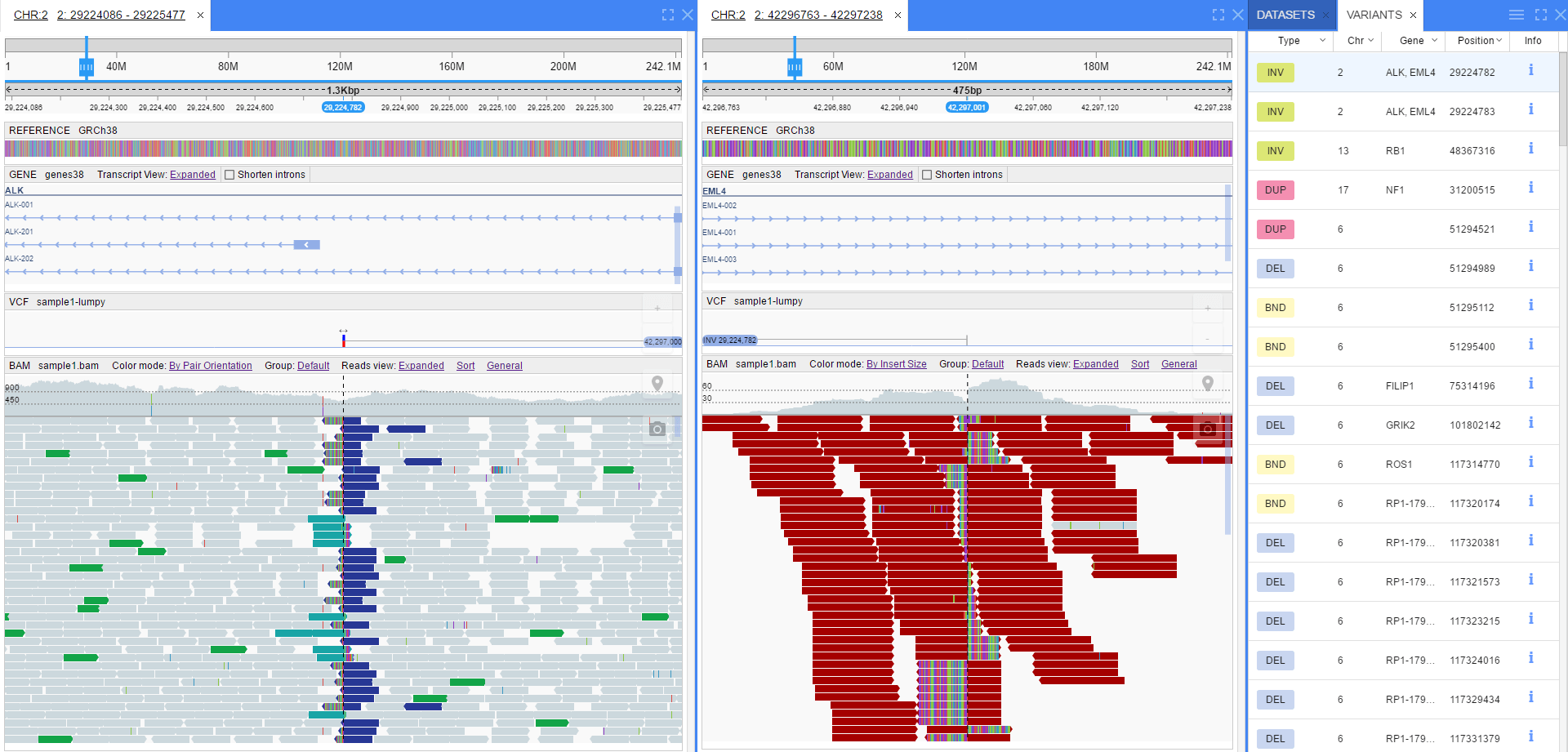
- Provides dedicated structural variation views, including supporting reads and rearrangement analysis.
- Includes RNA-Seq specific visualization modes.
- Integrates an embedded protein structure viewer.
- Supports CRAM format.
- Connects with external resources such as ENSEMBL and UniPROT.
- Handles large and cloud-based genome datasets with an emphasis on performance and scalability.
- Offers split-view mode, hotkeys, dockable panels, and session sharing tools.
Website: github.com/epam/NGB
Support:
Developer: EPAM Systems
License: MIT License
NGB is written in Java and JavaScript. Learn Java with our recommended free books and free tutorials.
Related Software
| Web-Based Desktop Genome Browsers | |
|---|---|
| Ensembl | Resource for geneticists, molecular biologists and other researchers |
| Genome Browser | Interactively visualize genomic data |
| GDV | Exploration and analysis of eukaryotic RefSeq genome assemblies |
| HiGlass | Explore and compare genomic contact matrices and tracks |
| igv.js | Embeddable genomic visualization |
| NGB | Web-based NGS data viewer |
| JBrowse 2 | Modern React-based genome browser |
| trackplot | Visualize various next-generation sequencing data |
| GIVE | Genomic Interactive Visualization Engine |
| Genoverse | HTML5 scrollable genome browser |
| Epigenome Browser | Visualization, integration and analysis tools for epigenomic datasets |
Read our verdict in the software roundup.
 Explore our carefully curated directory of recommended free and open source software, covering every major software category. Explore our carefully curated directory of recommended free and open source software, covering every major software category.The directory forms part of our extensive collection of articles for Linux enthusiasts. It includes hundreds of detailed reviews, together with free and open source alternatives to proprietary software from companies such as Google, Microsoft, Apple, Adobe, IBM, Cisco, Oracle, and Autodesk. LinuxLinks also covers interesting projects worth exploring, Linux-compatible hardware, free programming books and tutorials, and much more. Know a useful free and open source Linux application that we haven’t covered? Tell us about it using our submission form. |
Please read our Comment Policy before commenting.