
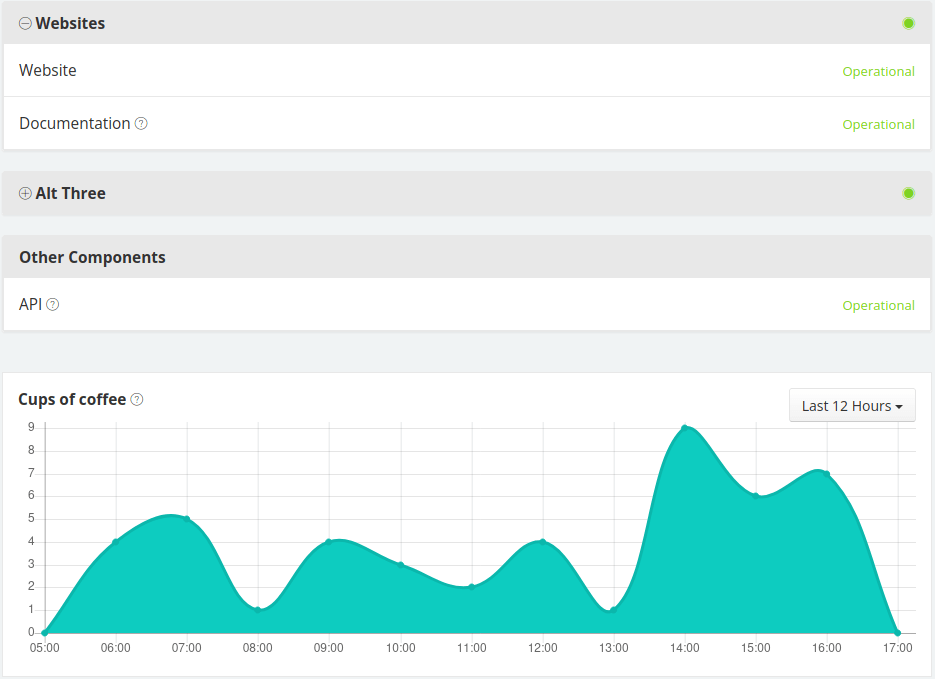
Cachet is a self-hosted status page system for communicating service availability, incidents and planned maintenance to customers and other stakeholders.
The application was developed using PHP and the Laravel framework. Its original open source releases provided an administrative dashboard for maintaining service components, publishing incident reports and displaying metrics.
Cachet was designed to make incident communication straightforward without requiring organisations to develop their own status reporting infrastructure. Administrators could describe operational problems, update their progress and record when services returned to normal.
The project subsequently underwent a significant redevelopment. Importantly, the current application uses a custom licence that restricts redistribution as a standalone product. It therefore no longer qualifies for inclusion in our roundup of free and open source status page systems.
The features below describe the historical open source application rather than guaranteeing identical behaviour in the separately licensed successor.
This is free and open source software.
Key Features
- Defines individual service components and communicates their operational status.
- Publishes incident reports with descriptions, status changes and resolution updates.
- Schedules maintenance periods to inform users about planned service interruptions.
- Supports Markdown formatting for incident communications.
- Displays operational metrics, including custom measurements supplied through the API.
- Provides a JSON API for integration with external applications and monitoring systems.
- Allows administrators to customise status page branding and presentation.
- Supports email notifications for subscribers following service incidents.
- Provides two-factor authentication for securing administrative access.
- Includes multilingual support and responsive layouts for desktop and mobile browsers.
Website: github.com/CachetHQ/Cachet
Support:
Developer: James Brooks
License: BSD 3-Clause ‘New’ or ‘Revised’ License (historical releases); custom Cachet License (current application)
Cachet is written in PHP. Learn PHP with our recommended free books and free tutorials.
Related Software
| Status Page Systems | |
|---|---|
| Uptime Kuma | Excellent monitoring tool with a simple status page |
| Statping-ng | Status page and monitoring server |
| OneUptime | Unified monitoring, incident response and status pages |
| Checkmate | Self-hosted infrastructure monitoring application |
| OpenStatus | Status page and uptime monitoring platform |
| Upptime | Uptime monitor / status page using GitHub Actions, Issues, and Pages |
| Kener | Node.js status page tool |
| Gatus | Developer-oriented status dashboard and health monitoring application |
| Vigil | Microservices status page |
| cState | Tiny and simple status page |
| UptimeFlare | Serverless uptime checks and customizable status pages |
| HertzBeat | Observability platform |
| PHP Server Monitor | Script that checks whether your websites and servers are up and running |
| Lunalytics | Collaborative service monitoring with public status pages |
| Kuvasz | Self-hosted uptime monitoring with configurable status pages |
| YASP | Self-hosted status page application |
| issue-status | Issue-driven status pages for tracking service disruptions |
| Tinystatus | Small, simple generator for static service status pages |
| status.sh | Shell-based generator for straightforward service status pages |
Read our verdict in the software roundup.
 LinuxLinks helps you discover the best free and open source software for Linux. Explore our extensive collection of recommended applications, including alternatives to popular proprietary software. We also publish software reviews, Linux tutorials, hardware reviews, free programming books and articles covering the wider open source community. Browse our Linux resources to discover more. Know a useful free and open source Linux application we haven't covered? Suggest a program for inclusion. Has your software been featured on LinuxLinks? Display one of our Featured on LinuxLinks badges on your website or GitHub README. |
Please read our Comment Policy before commenting.