

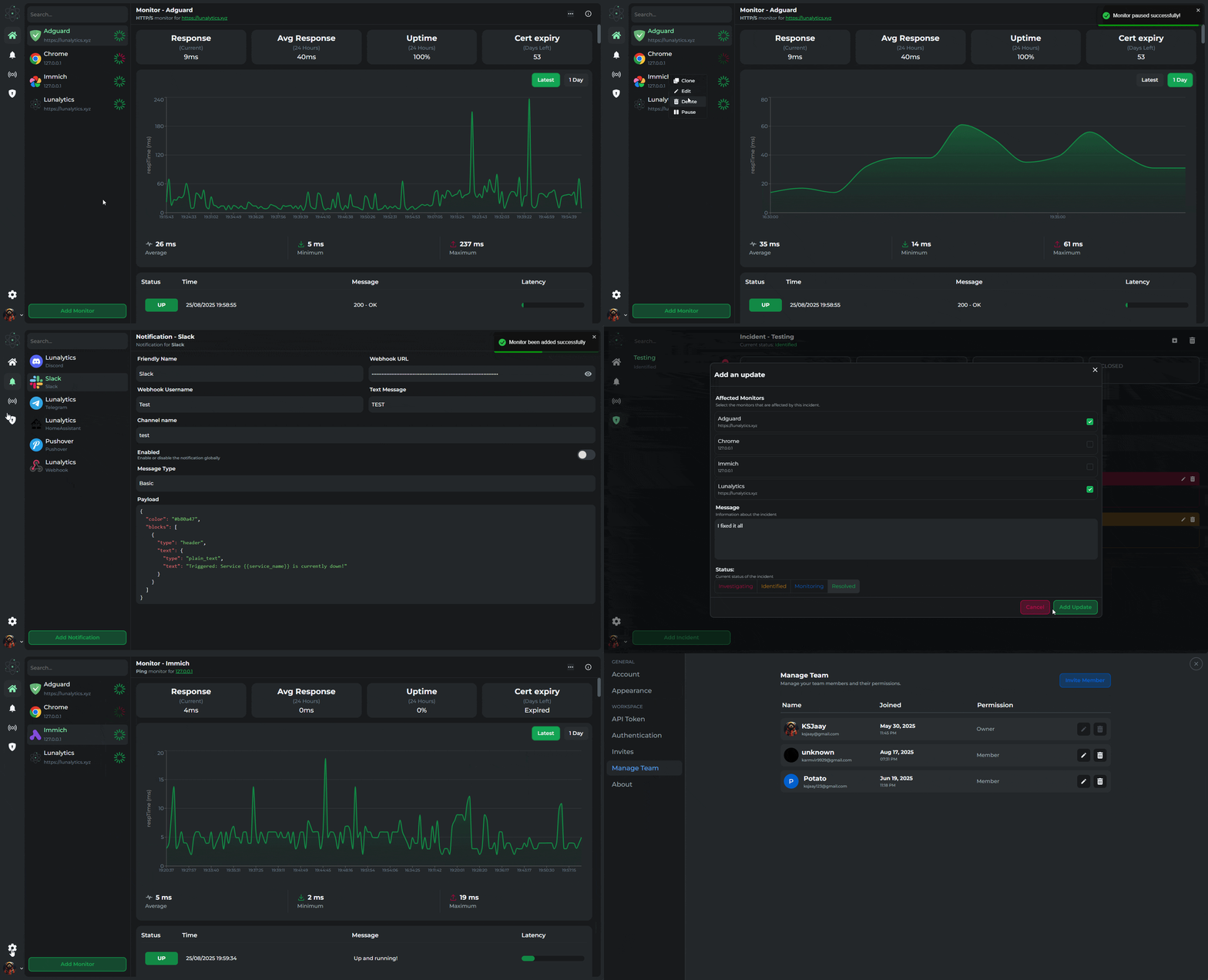
Lunalytics is a self-hosted monitoring application designed for people who need to share responsibility for services. It combines a Node.js backend with a React interface, providing a central place for a team to inspect availability and manage monitoring.
The application separates internal monitoring access from the information published through status pages. Its multi-user design makes it useful for colleagues managing shared infrastructure, or individuals who want to give other people controlled access to their monitoring installation.
This is free and open source software.
Key Features
- Monitor HTTP and HTTPS endpoints to check the availability of websites and web services.
- Test TCP connections and use ping checks to monitor network services and host reachability.
- Evaluate JSON responses through dedicated JSON Query monitors.
- Receive push checks from services that report their own status.
- Monitor Docker containers alongside conventional network endpoints.
- Provide separate user accounts with role-based access controls for managing permissions.
- Create customisable status pages and dashboards for presenting selected monitoring information.
- Use custom domains and icons to adapt status pages to an organisation or service.
- Manage incidents alongside monitoring results and service status information.
- Support single sign-on through custom identity providers such as Authentik, Authelia and Keycloak.
- Offer authentication integrations for services including GitHub, Google, Discord, Slack and Twitch.
- Send notifications through SMTP email, Discord, Slack, Telegram, Pushover, Home Assistant and webhooks.
- Connect to additional notification services through Apprise.
- Customise user profiles, themes and interface colours.
- Provide user API keys for programmatic access.
- Support SQLite and PostgreSQL for storing application data.
Website: github.com/KSJaay/Lunalytics
Support:
Developer: Karmvir Singh and contributors
License: GNU Affero General Public License v3.0
Lunalytics is written in JavaScript and TypeScript. Learn JavaScript with our recommended free books and free tutorials. Learn TypeScript with our recommended free books and free tutorials.
Related Software
| Status Page Systems | |
|---|---|
| Uptime Kuma | Excellent monitoring tool with a simple status page |
| Statping-ng | Status page and monitoring server |
| Cachet | Status page system for everyone |
| Checkmate | Self-hosted infrastructure monitoring application |
| OpenStatus | Status page and uptime monitoring platform |
| Upptime | Uptime monitor / status page using GitHub Actions, Issues, and Pages |
| Kener | Node.js status page tool |
| Gatus | Developer-oriented status dashboard and health monitoring application |
| Vigil | Microservices status page |
| cState | Tiny and simple status page |
| HertzBeat | Observability platform |
| Cabot | Provides features of PagerDuty, Server Density, Pingdom and Nagios |
| PHP Server Monitor | Script that checks whether your websites and servers are up and running |
| YASP | Self-hosted status page application |
| Statusfy | Focus on writing your Incidents Reports and let the magic happen |
Read our verdict in the software roundup.
 LinuxLinks helps you discover the best free and open source software for Linux. Explore our extensive collection of recommended applications, including alternatives to popular proprietary software. We also publish software reviews, Linux tutorials, hardware reviews, free programming books and articles covering the wider open source community. Browse our Linux resources to discover more. Know a useful free and open source Linux application we haven't covered? Suggest a program for inclusion. Has your software been featured on LinuxLinks? Display one of our Featured on LinuxLinks badges on your website or GitHub README. |
Please read our Comment Policy before commenting.