
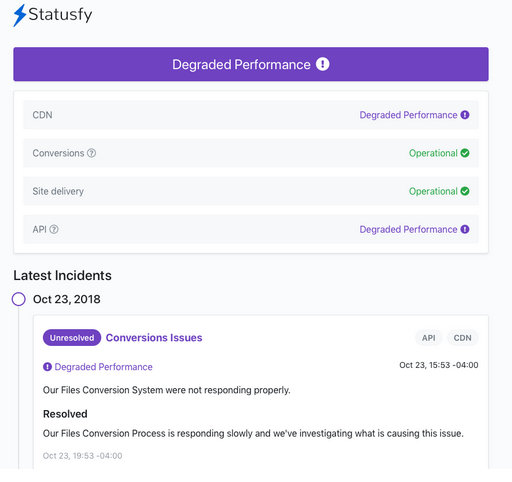
Statusfy is a status page system designed to help organisations communicate incidents, outages and planned service interruptions through a dedicated website.
The application was built using Vue and Nuxt.js, with support for generating static websites or running a server-rendered application.
Statusfy placed particular emphasis on straightforward incident reporting. Administrators could write incident reports using Markdown, define the affected services and publish updates without manually constructing HTML pages.
The generated status website could be customised to reflect an organisation’s branding, with support for different languages and responsive layouts. This made the software attractive to teams that wanted control over their incident communication pages without developing a complete application from scratch.
However, Statusfy is no longer maintained. The project’s repository was archived by its owner and is now read-only. Its historical releases remain available for reference, but the absence of ongoing maintenance means Statusfy should not be recommended for new production deployments.
This is free and open source software.
Key Features
- Generates static or server-rendered status page websites.
- Creates incident reports using Markdown, including GitHub Flavoured Markdown formatting.
- Defines individual systems and their operational status.
- Supports incident updates and reporting of previous service disruptions.
- Allows scheduled maintenance information to be published alongside other incidents.
- Provides a responsive default theme suitable for desktop and mobile browsers.
- Supports extensive visual customisation, including logos, colours and styles.
- Offers multilingual status pages and translated interface content.
- Includes progressive web application functionality.
- Supports search-engine-friendly page generation and metadata.
- Provides Google Analytics integration for examining website traffic.
- Supports both static content generation and server-side rendering through its Vue-based application architecture.
Website: github.com/juliomrqz/statusfy
Support:
Developer: Julio Marquez and contributors
License: Apache License 2.0
Statusfy is written in TypeScript and JavaScript. Learn TypeScript with our recommended free books and free tutorials. Learn JavaScript with our recommended free books and free tutorials.
Related Software
| Status Page Systems | |
|---|---|
| Uptime Kuma | Excellent monitoring tool with a simple status page |
| Statping-ng | Status page and monitoring server |
| Cachet | Status page system for everyone |
| Checkmate | Self-hosted infrastructure monitoring application |
| OpenStatus | Status page and uptime monitoring platform |
| Upptime | Uptime monitor / status page using GitHub Actions, Issues, and Pages |
| Kener | Node.js status page tool |
| Gatus | Developer-oriented status dashboard and health monitoring application |
| Vigil | Microservices status page |
| cState | Tiny and simple status page |
| HertzBeat | Observability platform |
| Cabot | Provides features of PagerDuty, Server Density, Pingdom and Nagios |
| PHP Server Monitor | Script that checks whether your websites and servers are up and running |
| YASP | Self-hosted status page application |
| Statusfy | Focus on writing your Incidents Reports and let the magic happen |
Read our verdict in the software roundup.
 LinuxLinks helps you discover the best free and open source software for Linux. Explore our extensive collection of recommended applications, including alternatives to popular proprietary software. We also publish software reviews, Linux tutorials, hardware reviews, free programming books and articles covering the wider open source community. Browse our Linux resources to discover more. Know a useful free and open source Linux application we haven't covered? Suggest a program for inclusion. Has your software been featured on LinuxLinks? Display one of our Featured on LinuxLinks badges on your website or GitHub README. |
Please read our Comment Policy before commenting.