
Power Consumption With CPU Stressed
I’m using s-tui to stress the CPU. It provides a convenient frontend to the stress utility.
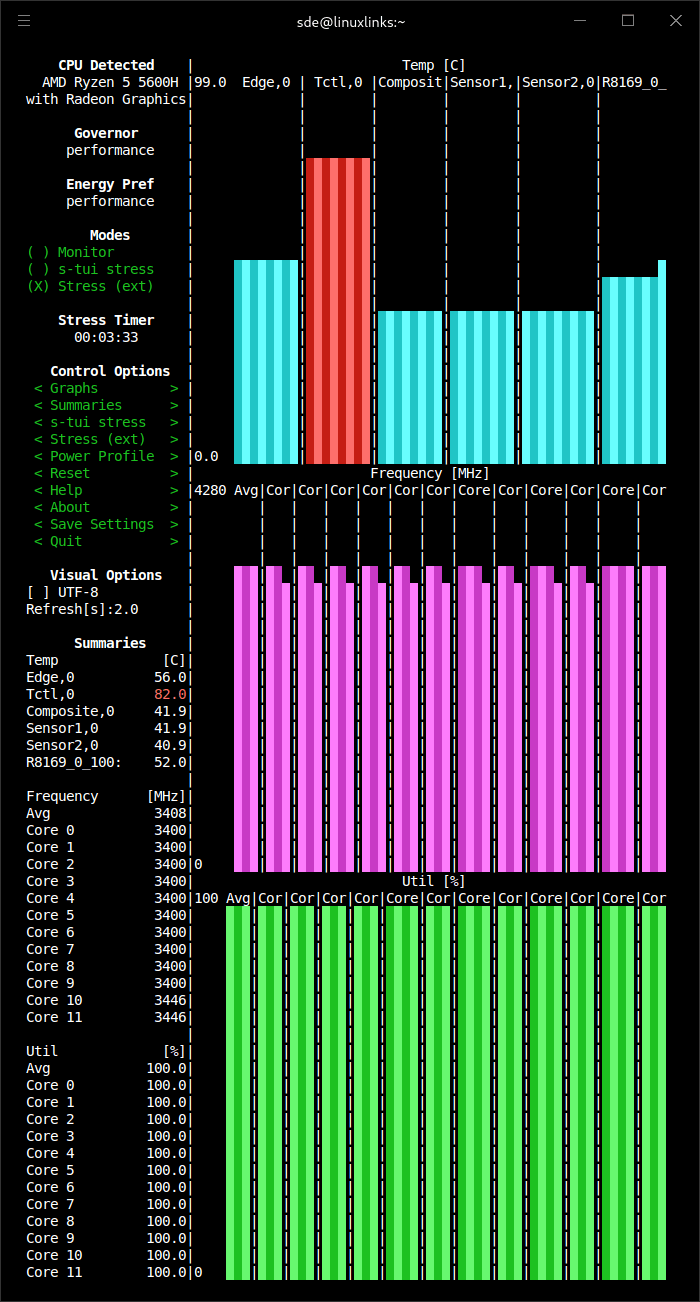
Under full CPU load in s-tui, the PELADN WO4 drives all 12 threads of the Ryzen 5 5600H to 100% utilisation. With the performance governor enabled, the processor holds an average clock of around 3.4GHz, indicating stable sustained all-core behaviour rather than obvious throttling during this short stress run. The hottest reading is Tctl at 82°C, which is warm but acceptable for a compact mini PC under a synthetic full-load workload.
Let’s look at power consumption.
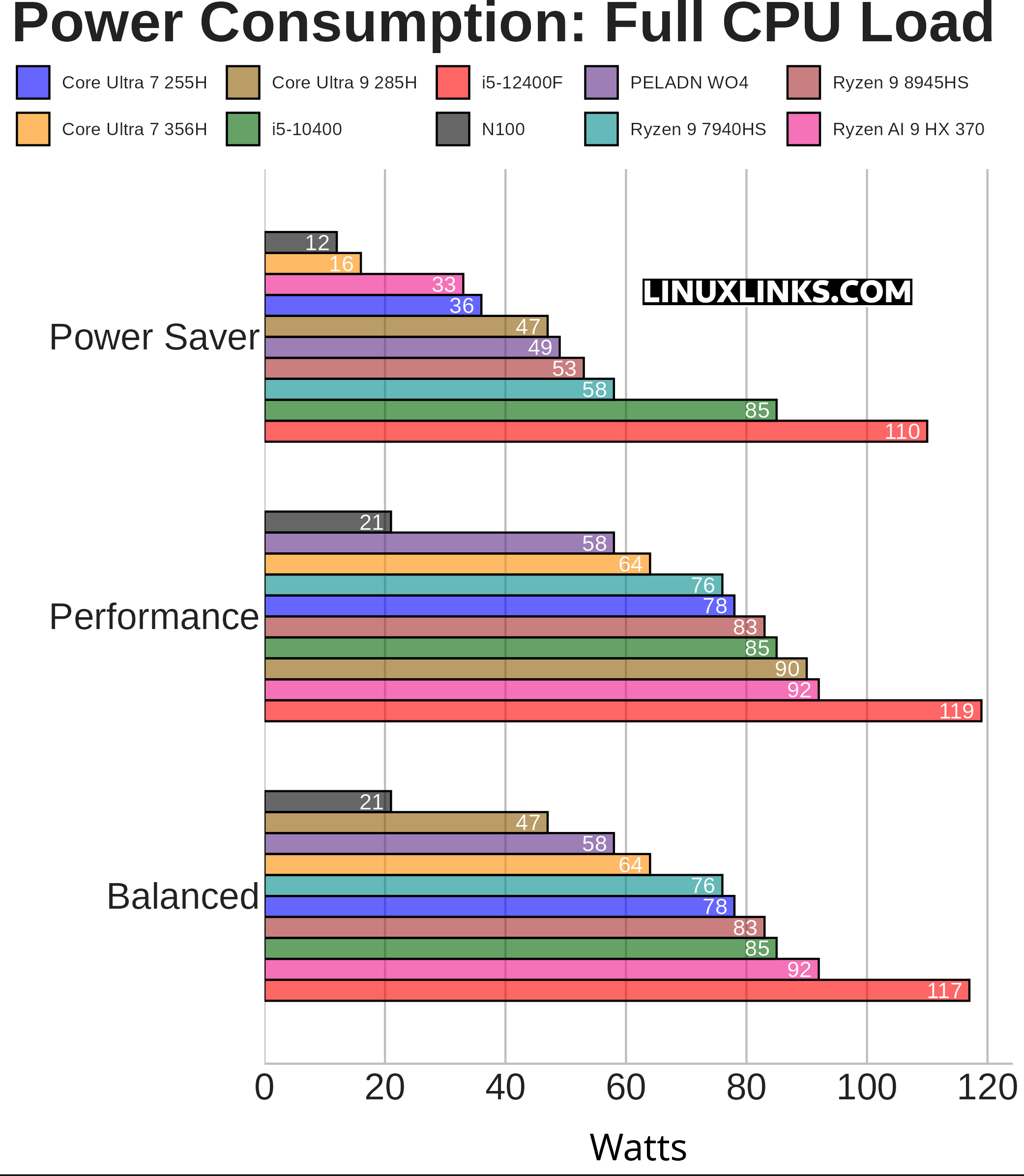
For a compact budget mini PC based on the older Ryzen 5 5600H, 58W under sustained full CPU load is a good result. The processor is working hard, temperatures remain acceptable, and total system power stays well below most of the modern H-class and high-performance comparison machines.
Using PassMark CPU Mark divided by the measured full-load system power in Performance mode, the Core Ultra 7 356H is the most efficient system in this chart by a clear margin. For the PELADN WO4, the result is respectable rather than outstanding. Its Ryzen 5 5600H records a PassMark CPU Mark of 16,425 and the system draws 58W under full CPU load, giving around 283 CPU Mark points per watt. That puts it behind the newer AMD and Intel mobile platforms, but ahead of the N100 and well ahead of the older i5-10400 system on this performance-per-watt calculation.
Summary
The PELADN WO4 is not a class leader for power efficiency, but that’s not really the point of this machine. It’s a budget mini PC built around a 2021 AMD Ryzen 5 5600H processor, and in that context its power consumption is perfectly reasonable.
At idle, the WO4 can’t match the best recent AMD and Intel platforms, but its figures remain respectable and show again why TDP is a poor guide to real-world system power draw. Under light desktop usage, the system draws more power than newer AMD Zen 4 and Zen 5 mini PCs, but it remains broadly competitive with some newer Intel H-class systems. Under sustained CPU load, 58W for the whole system is a good result, especially given that all 12 threads are fully loaded and temperatures remain under control.
The main takeaway is that the WO4 doesn’t offer cutting-edge efficiency, but it avoids the excessive power draw that might be expected from an older 45W mobile processor. For everyday desktop use, occasional heavier workloads, and budget-conscious buyers, its power consumption is acceptable. Newer mini PCs are clearly more efficient, but the WO4 still makes sense if the purchase price is low enough.
Next page: Page 4 – Electricity Costs
Pages in this article:
Page 1 – Power Consumption With System Idle
Page 2 – Power Consumption With Light Usage
Page 3 – Power Consumption With CPU Stressed
Page 4 – Electricity Costs
Complete list of articles in this series:
| PELADN WO4 5600H Mini PC | |
|---|---|
| Introduction | Introduction to the series and interrogation of the machine |
| Benchmarks | Benchmarking the PELADN WO4 5600H Mini PC |
| Power | Testing and comparing the power consumption |
| Noise | How quiet is this mini PC? |
| BIOS | In the world of computing, BIOS, which stands for Basic Input/Output System, plays a crucial role |
| Wi-Fi | Measuring WiFi Performance |
Please read our Comment Policy before commenting.