
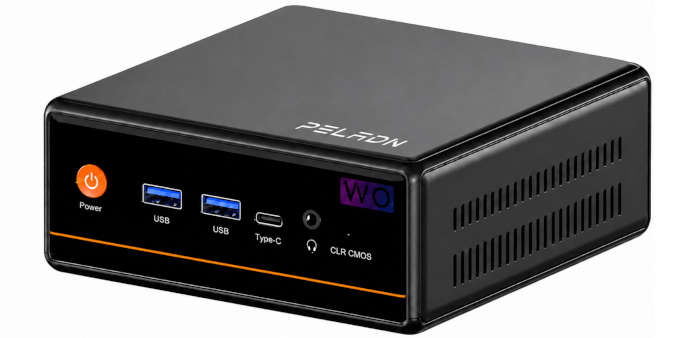
This article is part of a series looking at the PELADN WO4 5600H Mini PC.
The PELADN WO4 5600H is a compact mini PC built around AMD’s Ryzen 5 5600H, a 6-core, 12-thread processor with integrated Radeon graphics, giving it enough performance for everyday desktop use, office work, media playback, and light gaming. It’s available from Amazon US and Amazon UK. These are not affiliate links.
The PELADN WO4 is built around a familiar idea: keep the price low, the design simple, and the performance good enough for everyday desktop use. Rather than chasing premium mini PC territory, I see whether AMD’s Ryzen 5 5600H still has plenty to offer in a modest, affordable system.
For this article in the series, I’m looking at the power consumption of the PELADN WO4.
On the face of it, you might think the WO4’s power consumption will be on the high side. Its processor, the AMD Ryzen 5 5600H, has a TDP of 45 W. TDP most commonly means Thermal Design Power, a measurement of the maximum amount of heat a computer component like a CPU or GPU can produce under normal operating conditions. TDP is best treated as a thermal design figure, not a direct measure of real-world system power draw.
I’ll compare it with seven mini PCs and two desktop machines: Minisforum M2 Core Ultra 7 356H (“Core Ultra 7 356H”), Bosgame M7 Core Ultra 9 285H (“Core Ultra 9 285H”), Bosgame M4 Plus Ryzen 9 7940HS (“Ryzen 9 7940HS”), Minisforum UM890 Pro with Ryzen 9 8945HS (“Ryzen 9 8945HS”), Minisforum AI X1 Pro with AMD Ryzen AI 9 HX 370 (“Ryzen AI 9 HX 370”), ASRock Industrial NUC BOX-255H with an Intel Core Ultra 7 255H processor (“Core Ultra 7 255H”), DreamQuest Intel N100 (“N100”), and desktop machines with i5-10400 and i5-12400F processors.
Let’s start with idle power consumption.
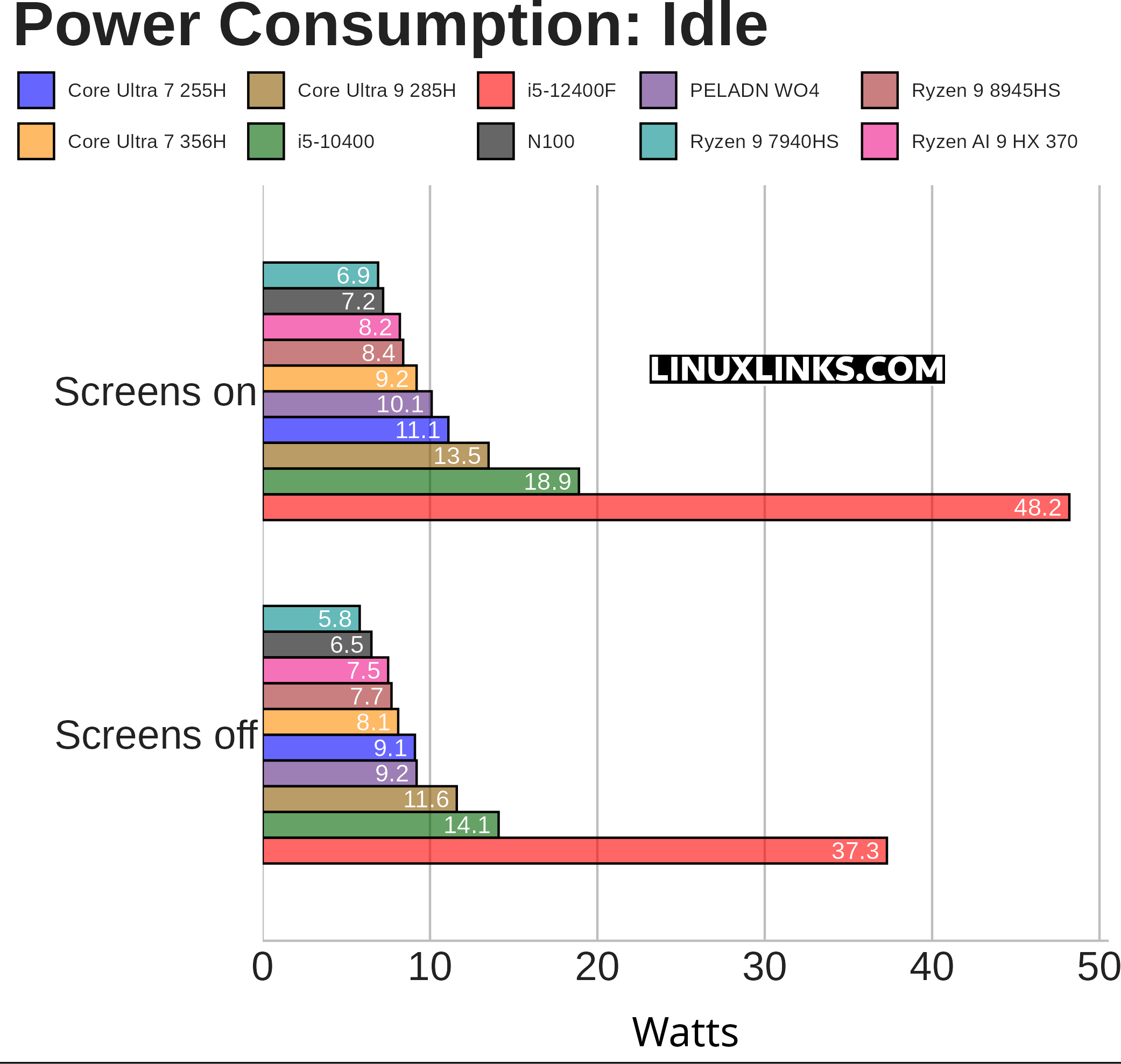
The PELADN WO4 doesn’t match the best modern Zen 4, Zen 5, or Panther Lake systems at idle, but its 10.1W and 9.2W results are respectable for a 2021-era 45W Zen 3 processor. Its idle consumption is better than some newer Intel mobile systems in the chart, showing that TDP alone is a poor predictor of idle power. The WO4’s main weakness is not that it’s inefficient, but that newer AMD platforms have moved the bar lower.
The i5-12400F desktop is the clear outlier. Its 37.3W screens-off and 48.2W screens-on results are heavily influenced by the dedicated graphics card. That makes it a useful real-world comparison, but not a clean CPU/platform efficiency comparison. The large jump when screens are enabled also reflects the GPU/display side of the system rather than just the processor.
Notes about the chart:
- The chart measures the power consumption of each system, not just the CPU.
- The i5-12400F machine hosts a dedicated graphics card, whereas the other machines all have onboard graphics. Power consumption at idle is much higher with a dedicated graphics card, in this case an NVIDIA ASUS RTX 3060 Ti.
- The Bosgame M7, Bosgame M4 Plus, Minisforum AI X1 Pro, i5-12400F, and i5-10400 machines offer BIOS power management options. Those power-management options were enabled for testing.
- The Power Saver CPU governor is used.
- The machines are running Ubuntu.
Next page: Page 2 – Power Consumption With Light Usage
Pages in this article:
Page 1 – Power Consumption With System Idle
Page 2 – Power Consumption With Light Usage
Page 3 – Power Consumption With CPU Stressed
Page 4 – Electricity Costs
Complete list of articles in this series:
| PELADN WO4 5600H Mini PC | |
|---|---|
| Introduction | Introduction to the series and interrogation of the machine |
| Benchmarks | Benchmarking the PELADN WO4 5600H Mini PC |
| Power | Testing and comparing the power consumption |
| Noise | How quiet is this mini PC? |
| BIOS | In the world of computing, BIOS, which stands for Basic Input/Output System, plays a crucial role |
| Wi-Fi | Measuring WiFi Performance |
Please read our Comment Policy before commenting.