
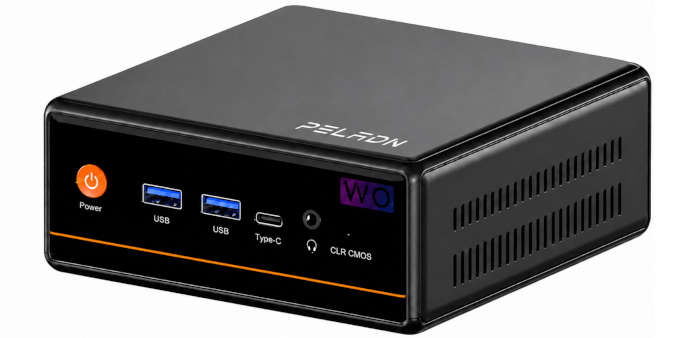
This is a new series looking at the PELADN WO4 5600H Mini PC.
The PELADN WO4 is built around a familiar idea: keep the price low, the design simple, and the performance good enough for everyday desktop use. Rather than chasing premium mini PC territory, I see whether the Ryzen 5 5600H still has plenty to offer in a modest, affordable system. It’s available from Amazon US and Amazon UK. These are not affiliate links.
In this article, I benchmark the PELADN WO4 5600H across a range of tests, most of which are run using the Phoronix Test Suite. Together with the PELADN WO4 5600H, I’ve run the same benchmarks on a few other machines to put the results into context, including an 11th generation Intel laptop. Note the N100 machine is much cheaper than the other machines. It’s included simply to put the performance improvement offered by the higher-specification machines into perspective.
Each machine is tested with the same software stack and configured to keep the results as consistent as possible. Power-saving features are disabled during benchmarking. Where the BIOS offers power-limit options, I select Performance Mode. I also apply every relevant performance setting, including using the performance governor, minimizing background processes, and running without Wayland unless a graphics benchmark requires it.
Let’s begin with a variety of processor benchmarks.
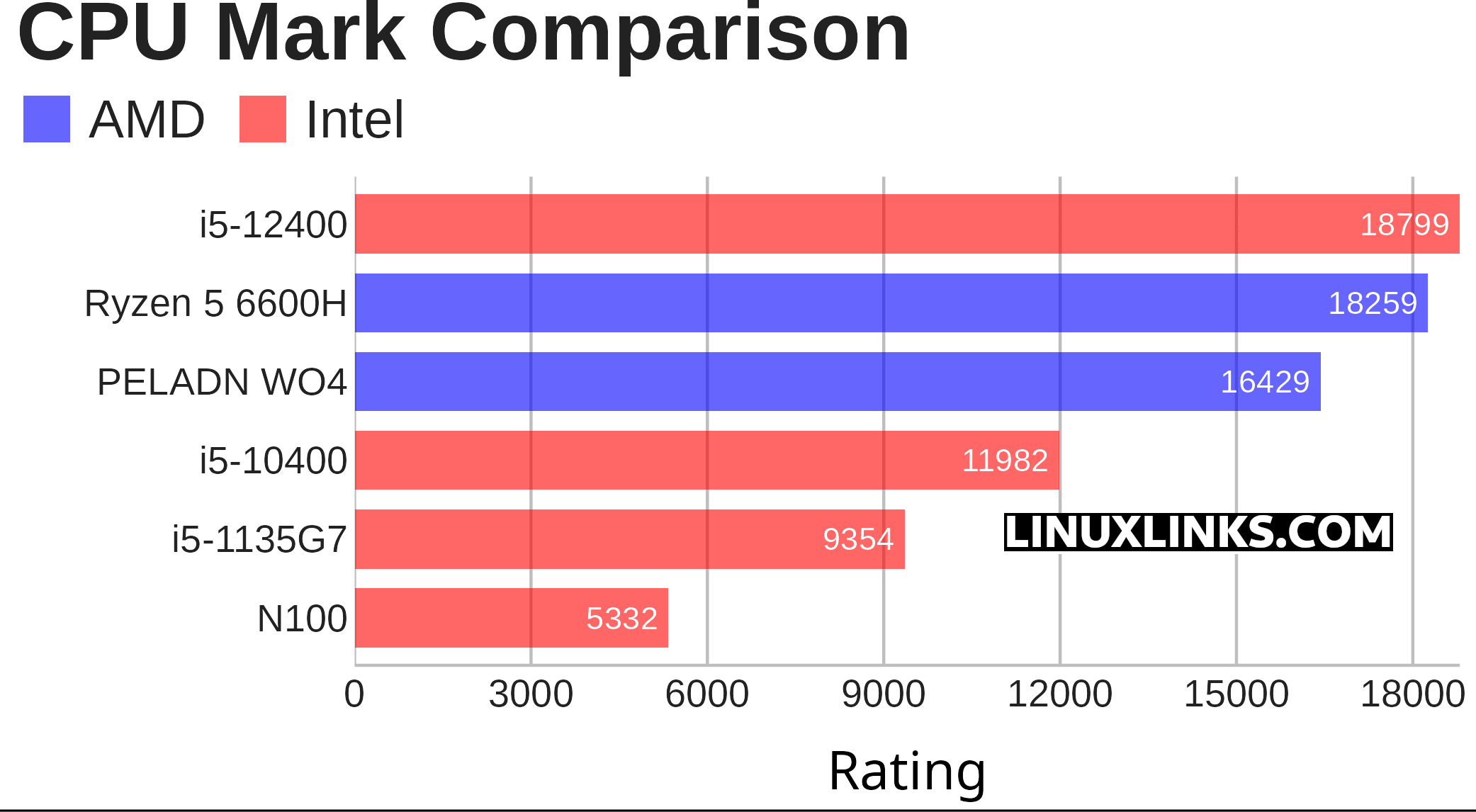
The PELADN WO4 posts a strong result for a budget-focused mini PC. Its Ryzen 5 5600H cannot quite match the newer Ryzen 5 6600H or the desktop Core i5-12400, but it remains close enough to show that AMD’s older Zen 3 mobile processor still has plenty to offer. More importantly, it comfortably outpaces the Core i5-10400, Core i5-1135G7, and Intel N100, making the WO4 much better suited to demanding desktop tasks, software compilation, compression, and other multi-threaded workloads than typical entry-level mini PCs.
$ phoronix-test-suite benchmark smallpt
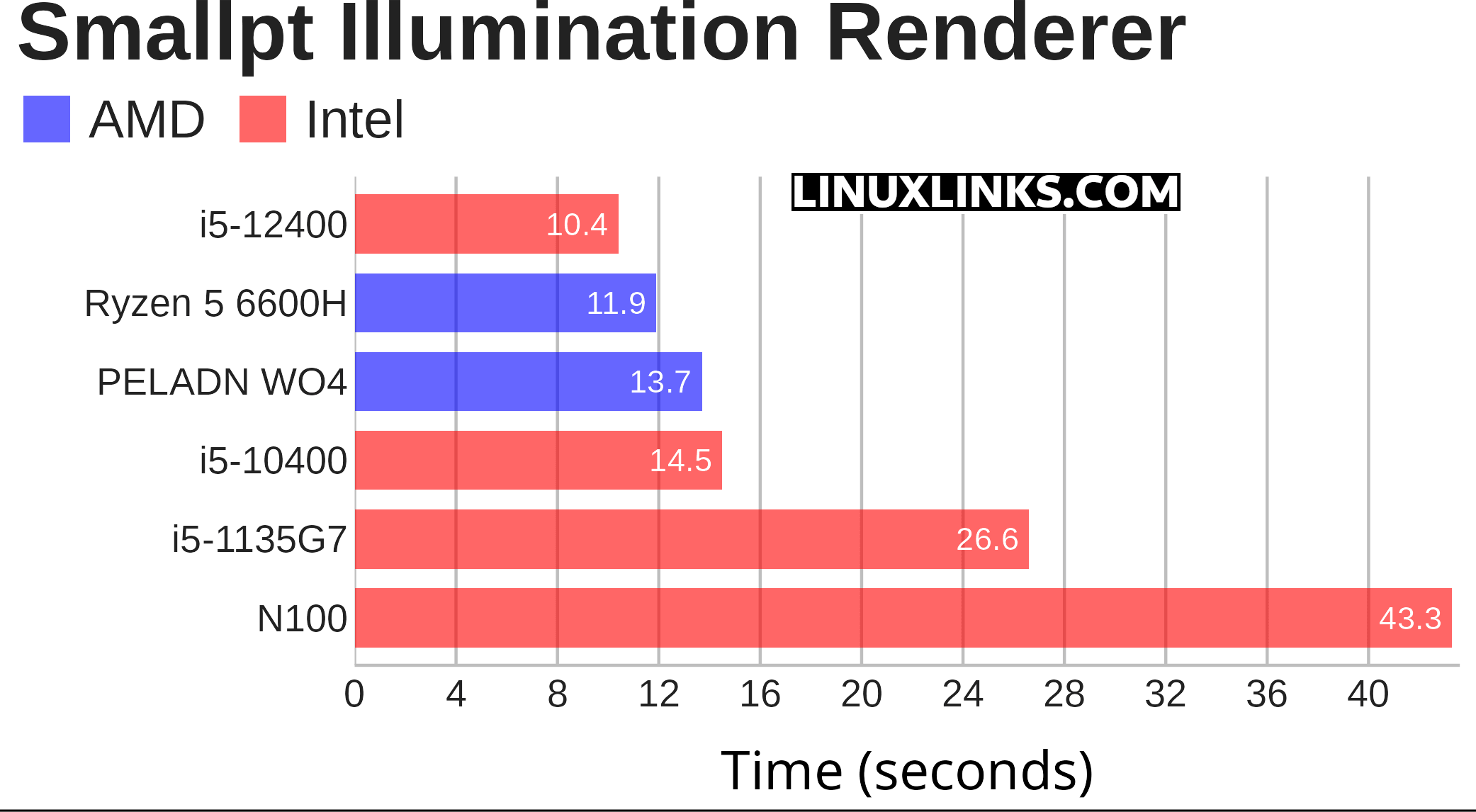
Smallpt is a C++ global illumination renderer written in fewer than 100 lines of code. It performs unbiased Monte Carlo path tracing and supports multi-threading via OpenMP. As this benchmark can use all CPU cores, processors with more cores complete the test considerably quicker.
Smallpt gives the PELADN WO4 another respectable showing. The Ryzen 5 5600H completes the render in 13.7 seconds, narrowly ahead of the Core i5-10400 and well clear of the Core i5-1135G7 and Intel N100. It can’t match the newer Ryzen 5 6600H or the desktop Core i5-12400, but that’s no surprise given the age and class of the processor. For a budget mini PC, this result shows that the WO4 remains a capable machine for CPU rendering and other multi-threaded workloads.
$ phoronix-test-suite benchmark openssl
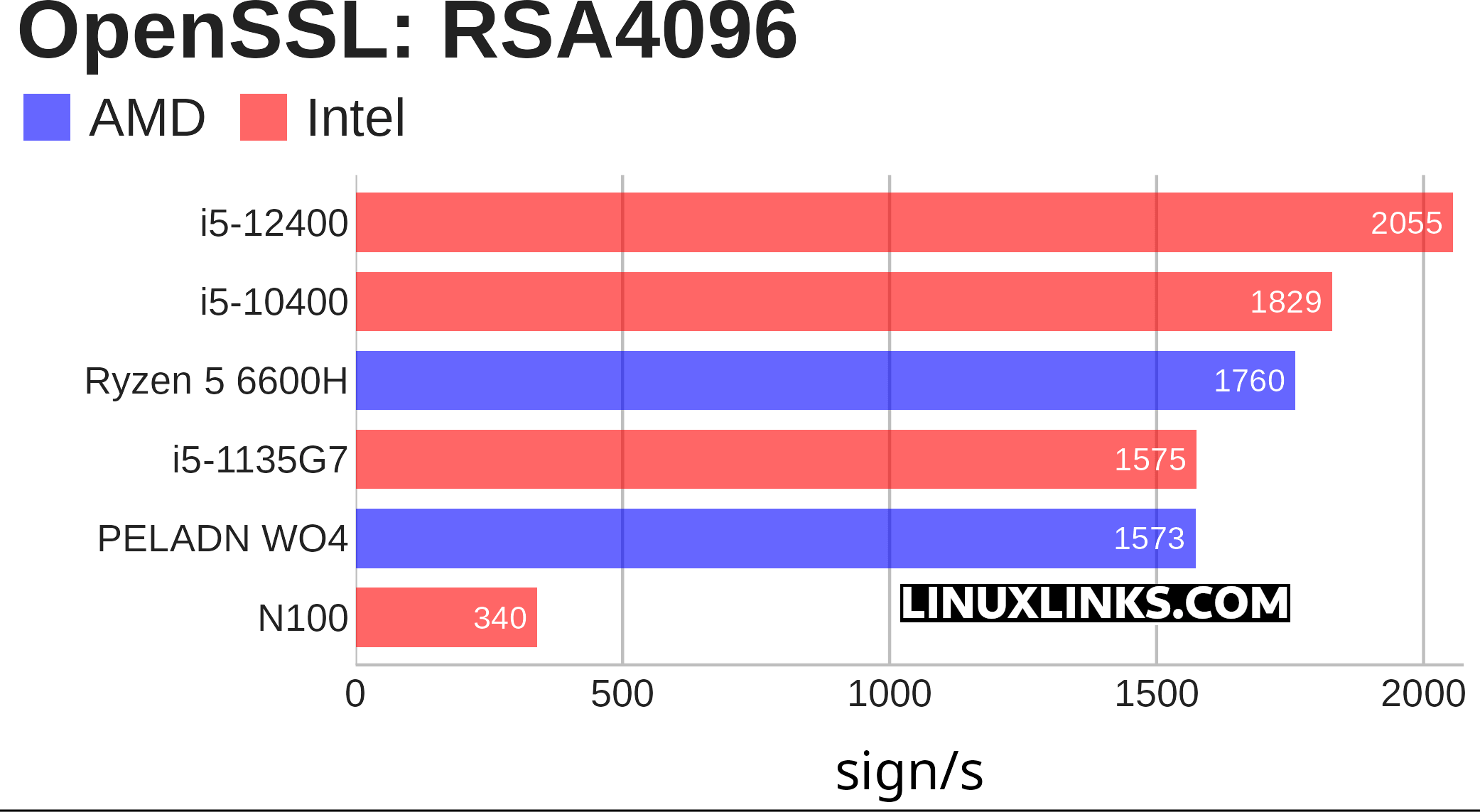
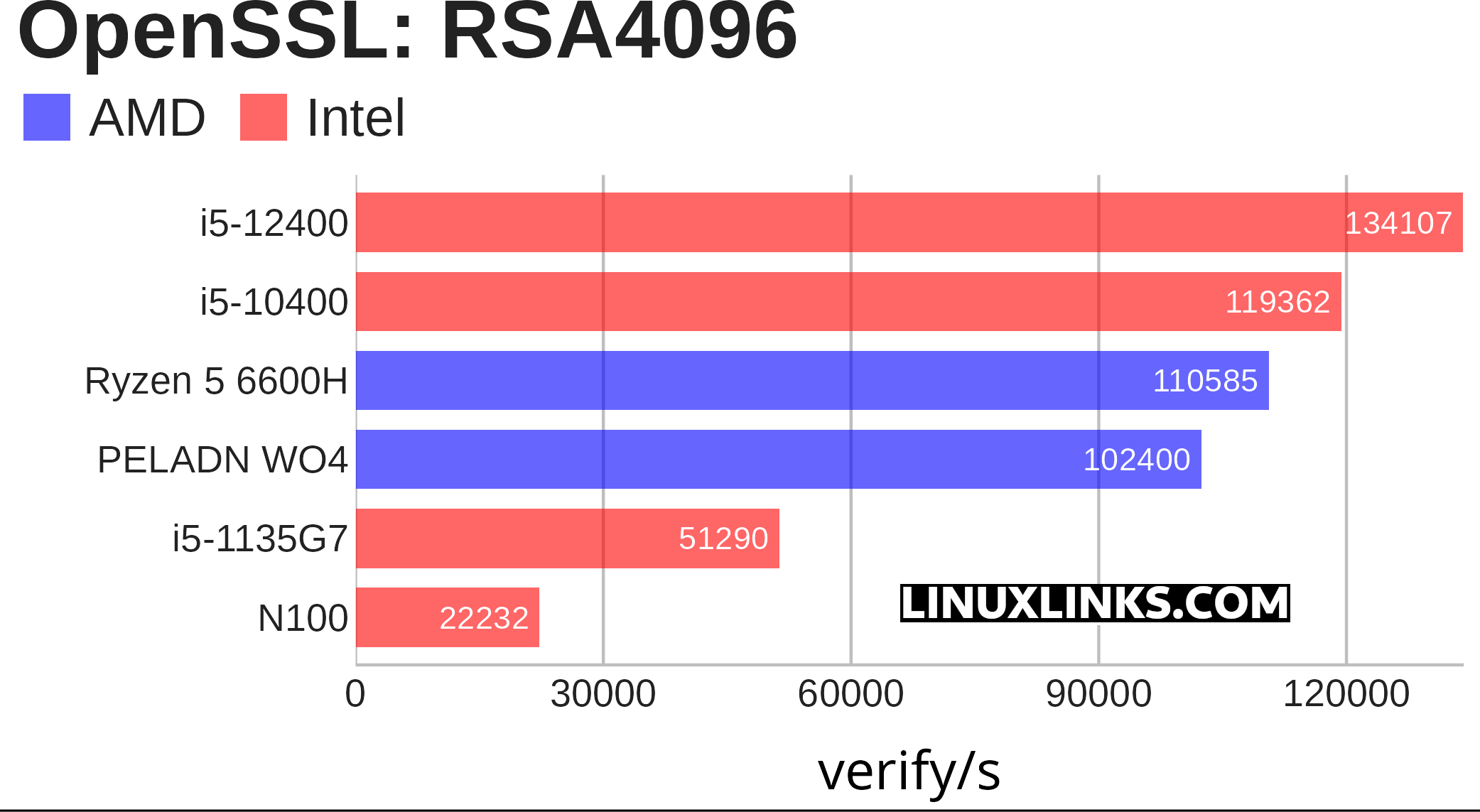
OpenSSL is an open-source cryptography toolkit best known for implementing TLS, and historically SSL, protocols. This test profile makes use of the built-in “openssl speed” benchmarking capabilities.
Various algorithms can be used for this benchmark. I focused on the RSA-4096 algorithm, since it serves as a good representative example for the other options. This benchmark includes two charts: one for signing speeds and another for verification speeds.
OpenSSL shows the PELADN WO4 in a slightly more uneven light. In RSA-4096 signing, the Ryzen 5 5600H sits almost level with the Core i5-1135G7 and trails the Ryzen 5 6600H, Core i5-10400, and Core i5-12400. The verification result is better, with the WO4 reaching 102,400 verify/s, not far behind the newer Ryzen 5 6600H and roughly twice the throughput of the Core i5-1135G7. As expected, the desktop Intel processors remain ahead, but the WO4 is vastly faster than the Intel N100 in both tests. For encryption, certificate handling, SSH, VPN, and other crypto-heavy workloads, the Ryzen 5 5600H still delivers solid performance for a low-cost mini PC.
$ phoronix-test-suite benchmark crafty
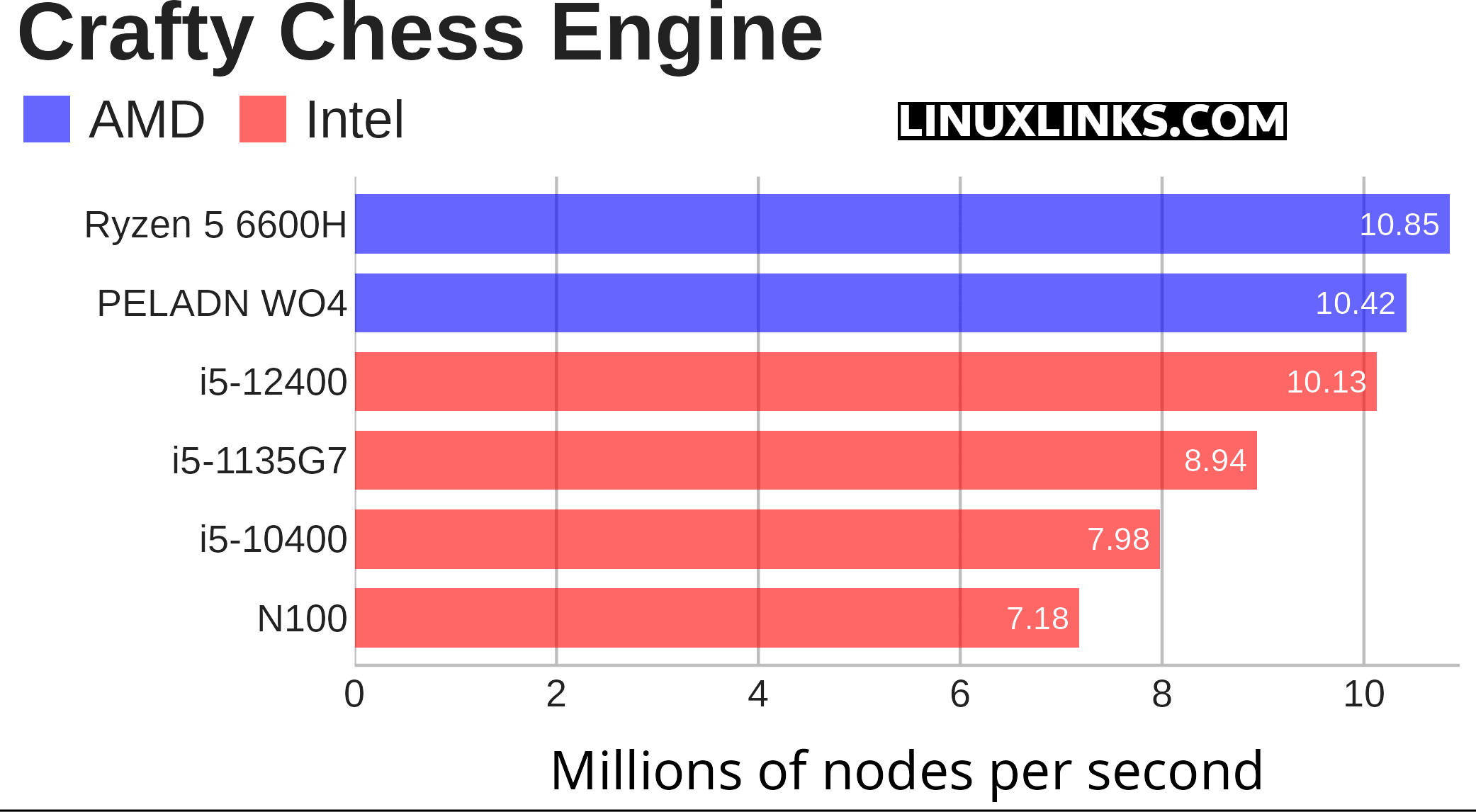
Crafty is a chess program directly derived from Cray Blitz, winner of the 1983 and 1986 World Computer Chess Championships. Crafty is a single-core benchmark.
Crafty gives the PELADN WO4 one of its strongest results. The Ryzen 5 5600H reaches 10.42 million nodes per second, only narrowly behind the newer Ryzen 5 6600H and broadly level with the desktop Core i5-12400. It also pulls well ahead of the Core i5-1135G7, Core i5-10400, and Intel N100. This benchmark highlights that the 5600H still has very capable per-core performance, which is useful for workloads that don’t simply scale with core count.
Pages in this article:
Page 1 – Introduction / Processor
Page 2 – Graphics
Page 3 – Memory
Page 4 – Disk and Summary
Complete list of articles in this series:
| PELADN WO4 5600H Mini PC | |
|---|---|
| Introduction | Introduction to the series and interrogation of the machine |
| Benchmarks | Benchmarking the PELADN WO4 5600H Mini PC |
| Power | Testing and comparing the power consumption |
| Noise | How quiet is this mini PC? |
| BIOS | In the world of computing, BIOS, which stands for Basic Input/Output System, plays a crucial role |
| Wi-Fi | Measuring WiFi Performance |
Please read our Comment Policy before commenting.