
One of the types of software that’s important for a web developer is the web framework. A framework “is a code library that makes a developer’s life easier when building reliable, scalable, and maintainable web applications” by providing reusable code or extensions for common operations. By saving development time, developers can concentrate on application logic rather than mundane elements.
A web framework offers the developer a choice about how to solve a specific problem. By using a framework, a developer lets the framework control portions of their application. While it’s perfectly possible to code a web application without using a framework, it’s more practical to use one.
Ruby is a general purpose, scripting, structured, flexible, fully object-oriented programming language with a focus on simplicity and productivity. Ruby is a very conservative language. It’s equipped with very carefully chosen features that have been fully tested.
When it comes to web development, there are a fairly small range of Ruby frameworks to choose. The choice depends on finding the right tool for the job at hand. Here’s our pick of the finest Ruby web frameworks.
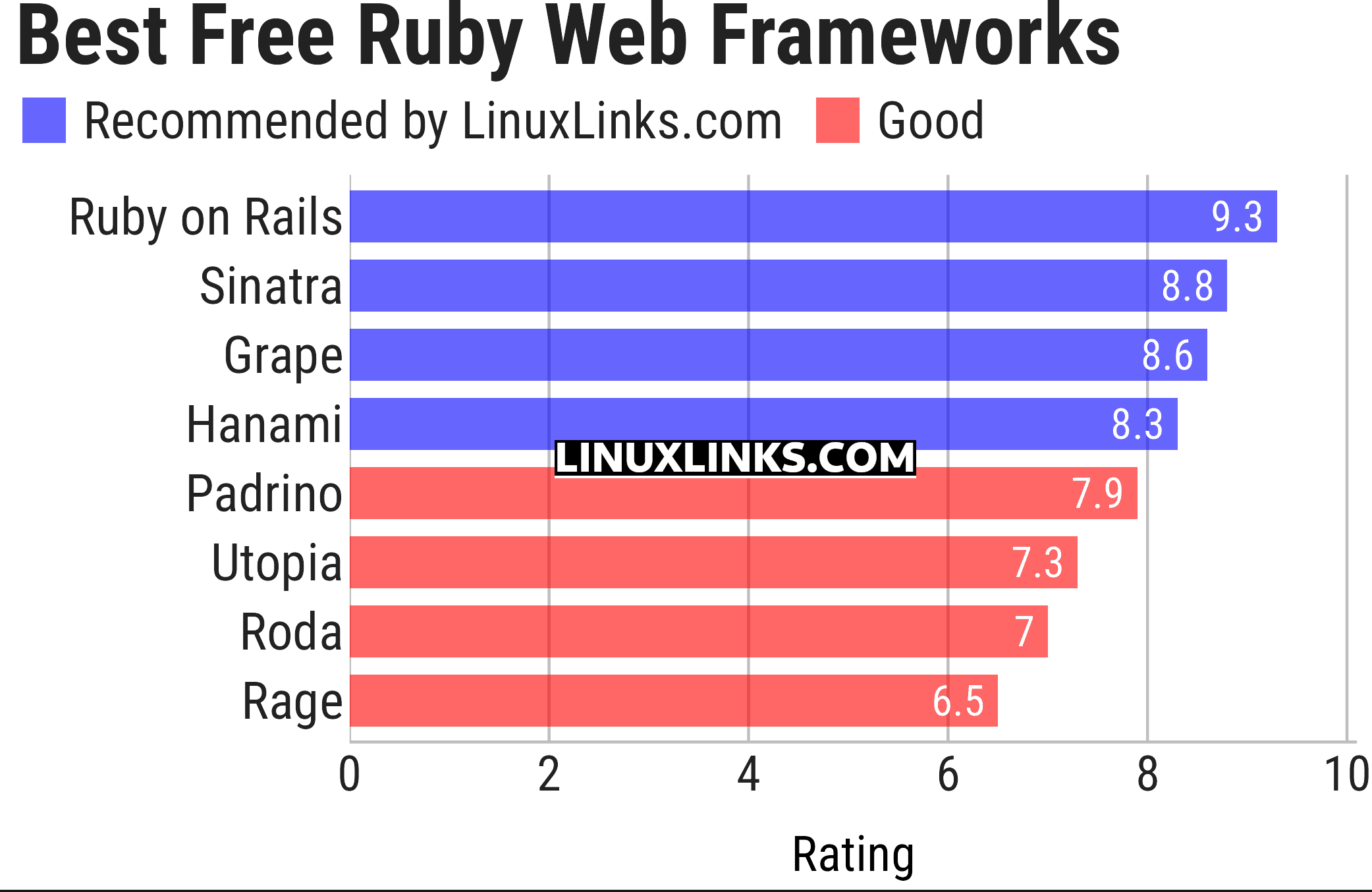
Let’s explore the 8 Ruby web frameworks. For each program we have compiled its own portal page, a full description with an in-depth analysis of its features, together with links to relevant resources.
| Ruby Web Frameworks | |
|---|---|
| Ruby on Rails | Full-stack web framework in Ruby for writing real-world applications |
| Sinatra | DSL for quickly creating web applications in Ruby with minimal effort |
| Grape | REST-like API framework for Ruby |
| Hanami | Full-stack Ruby web framework |
| Padrino | Full-stack ruby framework built upon Sinatra |
| Utopia | Website generation framework |
| Roda | Routing tree web toolkit for Ruby |
| Rage | API-first Ruby web framework |
This article has been updated to reflect the changes outlined in our recent announcement.
 Explore our carefully curated directory of recommended free and open source software, covering every major software category. Explore our carefully curated directory of recommended free and open source software, covering every major software category.The directory forms part of our extensive collection of articles for Linux enthusiasts. It includes hundreds of detailed reviews, together with free and open source alternatives to proprietary software from companies such as Google, Microsoft, Apple, Adobe, IBM, Cisco, Oracle, and Autodesk. LinuxLinks also covers interesting projects worth exploring, Linux-compatible hardware, free programming books and tutorials, and much more. Know a useful free and open source Linux application that we haven’t covered? Tell us about it using our submission form. |
Please read our Comment Policy before commenting.
How about Hanami, Grape and Rack?