

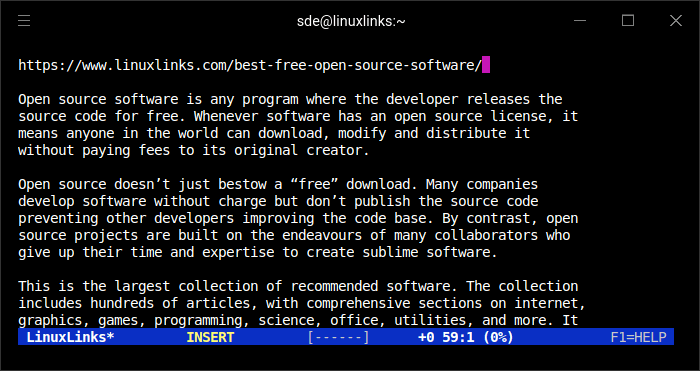
sled is a terminal text editor designed to be approachable for people who do not want to begin in vi’s command mode. It opens in an insert-first interface, allowing ordinary text entry immediately, while retaining a separate command mode for navigation and other editing actions.
Its author deliberately avoids turning it into a multi-file development environment. The program concentrates on editing one text file at a time. Additional instances can be used with a terminal multiplexer when several files need attention. This is part of its minimalist design, not an unimplemented multi-buffer feature.
The project follows a source-configuration philosophy. Users who want to change permanent settings are expected to adjust the supplied configuration header and rebuild; certain choices can also be made for an individual session. There is no conventional external configuration file or plugin framework.
This is free and open source software.
Key Features
- Insert mode starts by default for direct text entry.
- Command mode offers keyboard-driven navigation in the style of vi.
- Overwrite mode replaces existing characters as new text is entered.
- Selection mode extends a text selection during cursor movement.
- Additional help, text-input and numeric-input dialogs.
- Keyboard shortcuts for saving and exiting the editor.
- Source-level configuration and user-applied patches for custom behaviour.
- Single-file editing workflow with optional backup behaviour.
Website: strahinja.srht.site/sled
Support:
Developer: Strahinya Radich
License: GNU General Public License v3.0
sled is written in C. Learn C with our recommended free books and free tutorials.
Related Software
| Vim-like Text Editors | |
|---|---|
| Neovim | Vim-fork focused on extensibility and usability |
| Helix | Kakoune / Neovim inspired editor. |
| Lapce | Modern editor in Rust which uses native GUI and GPU rendering |
| NvChad | Neovim config aiming to provide a base configuration |
| LunarVim | IDE layer for Neovim |
| Kakoune | Implements Vi’s "keystrokes as a text editing language" model |
| Vis | Combining modal editing with structural regular expressions |
| vile | Text editor that combines aspects of the Emacs and vi editors |
| pyvim | Implementation of Vim in Python |
| gVim | Vim with a built-in GUI |
| amp | Vim-like editor written in Rust |
| Vy | Vim-like in Python made from scratch |
| moe | Command-line editor inspired by Vim |
| wig | Modal, Vim-like text editor |
| sled | Simple text editor with a terminal UI |
| red | Modern modal text editor written in Rust |
| ad | Adaptable text editor |
| hat | Hackable modal text editor |
| HAKO | Lightweight terminal-based modal text environment |
| xvi | Portable multi-file text editor |
| aretext | Minimalist text editor with vim-compatible key bindings |
| Levee | Also known as Captain Video |
Read our verdict in the software roundup.
 LinuxLinks helps you discover the best free and open source software for Linux. Explore our extensive collection of recommended applications, including alternatives to popular proprietary software. We also publish software reviews, Linux tutorials, hardware reviews, free programming books and articles covering the wider open source community. Browse our Linux resources to discover more. Know a useful free and open source Linux application we haven't covered? Suggest a program for inclusion. Has your software been featured on LinuxLinks? Display one of our Featured on LinuxLinks badges on your website or GitHub README. |
Please read our Comment Policy before commenting.
DOS *shudder*
You are so boring.
That’s what Linux needs, another text editor!!!!!
Q: Why?
A:
EDIT.COMis usually perceived as more familiar: type text straight away,C-Sto save, thenC-Q. (Sled still has vim‑like behavior, but it is “reverse” – default is insert mode, from which you can enter command mode.)suckless principles?
The suckless community is a group of like-minded people with the aim of creating software that is: