
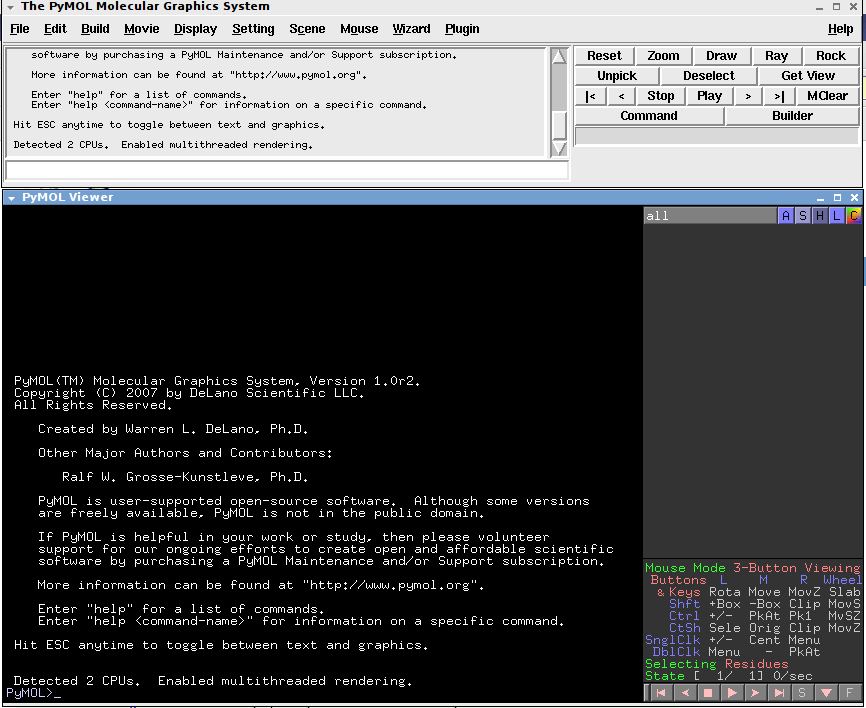
PyMOL is an OpenGL molecular graphics system.
PyMOL is a molecular graphics system with an embedded Python interpreter designed for real-time visualization and rapid generation of high-quality molecular graphics images and animations.
It is fully extensible and available free to everyone via the “Python” license. Although a newcomer to the field, PyMOL can already be used to generate stunning images and animations with unprecedented ease. It can also perform many other valuable tasks (such as editing PDB files) to assist you in your research.
Key Features
- Real-Time 3D visualization.
- Publication quality renderings.
- Extensive animation capabilities.
- Support for X-ray crystallography.
- Modular architecture.
- Volume visualization for unique display of volumetric data and simultaneous visualization of multiple iso-surfaces.
- Electron density map generation from reflection data.
- Stereochemical labeling.
- Atom Typing; MacroModel and SYBYL/MOL2 support.
- OpenGL Shaders (GLSL) for improved on-screen rendering (cartoons, sticks, surfaces, volumes).
- Dynamic measurements (distances, bond angles and dihedral angles).
- Flexible API for custom applications.
- Support for bg_gradient when ray tracing.
- Many non-standard nucleic acids (PSU, 5MU, 7MG, MIA, H2U, 4SU, MA6, UR3, 5MC, 40C, 2MG, TM2, 2MG) render correctly as cartoons.
- Surface color smoothing.
- Frame buffer-based antialiasing for real-time rendering.
- Optimized anaglyph colors and intensities for an improved 3D viewing experience.
- Real-time and ray-traced ambient occlusion.
- Support for reading compressed Maestro (.maegz)** and PyMOL session files (.pze, pzw, .pse.gz, .psw.gz).
- Written in C and Python.
Website: pymol.org
Support: Wiki
Developer: DeLano Scientific LLC
License: Open-source, user-sponsored
PyMOL is written in Python. Learn Python with our recommended free books and free tutorials.
Related Software
| Chemistry: Molecular Editors and Visualisation | |
|---|---|
| PyMOL | Molecular graphics system for visualizing structures and producing images |
| Avogadro | Advanced molecular editor and visualization application |
| Gabedit | Graphical interface for computational chemistry packages and modelling |
| Jmol | 3D molecular viewer for chemicals, crystals, materials and biomolecules |
| Patinae | Programmable molecular visualization toolkit with desktop and Python support |
| Coot | Interactive macromolecular model building, refinement and validation toolkit |
| IQmol3 | Molecular builder and visualization package for computational chemistry |
Read our verdict in the software roundup.
 Explore our carefully curated directory of recommended free and open source software, covering every major software category. Explore our carefully curated directory of recommended free and open source software, covering every major software category.The directory forms part of our extensive collection of articles for Linux enthusiasts. It includes hundreds of detailed reviews, together with free and open source alternatives to proprietary software from companies such as Google, Microsoft, Apple, Adobe, IBM, Cisco, Oracle, and Autodesk. LinuxLinks also covers interesting projects worth exploring, Linux-compatible hardware, free programming books and tutorials, and much more. Know a useful free and open source Linux application that we haven’t covered? Tell us about it using our submission form. |
Please read our Comment Policy before commenting.