

Mitos is a modal text editor based on Helix. It retains Helix’s selection-first editing model while pursuing a different approach to editor development and introducing additional functionality.
The editor is designed for programmers who favour keyboard-driven editing. Instead of selecting an editing operation and then identifying the text to change, users typically select the text first and apply an operation afterwards. This approach makes it particularly convenient to manipulate multiple sections of code simultaneously.
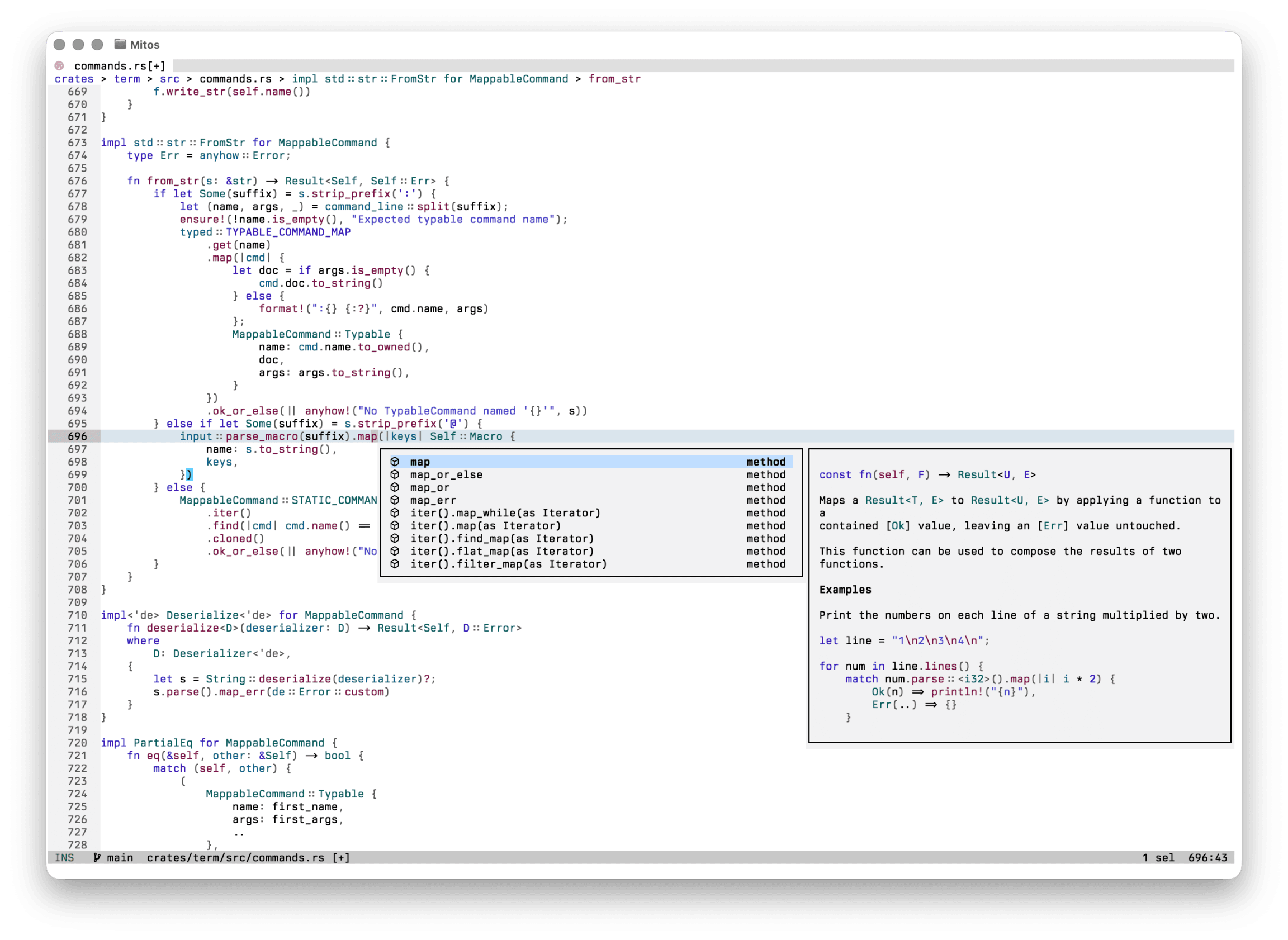
Mitos combines a terminal interface with functionality commonly associated with graphical development environments. It integrates code intelligence, syntax-aware editing and debugging into a single application.
This is free and open source software.
Key Features
- Selection-first modal editing model inherited from Helix.
- Multiple selections and cursors for editing several locations simultaneously.
- Built-in Language Server Protocol support for code completion, diagnostics and other language-aware functionality.
- Debug Adapter Protocol integration for debugging supported programming languages.
- Tree-sitter-powered incremental syntax highlighting and syntax-aware editing.
- Terminal interface built using Ratatui.
- Keyboard-driven navigation and editing commands.
- Supports structural selections and transformations for manipulating source code.
- Configurable editing behaviour and language-specific settings.
- Provides contextual completion suggestions and documentation from supported language servers.
- Supports code editing across multiple files and workspaces.
- Cross-platform support – runs on Linux, macOS, and Windows.
Website: github.com/mitos-editor/mitos
Support:
Developer: Mitos contributors
License: Mozilla Public License v2.0
Mitos is written in Rust. Learn Rust with our recommended free books and free tutorials.
Related Software
| Vim-like Text Editors | |
|---|---|
| Neovim | Vim-fork focused on extensibility and usability |
| Helix | Kakoune / Neovim inspired editor. |
| Lapce | Modern editor in Rust which uses native GUI and GPU rendering |
| NvChad | Neovim config aiming to provide a base configuration |
| LunarVim | IDE layer for Neovim |
| Kakoune | Implements Vi’s "keystrokes as a text editing language" model |
| Vis | Combining modal editing with structural regular expressions |
| vile | Text editor that combines aspects of the Emacs and vi editors |
| pyvim | Implementation of Vim in Python |
| gVim | Vim with a built-in GUI |
| amp | Vim-like editor written in Rust |
| Vy | Vim-like in Python made from scratch |
| moe | Command-line editor inspired by Vim |
| wig | Modal, Vim-like text editor |
| sled | Simple text editor with a terminal UI |
| red | Modern modal text editor written in Rust |
| ad | Adaptable text editor |
| hat | Hackable modal text editor |
| HAKO | Lightweight terminal-based modal text environment |
| xvi | Portable multi-file text editor |
| aretext | Minimalist text editor with vim-compatible key bindings |
| Levee | Also known as Captain Video |
Read our verdict in the software roundup.
 Explore our carefully curated directory of recommended free and open source software, covering every major software category. The directory forms part of our extensive collection of articles for Linux enthusiasts. It includes hundreds of detailed reviews, together with free and open source alternatives to proprietary software from companies such as Google, Microsoft, Apple, Adobe, IBM, Cisco, Oracle, and Autodesk. LinuxLinks also covers interesting projects worth exploring, Linux-compatible hardware, free programming books and tutorials, and much more. Know a useful free and open source Linux application that we haven’t covered? Tell us about it using our submission form. |
Please read our Comment Policy before commenting.