

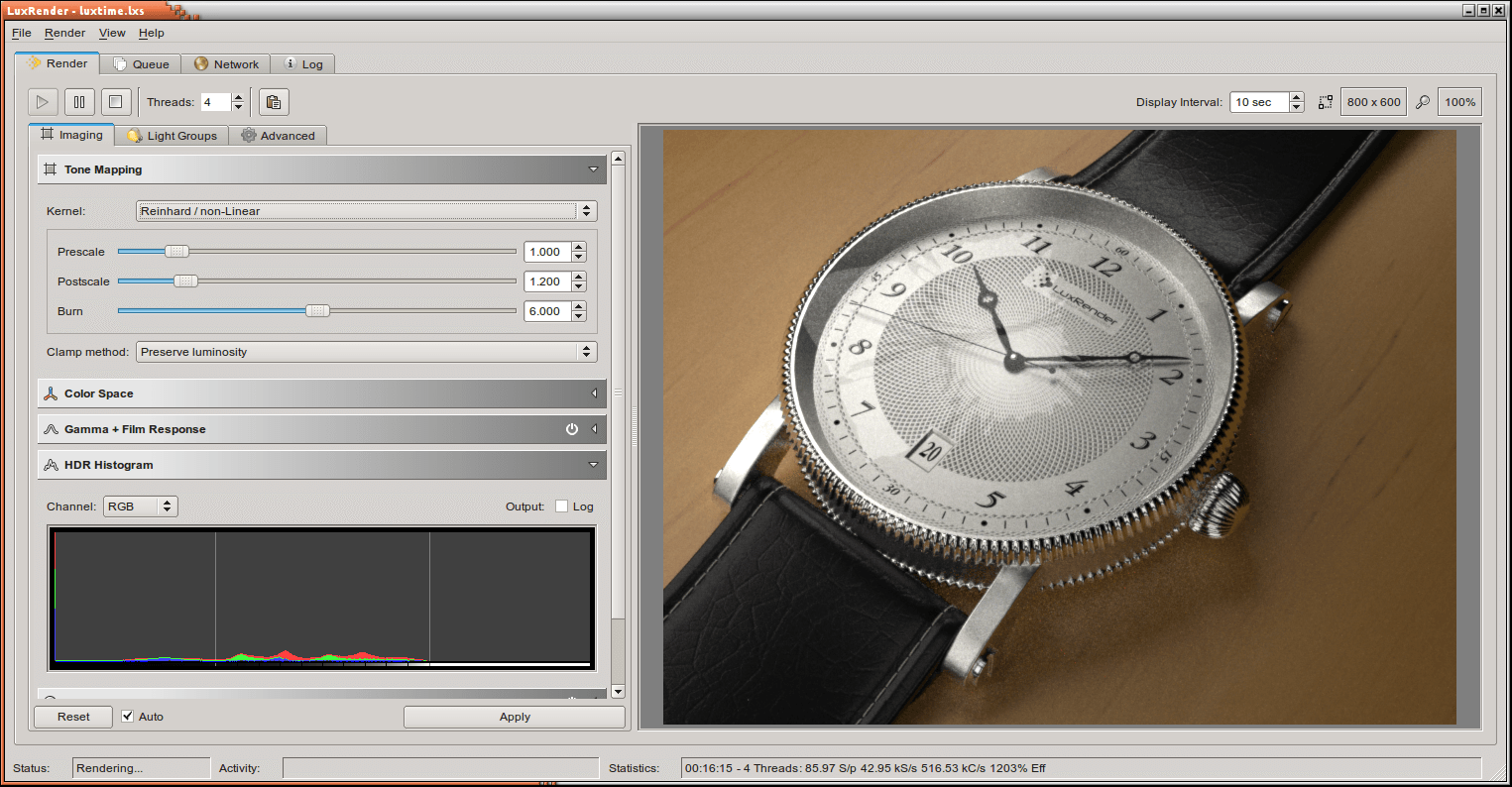
LuxCoreRender (formerly known as LuxRender) is an open source software rendering system for physically correct image synthesis. Based on state of the art algorithms, LuxCoreRender simulates the flow of light according to physical equations, thus producing realistic images of photographic quality.
LuxCoreRender features only a 3D renderer; it relies on other programs (3D modeling programs) to create the scenes to render, including the models, materials, lights and cameras. This content can then be exported from the application it was created in for rendering using LuxCoreRender. Fully functional exporters are available for Blender, DAZ Studio and Autodesk 3ds Max; partially functional ones for Cinema 4D, Maya, SketchUp and XSI.
LuxCoreRender uses the open GPGPU computing standard OpenCL to allow a variety of “compute devices” (such as graphics cards) in your system to accelerate the render process.
Key Features
- Fully spectral, physically-based core.
- Multiple rendering algorithms, including Kelemen-style metropolis light transport, photon mapping, and direct lighting.
- Biased and unbiased rendering: Users can choose between physical accuracy (unbiased) and speed (biased).
- Physically-based materials, including realistic simulations of metal, glass and car paint as well as traditional matte and glossy materials.
- Hierarchical procedural and image based texture system: Procedural and image based textures can be mixed in various ways, making it possible to create complex materials.
- Displacement mapping and subdivision: Based on procedural or image textures, object surfaces can be transformed.
- Spectral lighting system, including Gaussian and blackbody color definitions as well as RGB.
- SPPM Surface Integrator.
- Light Groups allow for instantaneous preview and calibration of scene lighting.
- Object-based participating media, for absorption, atmospheric effects, and unbiased multiple scattering (SSS).
- Camera simulations including multi-step motion blur, depth of field, film response, bloom, and glare.
- Built-in job queue and cooperative network rendering.
- Light groups: By using light groups, one can output various light situations from a single rendering, or make adjustments to the balance between light sources in real time.
- Tone mapping.
- Image denoising.
- Fleximage (virtual film): Allows you to pause and continue renders. The current state of the render can be written to a file, so that any system can continue the render at a later moment.
- GPU acceleration for path tracing when sampling one light at a time.
- Film response curves to emulate traditional cameras color response (some curve are for black&white films too).
- Volumetric rendering.
- Support for multiple 3D packages, including Blender, Autodesk 3DS Max, Poser, DAZ Studio, and Autodesk Softimage.
Website: github.com/LuxCoreRender/LuxCore
Support: GitHub Code Repository
Developer: David “Dade” Bucciarelli, Simon “B.Y.O.B.” Wendsche, Michael “neo2068” Klemm
License: Apache-2.0 License
LuxCoreRender is written in C++ and Python. Learn C++ with our recommended free books and free tutorials. Learn Python with our recommended free books and free tutorials.
Related Software
| Renderers | |
|---|---|
| Blender | 3D computer graphics software toolset that excels in many areas |
| Cycles | Physically based production renderer developed by the Blender project |
| Mitsuba | Extensible rendering framework written in portable C++ |
| LuxCoreRender | Physically based and unbiased rendering engine |
| MoonRay | Production path-tracing renderer |
| pbrt | Physically based ray tracing system |
| Malt | Fully customizable real-time rendering framework |
| Art of Illusion | 3D-modeler, renderer and raytracer |
| appleseed | Physically-based renderer targeted at production rendering |
| Renderer | Interactive 3D visualization of triangle meshes |
| Radiance | Suite of tools for performing lighting simulation |
| MiniLight | Minimal global illumination renderer |
| MantaRay | Advanced renderer which uses modern rendering techniques |
| Aqsis | 3D rendering solution adhering to the RenderMan standard |
Read our verdict in the software roundup.
| Ray Tracing Software | |
|---|---|
| POV-Ray | Full-featured ray tracer |
| Blender | 3D content creation suite with a huge range of uses |
| McXtrace | Monte Carlo Xray Tracing for simulation X-ray beamlines and experiments |
| McStas | Simulator for neutron scattering instruments and experiments |
| Embree | High-performance ray tracing library |
| LuxCoreRender | Rendering system for physically correct image synthesis |
| pbrt | Physically based ray tracing system |
| OSPRay | Scalable and portable ray tracing engine |
| BRL-CAD | Combinatorial Constructive Solid Geometry (CSG) solid modeling system |
| Visionaray | C++ ray tracing template library |
| MantaRay | Advanced renderer using modern rendering techniques |
| YafaRay | Montecarlo raytracing engine |
| Tachyon | Parallel / multiprocessor ray tracing system |
Read our verdict in the software roundup.
 Explore our comprehensive directory of recommended free and open source software. Our carefully curated collection spans every major software category. Explore our comprehensive directory of recommended free and open source software. Our carefully curated collection spans every major software category.This directory is part of our ongoing series of informative articles for Linux enthusiasts. It features hundreds of detailed reviews, along with open source alternatives to proprietary solutions from major corporations such as Google, Microsoft, Apple, Adobe, IBM, Cisco, Oracle, and Autodesk. You’ll also find interesting projects to try, hardware coverage, free programming books and tutorials, and much more. Discovered a useful open source Linux program that we haven’t covered yet? Let us know by completing this form. |
Please read our Comment Policy before commenting.