

qcd is a utility which lets you quickly change directory on the command line. It aims to improve your efficiency.
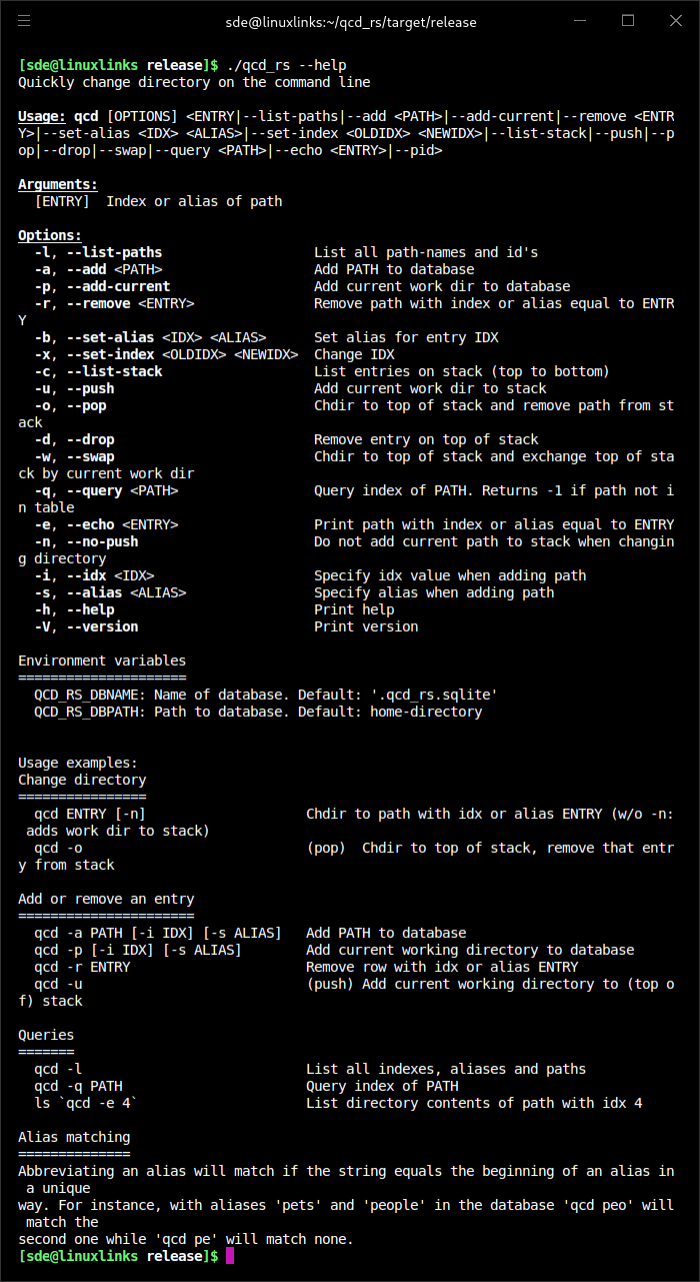
With qcd you change to another directory just by entering commands like qcd 3 and step back to where you came from with qcd -o>. Or you toggle between two directories with the swap functionality qcd -w.
For this to work you store frequently visited directories in a database file (sqlite3). Entries in this database get referred to via indices (value ‘3’ in the example). If you don’t like remembering indices you can assign aliases to each entry. Indices and aliases can be freely adjusted to your needs.
In addition, qcd provides a stack concept. In the example (qcd 3) the current working directory is put on (top of) the stack before changing the directory. Entering qcd -o pops (removes) the path from top of the stack and changes the working directory to that path.
This is free and open source software.
Website: github.com/ClaasBontus/qcd_rs
Support:
Developer: Claas Bontus
License: MIT License or Apache 2.0 License
qcd is written in Rust. Learn Rust with our recommended free books and free tutorials
Related Software
| Shell tools | |
|---|---|
| fzf | Command-line fuzzy finder for your shell |
| zoxide | Smarter cd command, inspired by z and autojump |
| broot | Reviewed under our Excellent Utilities series |
| McFly | Also reviewed under our Excellent Utilities series |
| z | Maintains a jump-list of the directories you actually use |
| autojump | Offers a fast way to navigate your filesystem |
| z.lua | Helps you navigate faster by learning your habits |
| HSTR | Bash and zsh shell history suggest box |
| enhancd | Next-generation cd command |
| fzy | Simple, fast fuzzy finder for the terminal |
| Navita | Rapid directory traversal |
| Jump | Quick and fuzzy directory jumper |
| walk | Simple and minimalistic terminal navigator |
| lacy | cd alternative that makes navigating much more efficient |
| DF-SHOW | Directory File Show |
| fz | Adds fuzzy search to tab completion of z |
| v | z for vim |
| pazi | Fast autojump helper |
| jumper | Files/directories jumper |
| cdhist | Linux shell cd history directory stack |
| icd | Shell utility that makes changing directories quicker and more convenient |
| fasd | Command-line productivity booster. It seeks inspiration from autojump, z and v |
| kn | Navigate folders quickly |
| Dongle | Move around deep directory trees |
| cdwe | cd with env vars |
| slingshot | Lightweight tool to browse files in the terminal |
| ff | Manage favourite folders |
| fastdiract | Quick shell navigation and command execution |
| zm | cd for lazy people |
| qcd | Quickly change directory |
| pm | Switch between projects |
| nav | Quickly navigate through directories |
| menucd | Directory browser and changer |
| jmp | The superior cd |
| gump | Smarter cd command |
Read our verdict in the software roundup.
 Explore our comprehensive directory of recommended free and open source software. Our carefully curated collection spans every major software category. Explore our comprehensive directory of recommended free and open source software. Our carefully curated collection spans every major software category.This directory is part of our ongoing series of informative articles for Linux enthusiasts. It features hundreds of detailed reviews, along with open source alternatives to proprietary solutions from major corporations such as Google, Microsoft, Apple, Adobe, IBM, Cisco, Oracle, and Autodesk. You’ll also find interesting projects to try, hardware coverage, free programming books and tutorials, and much more. Discovered a useful open source Linux program that we haven’t covered yet? Let us know by completing this form. |
Please read our Comment Policy before commenting.
Wow, but QCD takes SOOOOO much longer to type than ‘z’ or zi’ innit?
Use an alias…
I find some of the Linux jargon to be confusing. What does an alias mean?
An alias is simply a replacement string that references a Linux command and produces the same results as when executing the original command.
To make an alias permanent, an entry is saved in a shell configuration file.