

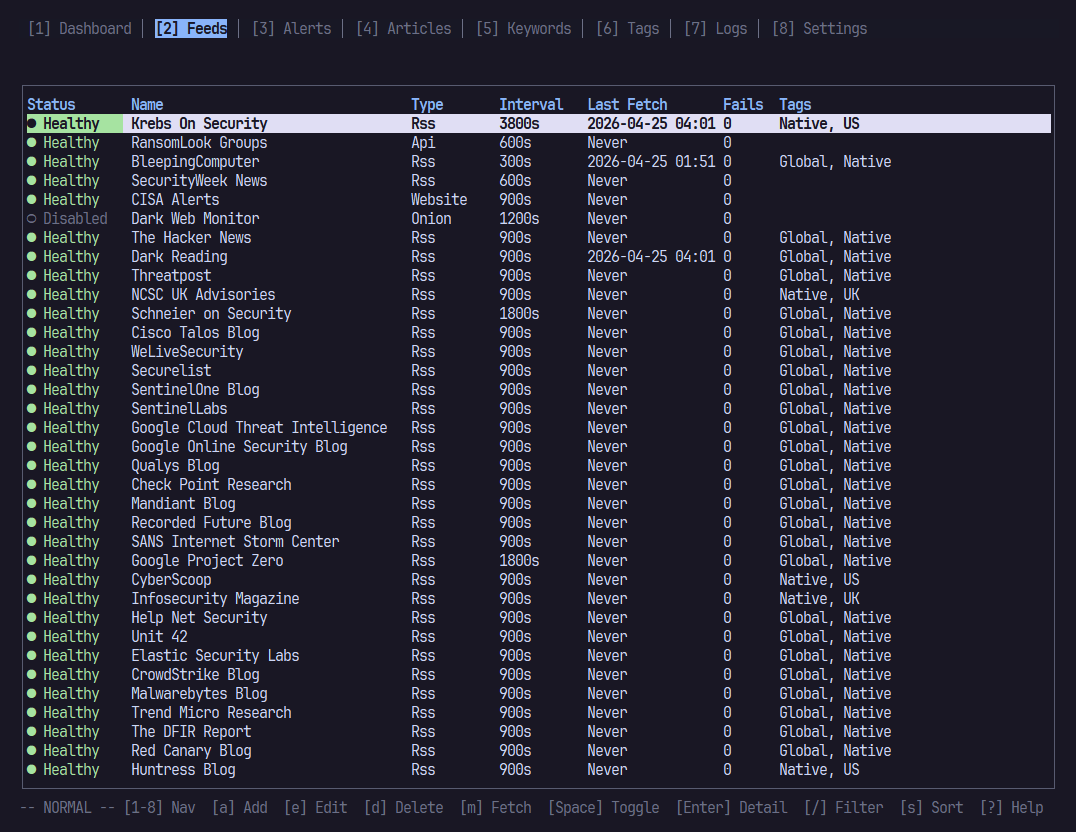
ThreatDeck is a terminal application for monitoring threat intelligence feeds and generating alerts from matched content.
It’s aimed at security operations teams, security researchers, and threat intelligence analysts who want a self-hosted text interface for aggregating API, RSS, website, and onion-source intelligence. The program stores its data locally, provides dashboard views, supports keyword-driven matching, and includes tools for managing feeds, alerts, articles, tags, logs, and settings from the terminal.
This is free and open source software.
Key Features
- Aggregates threat intelligence from APIs, RSS and Atom feeds, websites, and onion services accessed through Tor.
- Uses JSONPath templates to extract structured fields from JSON API feeds.
- Supports simple text and regex keyword matching with low, medium, high, and critical severity levels.
- Generates alerts with content hashing for deduplication, snippets, and preserved metadata.
- Provides a cached article view for browsing feed items and reading cleaned article text in the terminal.
- Offers tag management for organising feeds, keywords, and alerts with colour-coded labels.
- Sends notifications through SMTP email, webhooks, and Discord with configurable severity thresholds.
- Includes dashboard statistics, criticality distribution, recent alerts, and trend visualisation.
- Tracks feed health with status information, consecutive failure counts, and detailed health logs.
- Offers dark, light, solarized, dracula, and monokai themes.
Website: github.com/gripebomb/ThreatDeck
Support:
Developer: gripebomb
License: MIT License
ThreatDeck is written in Rust. Learn Rust with our recommended free books and free tutorials.
Related Software
| Threat Intelligence Platforms | |
|---|---|
| IntelOwl | Automates enrichment and analysis across a broad range of threat sources |
| OpenCTI | Connects threat data in a searchable intelligence graph |
| MISP | Share and correlate actionable threat intelligence |
| Yeti | Builds richer investigations from indicators, entities and context |
| ThreatDeck | Tracks threat intelligence feeds and surfaces meaningful changes quickly |
Read our verdict in the software roundup.
 Explore our carefully curated directory of recommended free and open source software, covering every major software category. Explore our carefully curated directory of recommended free and open source software, covering every major software category.The directory forms part of our extensive collection of articles for Linux enthusiasts. It includes hundreds of detailed reviews, together with free and open source alternatives to proprietary software from companies such as Google, Microsoft, Apple, Adobe, IBM, Cisco, Oracle, and Autodesk. LinuxLinks also covers interesting projects worth exploring, Linux-compatible hardware, free programming books and tutorials, and much more. Know a useful free and open source Linux application that we haven’t covered? Tell us about it using our submission form. |
Please read our Comment Policy before commenting.