

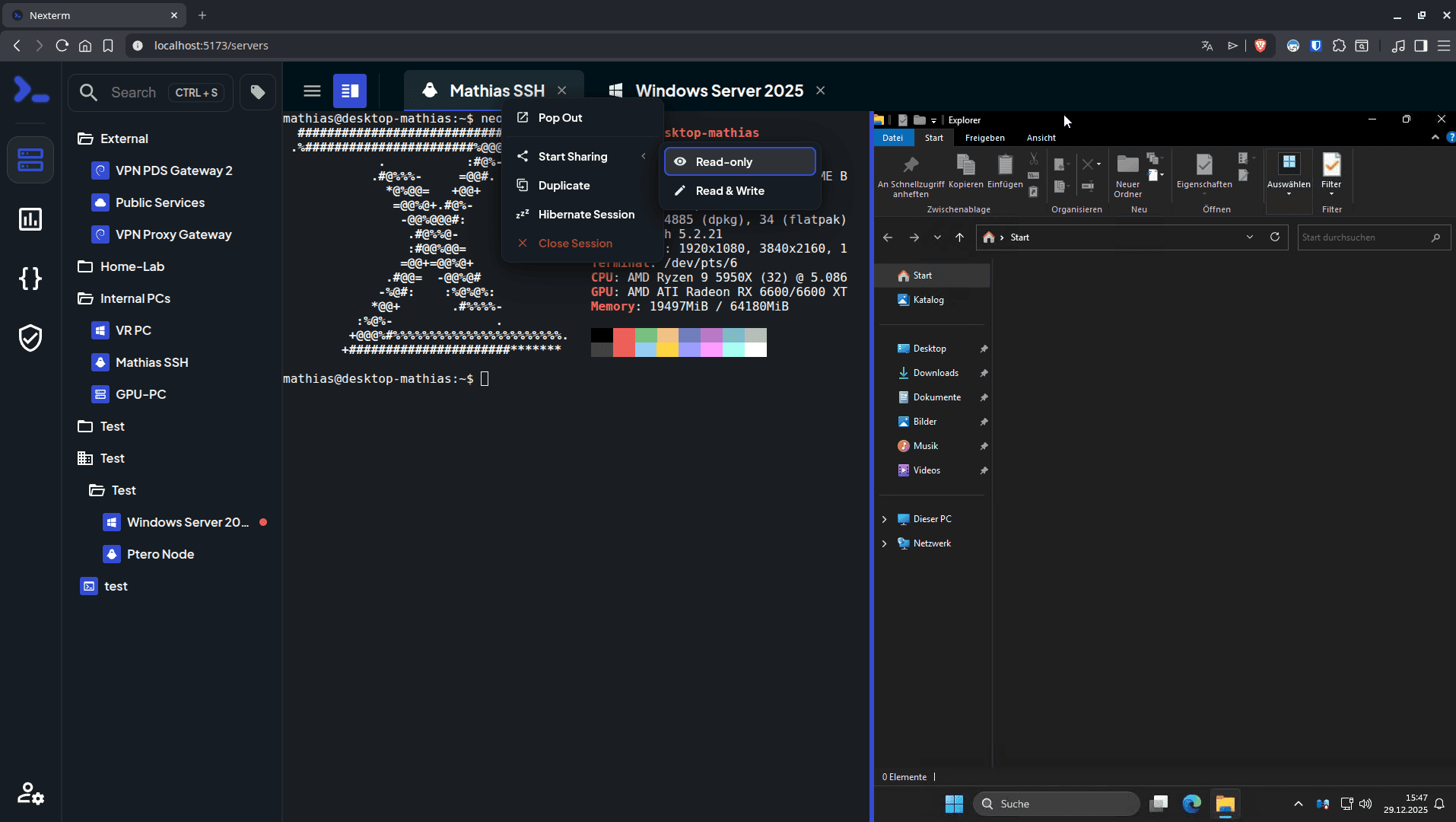
Nexterm is a self-hosted server management platform that brings remote access and infrastructure administration into a single web interface.
It is designed to replace a collection of separate tools with one central workspace for working with machines, files, scripts and virtualised or containerised workloads. Resources can be arranged into folders and tabs, while organisation support helps teams keep users and infrastructure logically separated. Nexterm also includes a remote browser which runs from the server-side network: pages and internal hostnames are reached through an SSH server, making it possible to open interfaces for routers, firewalls, NAS devices and other systems that are not directly reachable from the administrator’s local network.
This is free and open source software.
Key Features
- Connect to remote systems over SSH, RDP and VNC.
- Transfer and manage files through SFTP.
- Real-time monitoring for CPU, memory and process activity.
- Deploy applications and services with Docker.
- Manage Proxmox LXC and QEMU workloads.
- Create reusable command snippets for frequently used tasks.
- Run custom scripts to automate repetitive administration jobs.
- Two-factor authentication and OpenID Connect single sign-on.
- Session management and encrypted storage for passwords, SSH keys and passphrases.
- Separate users and servers into organisations.
- Record remote sessions for later review and auditing.
- Use granular permissions to control access to connection types and functions.
- Remote-browser sessions are isolated and their profiles are removed when closed.
- Support for an all-in-one deployment or separate server and engine components.
- A command-line utility is included for administrative tasks.
- Reverse-proxy configuration can preserve client IP addresses in audit logs.
Website: github.com/gnmyt/Nexterm
Support:
Developer: Mathias Wagner
License: MIT License
Nexterm is written in JavaScript. Learn JavaScript with our recommended free books and free tutorials.
Related Software
| Graphical SSH Frontends | |
|---|---|
| XPipe | Shell connection hub and remote file manager |
| Termix | Self-hosted all-in-one server management platform |
| RustConn | Connection orchestrator with a GTK4/Wayland-native interface |
| Ásbrú Connection Manager | Full-featured connection manager written in Perl |
| sshPilot | Lightweight SSH connection manager |
| PuTTY | SSH and telnet client with sessions |
| EasySSH | Connection manager written in Vala |
| Kerminal | Modern terminal emulator and SSH manager |
| OpenSSH GUI | Frontend for managing your SSH Keys |
Read our verdict in the software roundup.
 Explore our comprehensive directory of recommended free and open source software. Our carefully curated collection spans every major software category. Explore our comprehensive directory of recommended free and open source software. Our carefully curated collection spans every major software category.This directory is part of our ongoing series of informative articles for Linux enthusiasts. It features hundreds of detailed reviews, along with open source alternatives to proprietary solutions from major corporations such as Google, Microsoft, Apple, Adobe, IBM, Cisco, Oracle, and Autodesk. You’ll also find interesting projects to try, hardware coverage, free programming books and tutorials, and much more. Discovered a useful open source Linux program that we haven’t covered yet? Let us know by completing this form. |
Please read our Comment Policy before commenting.