

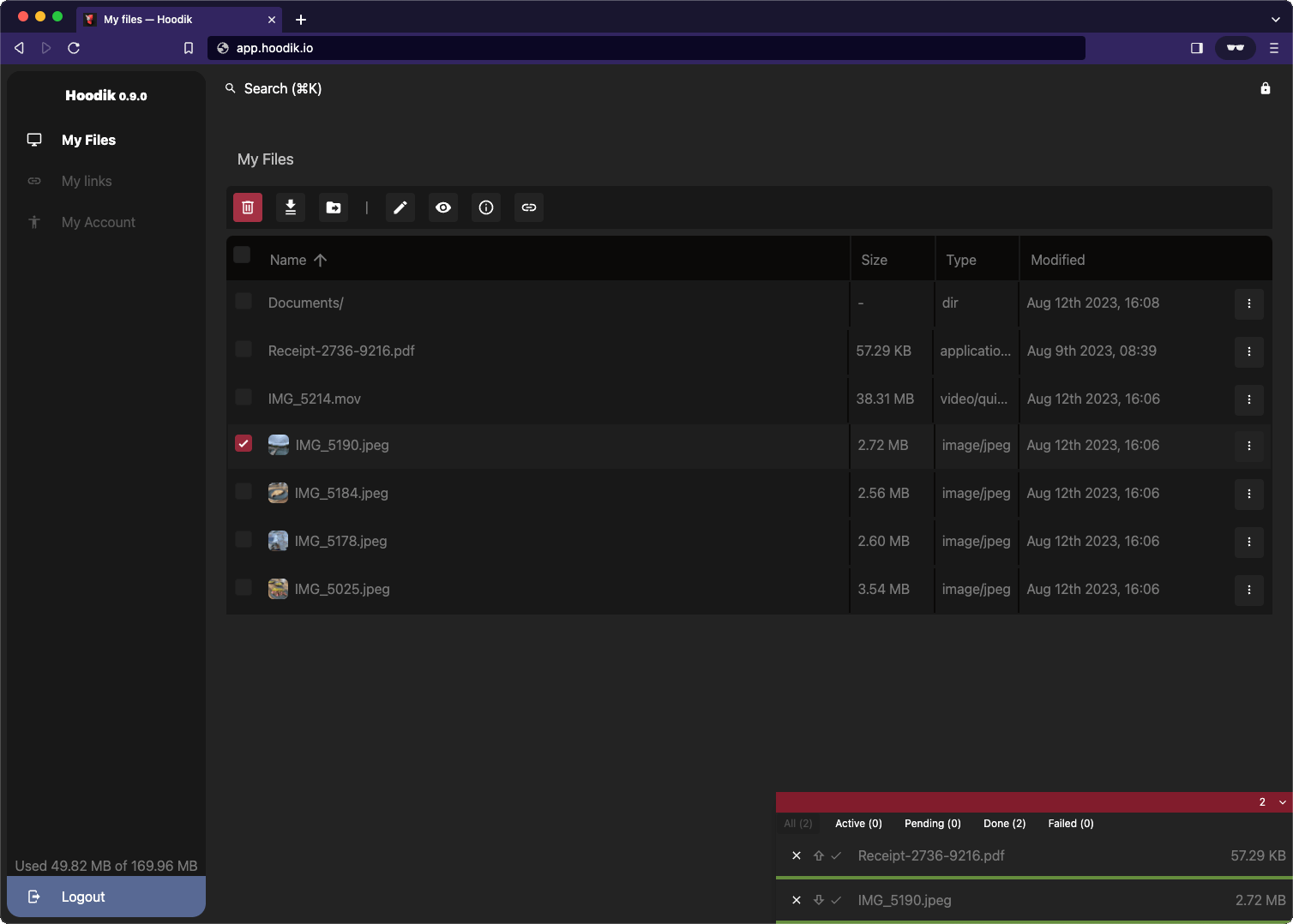
Hoodik is a lightweight, secure, and self-hosted cloud storage solution.
It’s designed and built with Rust and Vue, focusing on end-to-end encryption that shields your data from prying eyes and hackers. Hoodik supports file uploading and downloading, making it easy for you to share files with other users.
Hoodik supports either Sqlite or Postgres databases. Sqlite is enabled by default and it creates a database file in your DATA_DIR right out of the box.
This is free software but its license doesn’t meet the OSI definition to be classed as open source.
Website: github.com/hudikhq/hoodik
Support:
Developer: Hudik
License: Creative Commons Attribution-NonCommercial 4.0 International
Hoodik is written in Rust. Learn Rust with our recommended free books and free tutorials.
Related Software
| Self-Hosted Cloud Storage Tools | |
|---|---|
| Puter | Privacy-first personal cloud |
| Nextcloud | Personal cloud storage, text editor, photo gallery, file share, calendaring app |
| Cloudreve | Self-hosted file management system with multi-cloud support |
| Seafile | Cloud storage system with privacy protection and teamwork features |
| RustFS | Put S3 and Swift storage on a cluster with healing and replication |
| ownCloud | File sync and sharing platform based on Infinite Scale |
| VersityGW | Make existing filesystems speak the language of S3 |
| Peergos | Secure file storage, social network and application protocol |
| MyDrive | Cloud file storage server |
| Pydio Cells | File sharing platform for organizations |
| OxiCloud | Self-hosted cloud with WebDAV, CalDAV and CardDAV |
| OpenCloud | File sharing and collaboration solution |
| Sync-in | Synchronise files between servers with scheduled, two-way transfers |
| Garage | S3-compatible distributed object storage service |
| Alarik | Spread S3 data across a cluster with erasure coding and a web console |
| Twake Drive | Alternative to Google Drive |
| Flowinity | Image uploader and file storage solution |
| S4 | Store more in less space using append-only volumes and deduplication |
| HS5 | Fast single-node S3 storage with metadata kept apart |
| Trove | Your own file cloud, with full-text search and secure sharing links |
Read our verdict in the software roundup.
 Explore our carefully curated directory of recommended free and open source software, covering every major software category. Explore our carefully curated directory of recommended free and open source software, covering every major software category.The directory forms part of our extensive collection of articles for Linux enthusiasts. It includes hundreds of detailed reviews, together with free and open source alternatives to proprietary software from companies such as Google, Microsoft, Apple, Adobe, IBM, Cisco, Oracle, and Autodesk. LinuxLinks also covers interesting projects worth exploring, Linux-compatible hardware, free programming books and tutorials, and much more. Know a useful free and open source Linux application that we haven’t covered? Tell us about it using our submission form. |
Please read our Comment Policy before commenting.