

Bedroom
The bedroom is located directly above the room with the router, so there is no wall to go through, just a ceiling. But this sort of test can still be challenging for Wi-Fi 7.
Here are test results with the MS-02 Ultra / Cudy.
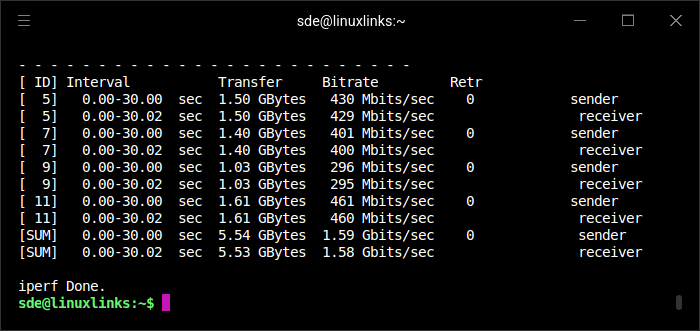
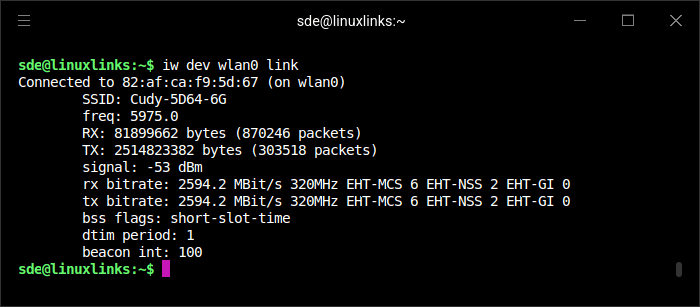
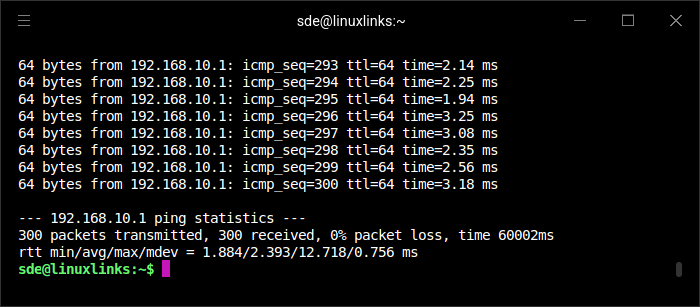
The Cudy WR11000 delivers the higher headline performance in the bedroom, with the 285HX averaging 1.63Gbps over 6GHz compared with 1.37Gbps from the Zyxel over 5GHz. That’s a meaningful uplift, especially as the Cudy’s 6GHz signal is weaker at this location. However, the Zyxel remains the more composed router in this specific test. Its latency is lower, its jitter is tighter, and it recorded almost no TCP retransmits. The Cudy is faster, but the Zyxel’s connection looks more stable and efficient. For large file transfers, the Cudy wins. For latency-sensitive use, the Zyxel’s 5GHz result is cleaner.
In the bedroom, the Cudy’s 5GHz result with the MS-02 Ultra 285HX is stable rather than spectacular. The signal is strong at -43 dBm, matching the Zyxel’s 5GHz reading and clearly better than the Cudy’s weaker -53 dBm 6GHz bedroom connection. Latency is respectable too, with an average ping of 2.25 ms, no packet loss, and a maximum of 8.83 ms.
Throughput is the weaker part. The 5GHz iperf3 run averages around 1.08 to 1.09Gbps, which is well behind the Cudy’s earlier 6GHz result of 1.63Gbps and also below the Zyxel 5GHz result of 1.37Gbps. That’s despite the Cudy 5GHz link showing a decent Wi-Fi 7 connection at 160MHz, with transmit rate reported at 1921.5 Mbit/s.
The M2’s 6GHz signal is better than the MS-02 Ultra’s earlier 6GHz reading, at -49 dBm versus -53 dBm, but its negotiated rate is lower at 2305.6 Mbit/s rather than 2594.2 Mbit/s. Throughput lands at 1.34Gbps, which is solid, but behind the MS-02 Ultra’s 1.63Gbps Cudy 6GHz result.
The important positive is that the M2 recorded 0 retransmits. That makes this a much cleaner result than the earlier MS-02 Ultra 6GHz run, which was faster but messy under load. Latency is also reasonable, averaging 2.36 ms, with a maximum of 6.39 ms.
The VTA-439 struggled particularly with MLO. While most runs were around 1Gbps, some of the 40 tests were much slower, pulling the average down to around 682Mbps.
Pages in this article:
Page 1 – Introduction
Page 2 – 5m from router line of sight
Page 3 – Bedroom
Page 4 – Office
Page 5 – Power Consumption and Summary
Please read our Comment Policy before commenting.