

Cantor is a graphical front-end for mathematical, statistical and scientific computing software. Rather than implementing its own calculation engine, it provides a consistent KDE worksheet interface for a collection of external programming languages, computer algebra systems and numerical computing packages.
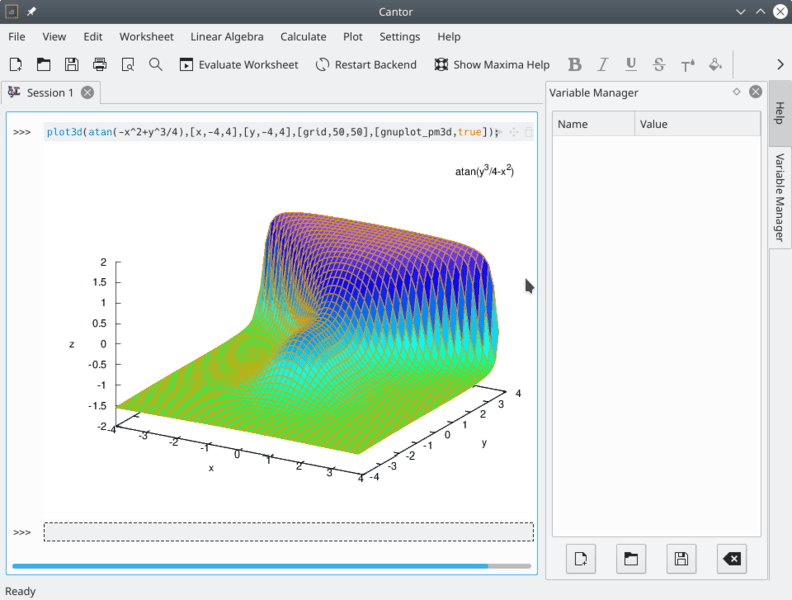
Expressions, explanatory text, mathematical notation, images and results can be combined within a worksheet. Cantor can display plots and formatted mathematical output alongside the commands that produced them, making it useful for exploratory work, teaching and preparing reproducible mathematical documents.
This is free and open source software.
Key Features
- Worksheet-based graphical interface for mathematical and scientific computing.
- Supports Julia, KAlgebra, Lua, Maxima, Octave, Python, Qalculate!, R, Sage and Scilab backends.
- Plugin-based architecture allows additional calculation backends to be implemented.
- Work with multiple worksheets using a tabbed interface.
- Insert command, text, Markdown, LaTeX, image and page-break entries.
- Evaluate individual expressions or an entire worksheet.
- Displays plots and other graphical results directly inside worksheets.
- Backend-aware syntax highlighting and code completion.
- Mathematical formula typesetting using LaTeX.
- PDF-based rendering of LaTeX entries and results.
- Assistant dialogs for common mathematical tasks such as integrating functions and entering matrices.
- Variable manager displays available variables for supported backends.
- Shows variable values, types, sizes and dimensions when provided by the backend.
- Contextual help panel and optional embedded documentation.
- Import and export Jupyter Notebook files.
- Save worksheets in Cantor’s native format, including embedded images.
- Export worksheets as PDF, LaTeX or plain text.
- Print and print-preview support.
- Collapse, expand or remove worksheet results.
- Zoom controls for the worksheet view.
- Download and publish example worksheets through KDE’s Get Hot New Stuff framework.
- Integrated file-browser panel.
- Restores open sessions through XSMP session management.
Website: invent.kde.org/education/cantor
Support:
Developer: KDE
License: GNU General Public License v2.0
Cantor is written in C++. Learn C++ with our recommended free books and free tutorials.
Related Software
| Notebook software | |
|---|---|
| JupyterLab | The next generation user interface for Project Jupyter |
| RStudio | Integrated development environment (IDE) for R |
| Jupyter Notebook | Web-based notebook environment for interactive computing |
| Positron | Next-generation data science IDE |
| marimo | Reactive Python notebook |
| Apache Zeppelin | Multi-purpose notebook |
| IPython | Rich architecture for interactive computing |
| euporie | Terminal interface for Jupyter notebooks and kernels |
| Polynote | Experimental polyglot notebook environment |
| Livebook | Interactive and collaborative code notebooks |
| nteract | Notebooks on your Desktop |
| Pluto | Simple reactive notebooks for Juli |
| Cantor | Frontend for mathematical and scientific software |
| Pretzel | Billed as a modern replacement for Jupyter Notebooks |
| Spark Notebook | Interactive and reactive data science using Scala and Spark |
| BeakerX | Kernels and extensions to the Jupyter interactive computing environment |
Read our verdict in the software roundup.
 Explore our carefully curated directory of recommended free and open source software, covering every major software category. Explore our carefully curated directory of recommended free and open source software, covering every major software category.The directory forms part of our extensive collection of articles for Linux enthusiasts. It includes hundreds of detailed reviews, together with free and open source alternatives to proprietary software from companies such as Google, Microsoft, Apple, Adobe, IBM, Cisco, Oracle, and Autodesk. LinuxLinks also covers interesting projects worth exploring, Linux-compatible hardware, free programming books and tutorials, and much more. Know a useful free and open source Linux application that we haven’t covered? Tell us about it using our submission form. |
Please read our Comment Policy before commenting.