

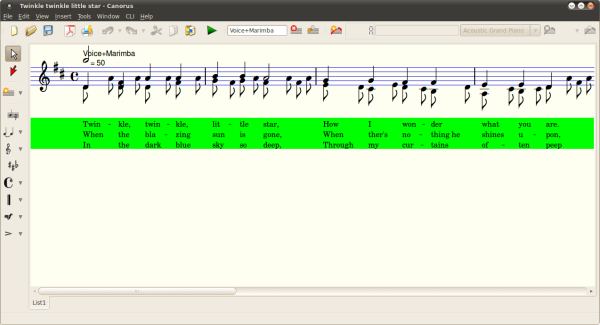
Canorus is a graphical music score editor for creating and modifying traditional musical notation. It provides an interactive workspace in which musicians can enter notes, rests and other symbols directly onto staves.
The application originated as a successor to NoteEdit and uses the Qt toolkit for its interface. It supports compositions containing multiple voices and staves, together with the notation required for instrumental and vocal music.
Canorus also integrates with LilyPond to prepare engraved scores. This allows musicians to combine graphical notation entry with text-based music engraving, although some import and export capabilities remain less complete than those of more established notation applications.
This is free and open source software.
Key Features
- Graphical score editing – enters and modifies music notation using the keyboard and mouse.
- Multiple voices – supports polyphonic notation within musical staves.
- Multiple score views – provides different views of the same composition.
- Conventional notation – handles notes, rests, clefs, key signatures, time signatures and barlines.
- Rhythmic structures – supports tuplets, ties, slurs and other duration-related notation.
- Musical expressions – inserts articulations, dynamics, ornaments and tempo markings.
- Lyrics – adds vocal text to musical scores.
- MIDI input – captures note information from compatible MIDI keyboards.
- MIDI playback – plays scores through supported MIDI output systems.
- Transposition – changes the pitch of musical material and adjusts relevant notation.
- LilyPond integration – exports scores for engraving and printed output.
- MusicXML interchange – supports basic import of MusicXML scores.
- Score export – provides output through LilyPond, including PDF and SVG conversion.
- Undo and redo – reverses or reapplies editing operations.
- Scripting – supports extending editor functionality through scripting facilities.
- Cross-platform support – runs on Linux, macOS, and Windows.
Website: sourceforge.net/projects/canorus
Support:
Developer: Canorus Development Team
License: GNU General Public License v3.0
Canorus is written in Python, C++, and Ruby. Learn Python with our recommended free books and free tutorials. Learn C++ with our recommended free books and free tutorials. Learn Ruby with our recommended free books and free tutorials.
Related Software
| Open Source Scorewriters | |
|---|---|
| Rosegarden | Sophisticated MIDI (and audio) sequencer and notation editor |
| MuseScore Studio | Graphical WYSIWYG music score typesetter |
| Lilypond | Produce musical scores that are engraved with traditional layout rules |
| Frescobaldi | LilyPond sheet music text editor |
| Denemo | Musical score editor intended primarily as a frontend to Lilypond |
| music21 | Toolkit for computational musicology |
| mup | Very feature-laden application for producing printed music |
| TuxGuitar | Multitrack tablature editor and player writen in Java-SWT |
| Aria Maestosa | Midi sequencer/editor |
| Gregorio | Tools for Typesetting Gregorian Chant |
| Canorus | Graphical music score editor written for the Qt4 toolkit |
| PMW | Music typesetting program for creating high-quality scores |
| EasyABC | Graphical editor for creating and editing ABC music notation |
Read our verdict in the software roundup.
 LinuxLinks helps you discover the best free and open source software for Linux. Explore our extensive collection of recommended applications, including alternatives to popular proprietary software. We also publish software reviews, Linux tutorials, hardware reviews, free programming books and articles covering the wider open source community. Browse our Linux resources to discover more. Know a useful free and open source Linux application we haven't covered? Suggest a program for inclusion. Has your software been featured on LinuxLinks? Display one of our Featured on LinuxLinks badges on your website or GitHub README. |
Please read our Comment Policy before commenting.