
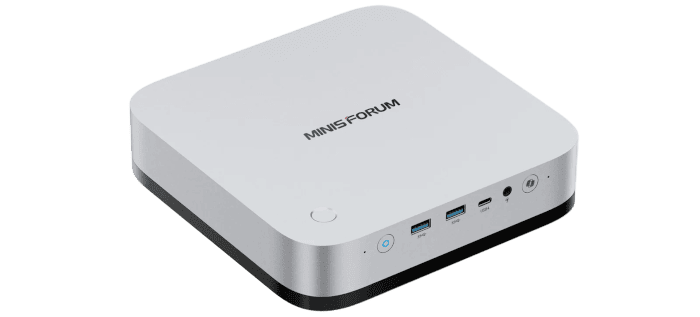
This is the second article in my series looking at the Minisforum M2 Pro running Linux. In the first article, I examined the hardware, installed CachyOS, and checked how Linux recognised the machine’s components. Now it’s time to put the hardware to work.
The M2 Pro combines an Intel Core Ultra X7 358H processor with Intel Arc B390 integrated graphics, 32GB of LPDDR5X memory running at 7467 MT/s, and a 1TB NVMe SSD. This article covers processor, graphics, memory, and storage performance, using a selection of benchmarks, most available through the Phoronix Test Suite.
The Core Ultra 7 356H is a particularly useful comparison, as it has a very similar Panther Lake CPU configuration. Comparing the two should help show where the M2 Pro’s stronger graphics and faster memory make a difference. I’m also interested in how it fares against the Ryzen AI 9 HX 370 in the Minisforum AI X1 Pro and the newer Ryzen AI 9 HX 470.
The charts also include a Core Ultra 9 285HX system, but that processor is housed in a mini workstation, providing a reference from a different class of machine.
For benchmarking, I set the M2 Pro’s BIOS to Performance mode and used the performance CPU governor. I ran the CPU tests from a text console, with KDE Plasma and the graphical desktop session stopped, to minimise interference from desktop activity.
Processor
The Core Ultra X7 358H has 16 cores: four performance cores, eight efficiency cores, and four low-power efficiency cores. It supports 16 threads, compared with the 12 cores and 24 threads of the two Ryzen AI processors. These tests cover both workloads that can use many threads and those that depend on a single core.
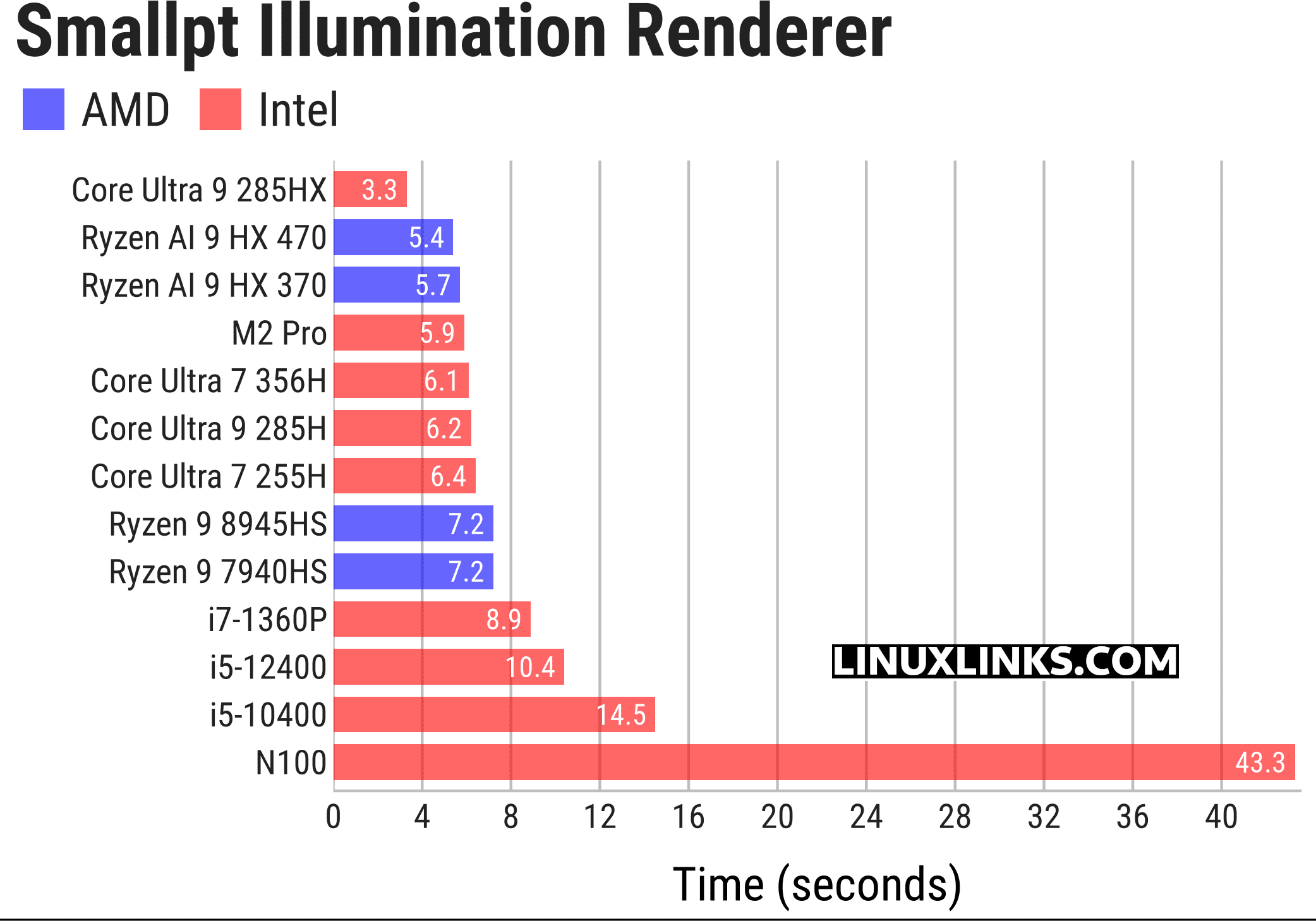
$ phoronix-test-suite benchmark smallptSmallpt renders a scene using path tracing. It can use multiple CPU cores, making it a useful test of rendering throughput. The result is the time taken to finish the task, so lower is better.
The M2 Pro completes the render in 5.9 seconds, shaving 0.2 seconds off the 356H’s time. That’s a modest improvement of around 3%. The Ryzen AI processors remain slightly ahead, with the HX 370 finishing in 5.7 seconds and the HX 470 in 5.4 seconds. There’s little separating the M2 Pro and AI X1 Pro here.
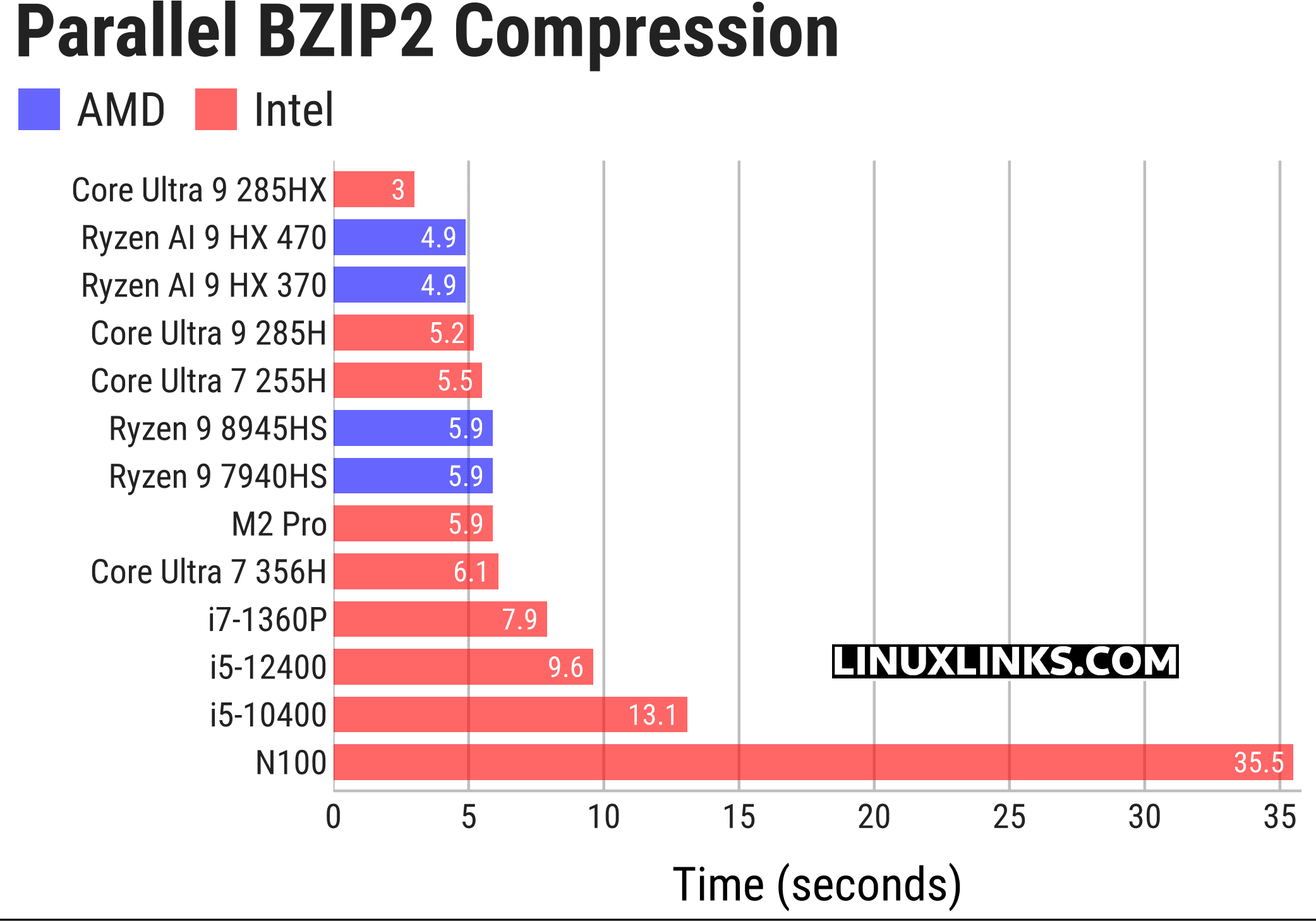
$ phoronix-test-suite benchmark compress-pbzip2pbzip2 compresses data using multiple threads. This test measures how long it takes to compress a Linux kernel source archive. Lower is better.
The M2 Pro completes the benchmark in 5.9 seconds, marginally ahead of the 356H at 6.1 seconds. Both Ryzen AI systems finish in 4.9 seconds, making the M2 Pro around 20% slower. As with the other CPU benchmarks, memory speed has little influence on performance. I’ve demonstrated this in previous testing, where upgrading a system from single-channel to dual-channel memory produced virtually identical results.
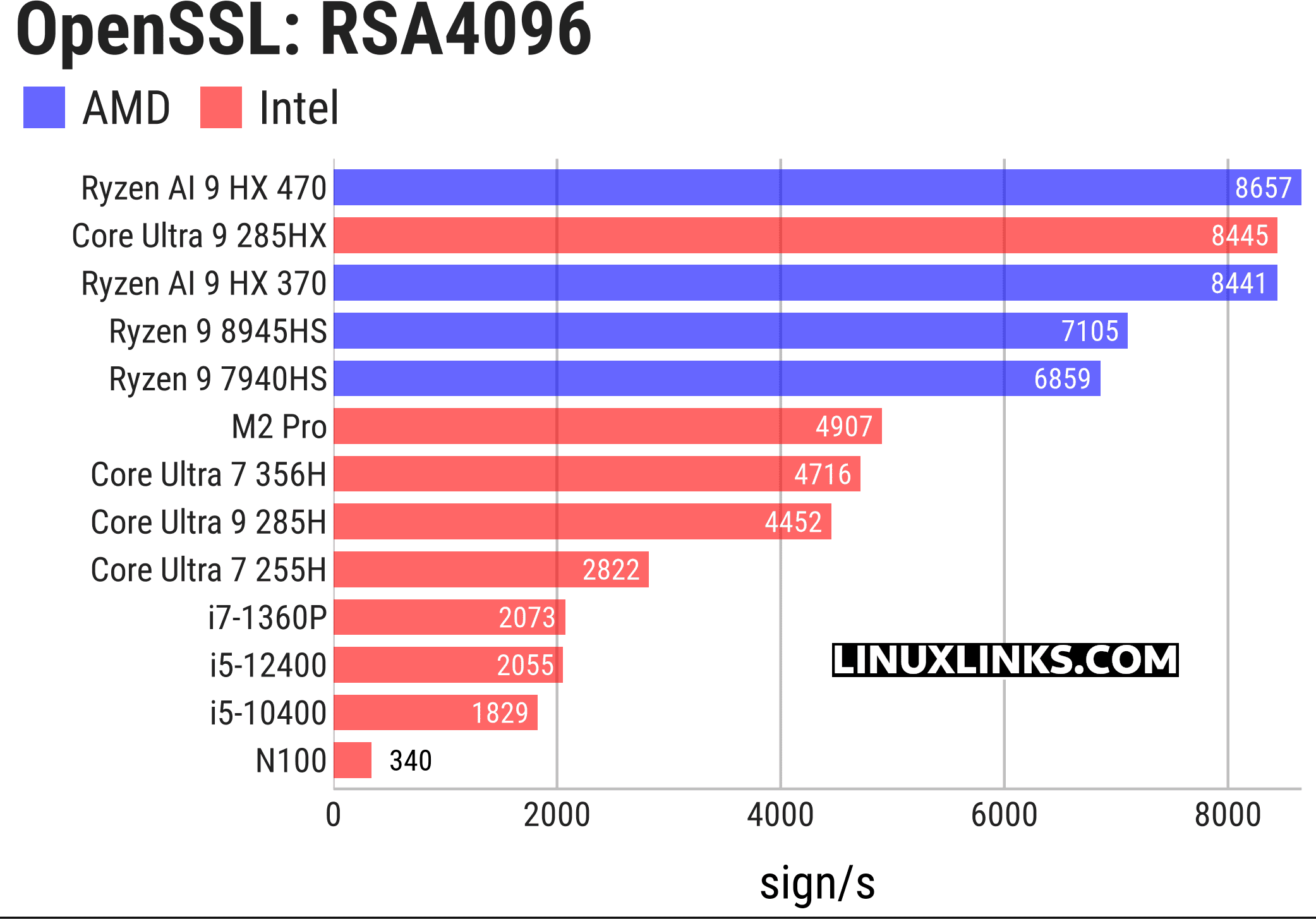
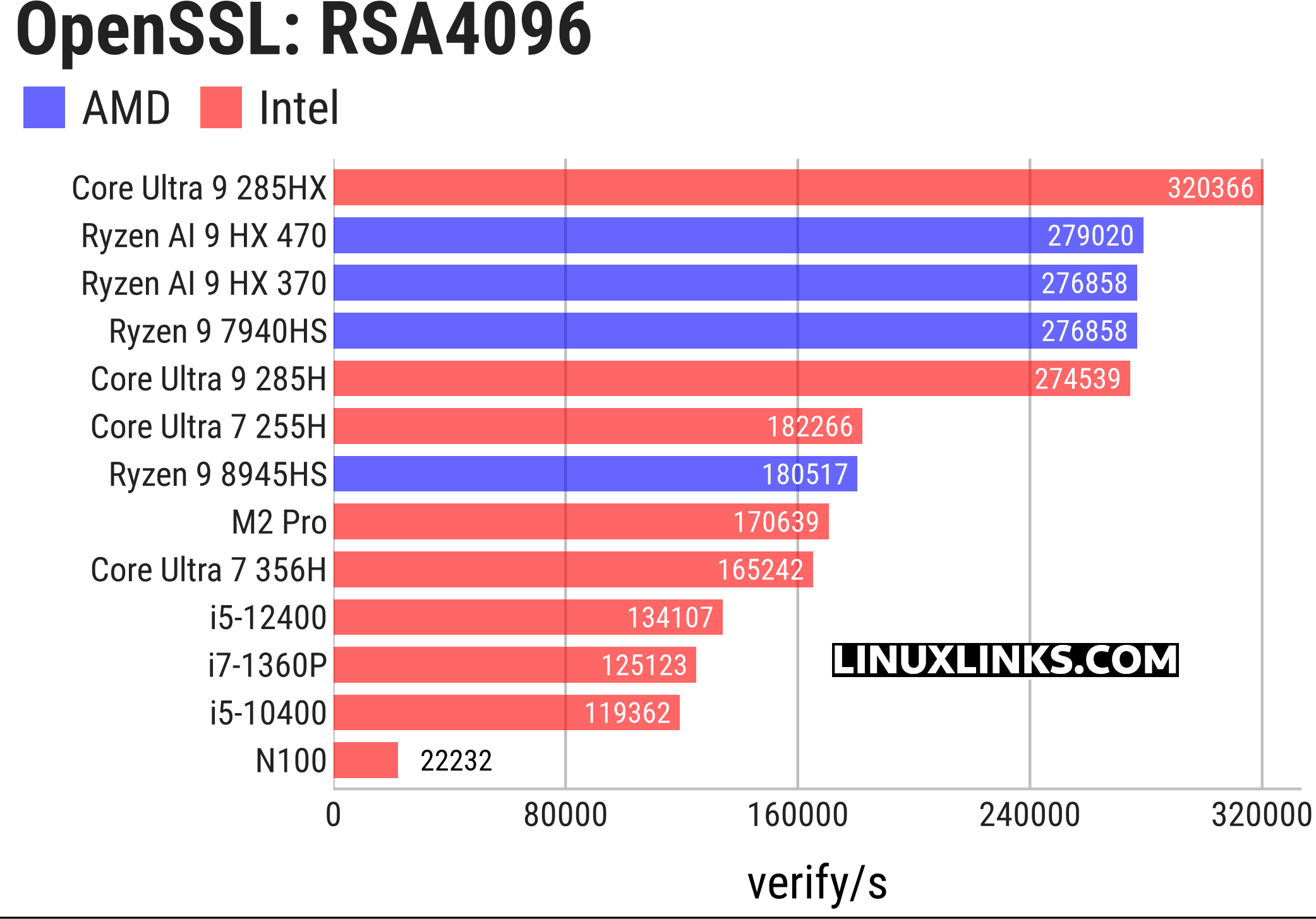
$ phoronix-test-suite benchmark opensslThe OpenSSL tests measure RSA-4096 signing and verification rates. These are separate operations, so a processor’s position can differ between the two charts. Higher is better in both.
The M2 Pro achieves 4,907 signing operations and 170,639 verification operations per second, around 4% and 3% ahead of the 356H respectively. The Ryzen AI processors have a much clearer lead: both deliver over 8,400 signing operations and 276,000 verification operations per second. RSA-4096 is a strong workload for the AMD systems in this comparison.
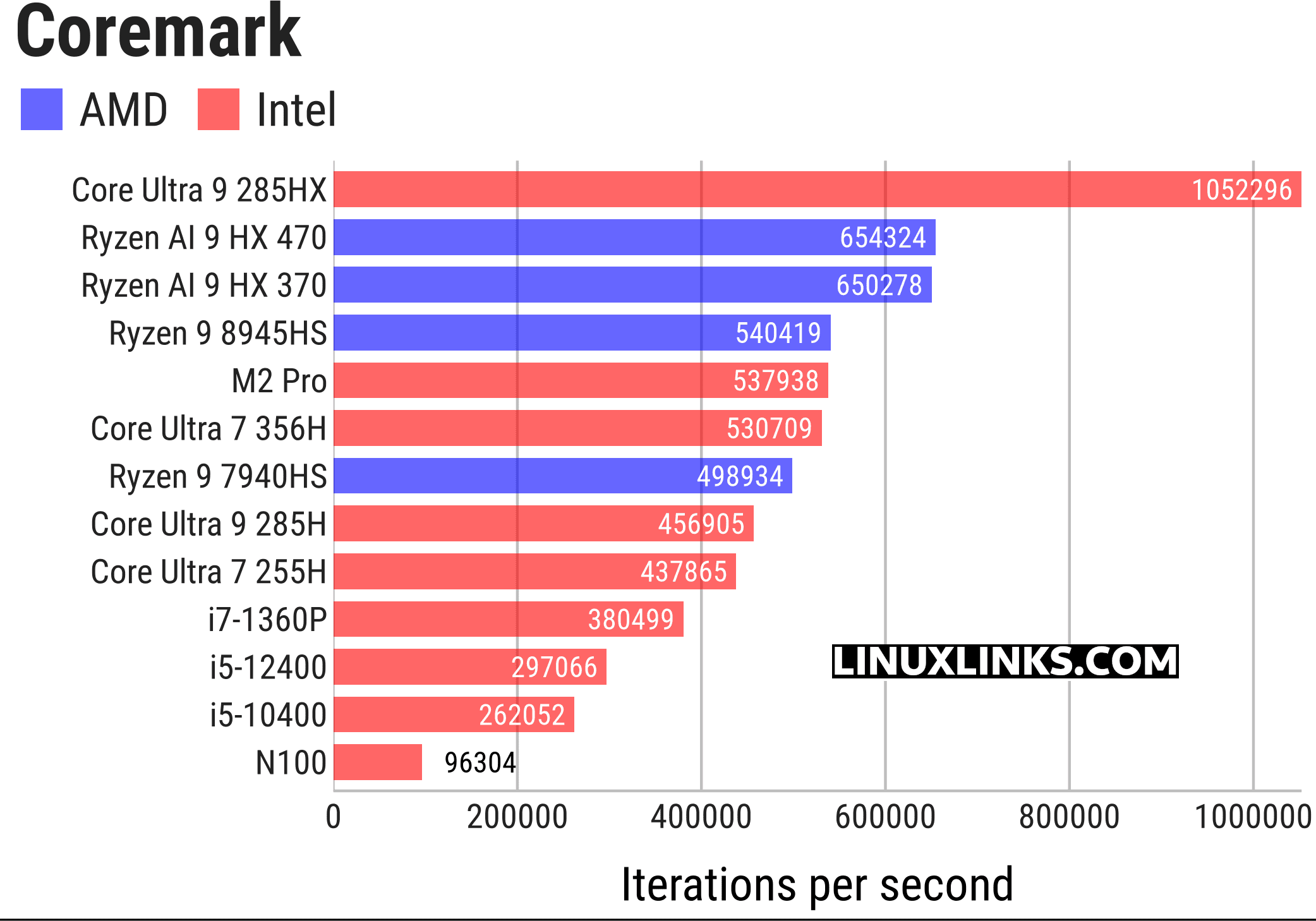
$ phoronix-test-suite benchmark coremarkCoreMark exercises integer processing through tasks including list handling, matrix operations, and CRC calculations. Results are expressed in iterations per second, with higher scores indicating better performance.
At 537,938 iterations per second, the M2 Pro is only 1.4% ahead of the 356H. The HX 370 and HX 470 deliver around 650,000 iterations per second, giving them roughly a 21% to 22% advantage. Once again, the two Panther Lake systems perform much alike.
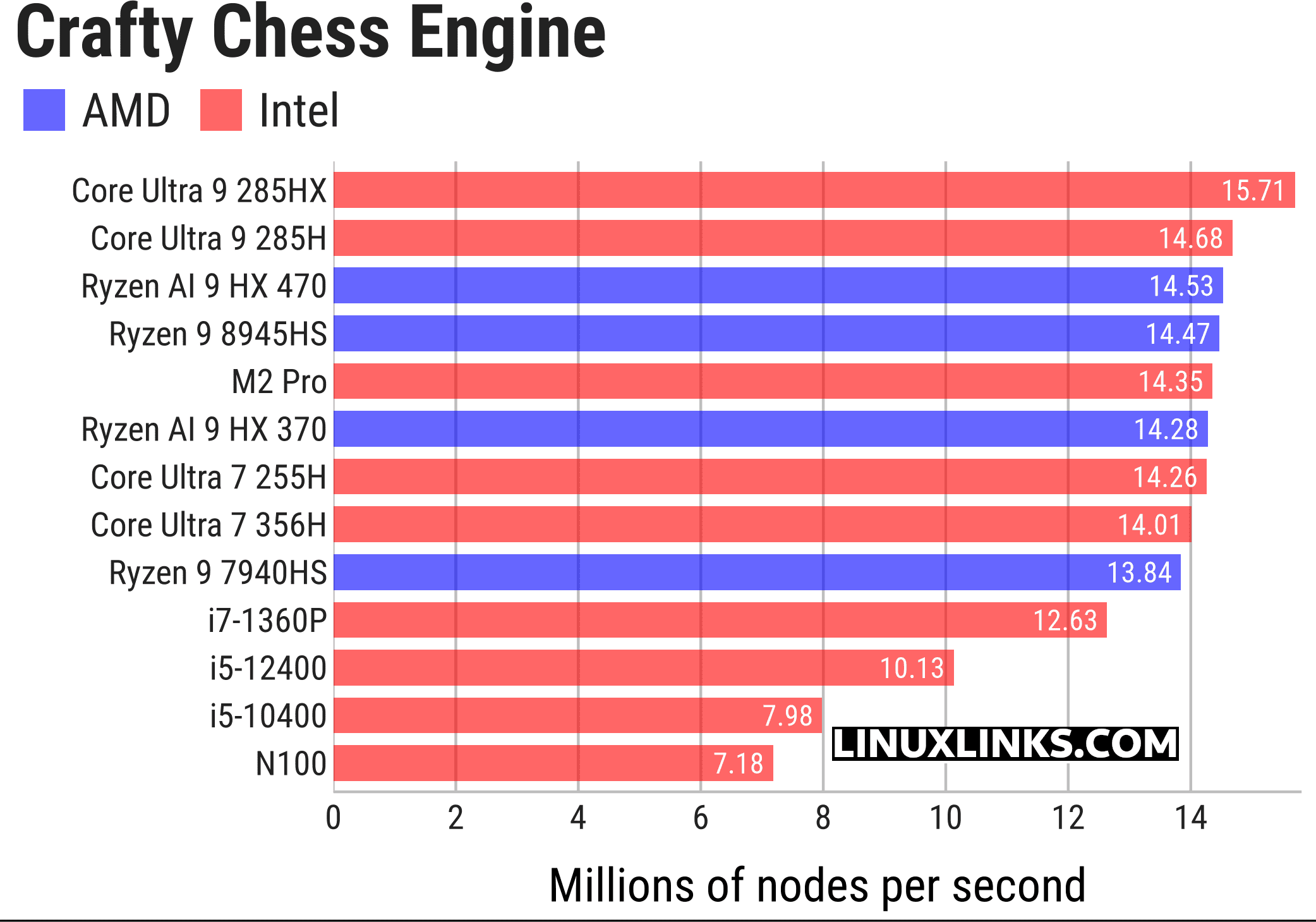
$ phoronix-test-suite benchmark craftyCrafty provides a single-core chess benchmark, offering a different perspective from the heavily threaded tests above. It helps show how quickly a processor handles work that cannot benefit from additional cores. Higher is better.
The M2 Pro reaches 14.35 million nodes per second, around 2.4% ahead of the 356H. It falls between the HX 370 at 14.28 and the HX 470 at 14.53. Those differences are small: in this single-core test, the M2 Pro is effectively keeping pace with both Ryzen AI systems.
Pages in this article:
Page 1 – Introduction / Processor
Page 2 – Graphics
Page 3 – Memory
Page 4 – Disk and Summary
Complete list of articles in this series:
| MINISFORUM M2 Pro-358H | |
|---|---|
| Introduction | Introduction to the series and interrogation of the machine |
Please read our Comment Policy before commenting.