
Object–relational mapping (ORM) is a programming technique for converting data between incompatible type systems using object-oriented programming languages. This creates, in effect, a “virtual object database” that can be used from within the programming language.
In essence, ORM is a design pattern for converting (wrapping) that data stored within a relational database into an object that can be used within an object oriented language. It creates a layer between the language and the database, helping programmers work with data without the OOP paradigm.
Compared to traditional techniques of exchange between an object-oriented language and a relational database, ORM often reduces the amount of code that needs to be written. It standardizes interfaces reducing boilerplate and speeding development time. Advocates of ORMs claim they increase productivity, improve application design, reuse code and maintain the application over time. On the other hand, ORM suffers the disadvantage of the abstraction obscuring what’s happening in the code. And over-use of ORM software can produce poorly designed databases.
There is a good range of ORM software available. Here are our recommendations summarized in a legendary ratings chart.
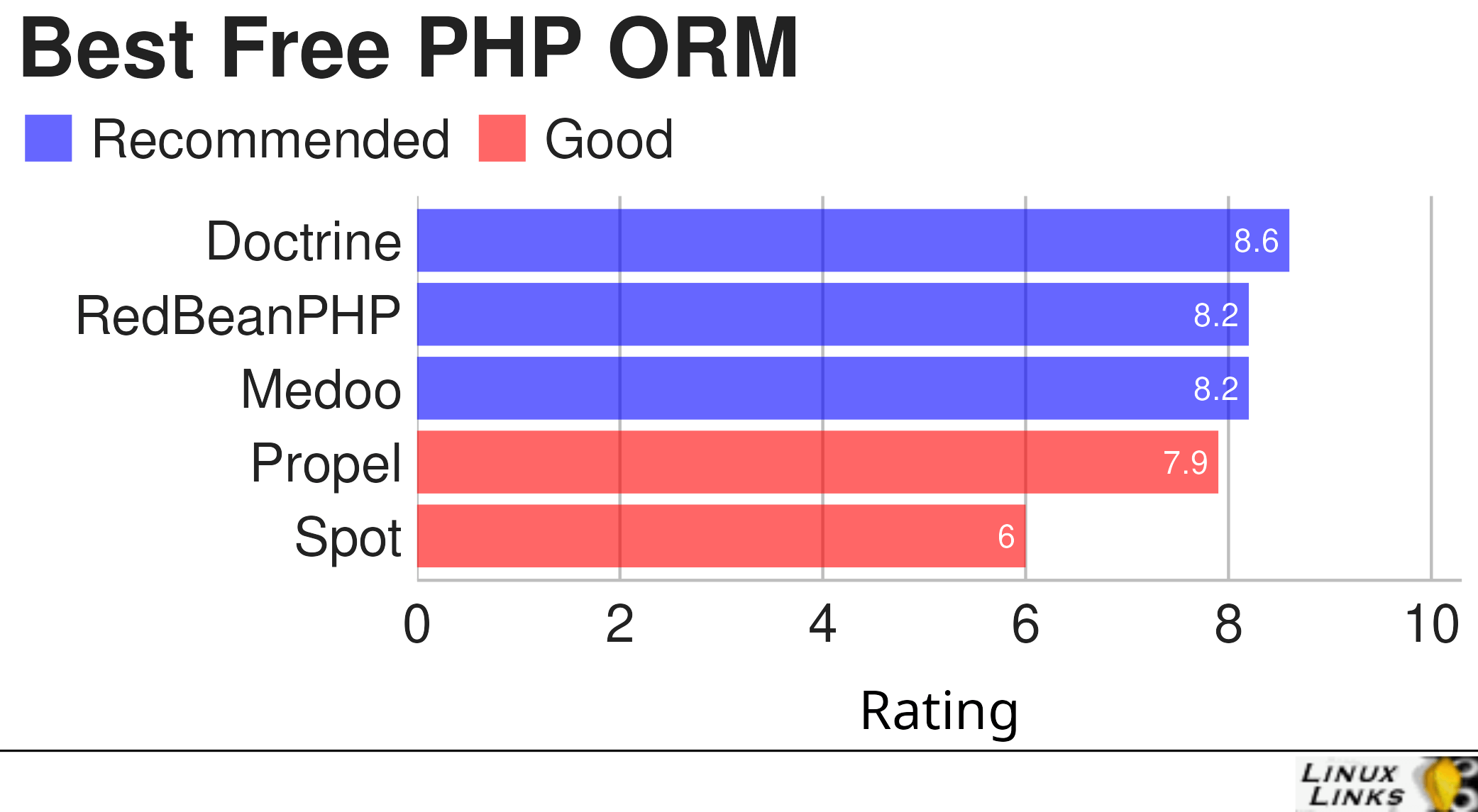
Let’s explore the 5 ORM tools for PHP. For each program we have compiled its own portal page, a full description with an in-depth analysis of its features, together with links to relevant resources.
| Object-Relational Mapping Software for PHP | |
|---|---|
| Doctrine | Focused on providing persistence services and related functionality |
| RedBeanPHP | On-the-fly object mapper, especially suited for RAD, prototyping |
| Medoo | Lightweight PHP database framework |
| Propel | Customizable and fast ORM library |
| Spot | Simple and efficient DataMapper built on Doctrine DBAL |
Many full stack frameworks provide their own database abstraction approaches or ORMs. so they are not included here. For example, Laravel, CakePHP, CodeIgniter include an ORM. Read about them in our PHP web frameworks roundup.
 Explore our carefully curated directory of recommended free and open source software, covering every major software category. Explore our carefully curated directory of recommended free and open source software, covering every major software category.The directory forms part of our extensive collection of articles for Linux enthusiasts. It includes hundreds of detailed reviews, together with free and open source alternatives to proprietary software from companies such as Google, Microsoft, Apple, Adobe, IBM, Cisco, Oracle, and Autodesk. LinuxLinks also covers interesting projects worth exploring, Linux-compatible hardware, free programming books and tutorials, and much more. Know a useful free and open source Linux application that we haven’t covered? Tell us about it using our submission form. |
Please read our Comment Policy before commenting.
Hi, Good article