

Malware sandboxes provide a controlled environment for examining suspicious software without exposing the host system to unnecessary risk. They help security researchers observe behaviour, inspect system changes, capture network activity, and identify indicators of compromise.
The tools covered here support approaches including hardware-assisted isolation, virtual machines, automated dynamic analysis, and static inspection. They are useful for investigating potentially malicious executables, understanding how malware behaves, and supporting threat analysis and incident response.
Here’s our verdict captured in a legendary LinuxLinks-style ratings chart. Only free and open source software is eligible for inclusion here.
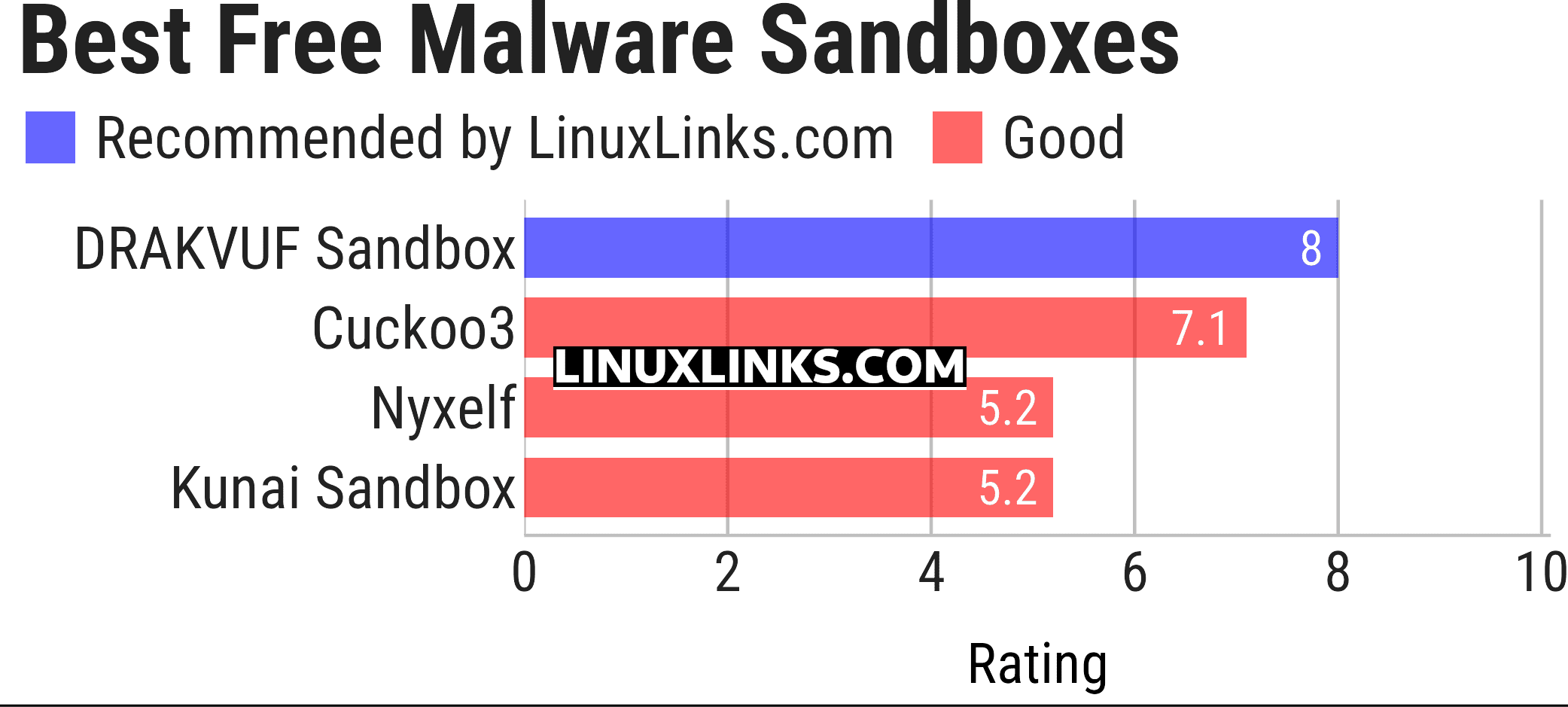
Click the links in the table below to learn more about each program.
| Malware Sandboxes | |
|---|---|
| DRAKVUF Sandbox | Agentless malware analysis using hardware virtualization |
| Cuckoo3 | Automated malware analysis sandbox |
| Nyxelf | Static and dynamic analysis of ELF malware |
| Kunai Sandbox | QEMU-based platform for dynamic malware analysis |
 LinuxLinks helps you discover the best free and open source software for Linux. Explore our extensive collection of recommended applications, including alternatives to popular proprietary software. We also publish software reviews, Linux tutorials, hardware reviews, free programming books and articles covering the wider open source community. Browse our Linux resources to discover more. Know a useful free and open source Linux application we haven't covered? Suggest a program for inclusion. Has your software been featured on LinuxLinks? Display one of our Featured on LinuxLinks badges on your website or GitHub README. |
Please read our Comment Policy before commenting.