

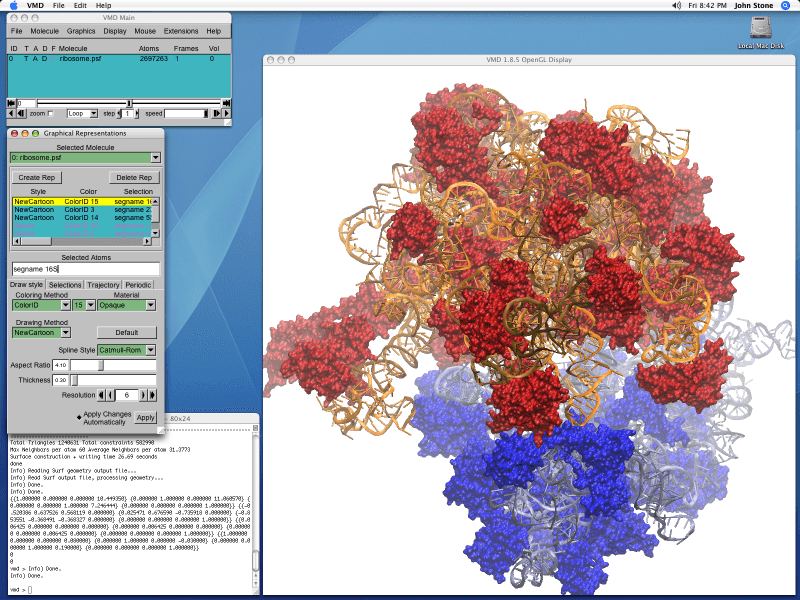
VMD is a molecular visualization program for displaying, animating, and analyzing large biomolecular systems using 3-D graphics and built-in scripting.
It can be used to view more general molecules, as VMD reads standard Protein Data Bank (PDB) files and display the contained structure. VMD provides a wide variety of methods for rendering and coloring molecule.
VMD can be used to animate and analyze the trajectory of molecular dynamics (MD) simulations, and can interactively manipulate molecules being simulated on remote computers (Interactive MD).
Key Features
- Support for GPU accelerated computation.
- No limits on the number of molecules, atoms, residues or number of trajectory frames, except available memory.
- Rendering mode which supports scene capture with Adobe Acrobat3D, allowing researchers to create PDF documents containing 3-D scenes from VMD.
- Many molecular rendering and coloring methods including support for high-quality molecular scene rendering using Tachyon, NVIDIA Gelato, and PIXAR RenderMan.
- Stereo display capability.
- Extensive atom selection syntax for choosing subsets of atoms for display (includes boolean operators, regular expressions, and more).
- Support for over 60 molecular file formats and data types through an extensive library of built-in file reader/writer plugins and translators VMD includes a multiple sequence alignment plugin, a unified bioinformatics analysis environment that allows one to organize, display, and analyze both sequence and structure data for proteins and nucleic acids.
- Ability to export displayed graphics to files which may be processed by a number of popular ray tracing and image rendering packages, including POV-Ray, Rayshade, Raster3D, and Tachyon.
- User-extensible graphical and text-based user interfaces, built-on standard Tcl/Tk and Python scripting languages.
- Extensions to the Tcl language which enable researchers to write their own routines for molecular analysis.
- Modular, extensible source code using an object-oriented design in C++, with a programmers guide describing the program architecture and source code.
- Integration with the program NAMD, a fast, parallel, and scalable molecular dynamics program.
- VMD tutorials developed locally, and by the research community at large.
Website: www.ks.uiuc.edu/Research/vmd
Support: Documentation
Developer: University of Illinois at Urbana-Champaign
License: Freeware
VMD is written in C++. Learn C++ with our recommended free books and free tutorials.
Related Software
| Biology Tools | |
|---|---|
| EMBOSS | The European Molecular Biology Open Software Suite |
| NAMD | Parallel, object-oriented molecular dynamics |
| GROMACS | Molecular dynamics simulator, with building and analysis tools |
| VMD | Displays, animates, and analyzes large biomolecular systems 3-D graphics |
| simuPOP | Forward-time population genetics simulation environment |
| MUSCLE | MUltiple Sequence Comparison by Log-Expectation |
| SeaView | Graphical user interface for molecular phyologeny |
| SeqViz | DNA, RNA, and protein sequence viewer |
| TREE-PUZZLE | Reconstruction of phylogenetic trees by maximum likelihood |
| TreeView X | Displays and prints phylogenetic trees |
| CellProfiler | Image analysis application for researchers |
| napari | Python-based image viewer |
| COPASI | Biochemical systems simulator |
| VCell | Modeling and simulation framework |
| NEURON | Build and run biophysically detailed models |
| NEST | Simulator for spiking neural network models |
Read our verdict in the software roundup.
 Explore our comprehensive directory of recommended free and open source software. Our carefully curated collection spans every major software category. Explore our comprehensive directory of recommended free and open source software. Our carefully curated collection spans every major software category.This directory is part of our ongoing series of informative articles for Linux enthusiasts. It features hundreds of detailed reviews, along with open source alternatives to proprietary solutions from major corporations such as Google, Microsoft, Apple, Adobe, IBM, Cisco, Oracle, and Autodesk. You’ll also find interesting projects to try, hardware coverage, free programming books and tutorials, and much more. Discovered a useful open source Linux program that we haven’t covered yet? Let us know by completing this form. |
Please read our Comment Policy before commenting.