

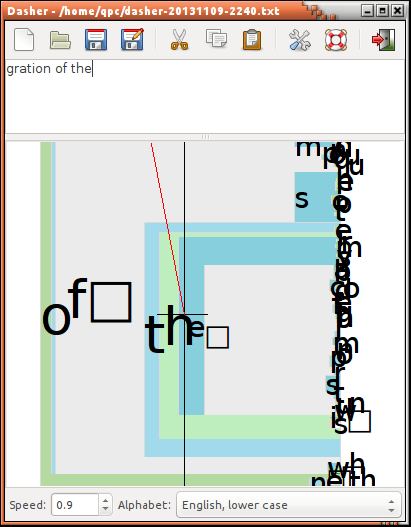
Dasher is an open source information-efficient text-entry interface, driven by natural continuous pointing gestures.
Dasher is a zooming predictive text entry system designed for situations where keyboard input is not practical (for accessibility reasons, on a palmtop or wearable computer, when operating a computer one-handed, by joystick, touchscreen, trackball, mouse or when operating a computer with no hands (i.e. by head-mouse or by eyetracker).
The eyetracking version of Dasher allows an experienced user to write text as fast as normal handwriting – 25 words per minute; using a mouse, experienced users can write at 39 words per minute.
Dasher uses a more advanced prediction algorithm than the T9 system often used in mobile phones, making it sensitive to surrounding context.
Dasher is designed to help people with physical difficulties and therefore this is where it is most accessible.
A new version is under development which is Electron based.
Key Features
- Employs an intelligent prediction engine.
- Mode-free: the user does not need to switch from a writing mode to an “accept-model-predictions” mode.
- Easy to train the model on any writing style.
- Two-push, one button, dynamic mode.
- Alphabet descriptions for over 150 languages.
- Letter colours settings.
- Training files in all languages.
- Support for USB joystick control.
Website: www.inference.org.uk/dasher
Support: GitHub Code Repository
Developer: The Dasher Project
License: GNU GPL v2
Dasher v5 is written in C and C++. Learn C with our recommended free books and free tutorials. Learn C++ with our recommended free books and free tutorials.
Dasher v6 is written in JavaScript. Learn JavaScript with our recommended free books and free tutorials.
Related Software
| Universal Access Tools | |
|---|---|
| Orca Screen Reader | Scriptable screen reader |
| Liblouis | Braille translator, back-translator and formatter |
| Florence Virtual Keyboard | Extensible scalable virtual keyboard |
| Speakup | Kernel-based speech synthesizer driver suite |
| BRLTTY | Gives a braille user access to the text consoles |
| Maliit | Virtual keyboard implemented as a plug-in for Maliit Framework |
| keymapper | Context-aware key remapping with layers, shortcuts and macros |
| Julius | Two-pass large vocabulary continuous speech recognition engine |
| Emacspeak | Emacs extension that provides spoken output |
| Mouse actions | Execute commands from mouse events |
| squeekboard | Keyboard-shaped input method supporting Wayland |
| GOK | GNOME On Screen Keyboard |
| CoreKeyboard | Simple virtual keyboard with word suggestions |
| Dasher | Graphical predictive text input system |
| borse | Practice braille, Morse, semaphore |
| KMouseTool | Clicks automatically when the mouse pointer pauses |
| KMouth | Speech aid that turns typed text into spoken words and phrases |
Read our verdict in the software roundup.
 Explore our carefully curated directory of recommended free and open source software, covering every major software category. Explore our carefully curated directory of recommended free and open source software, covering every major software category.The directory forms part of our extensive collection of articles for Linux enthusiasts. It includes hundreds of detailed reviews, together with free and open source alternatives to proprietary software from companies such as Google, Microsoft, Apple, Adobe, IBM, Cisco, Oracle, and Autodesk. LinuxLinks also covers interesting projects worth exploring, Linux-compatible hardware, free programming books and tutorials, and much more. Know a useful free and open source Linux application that we haven’t covered? Tell us about it using our submission form. |
Please read our Comment Policy before commenting.