

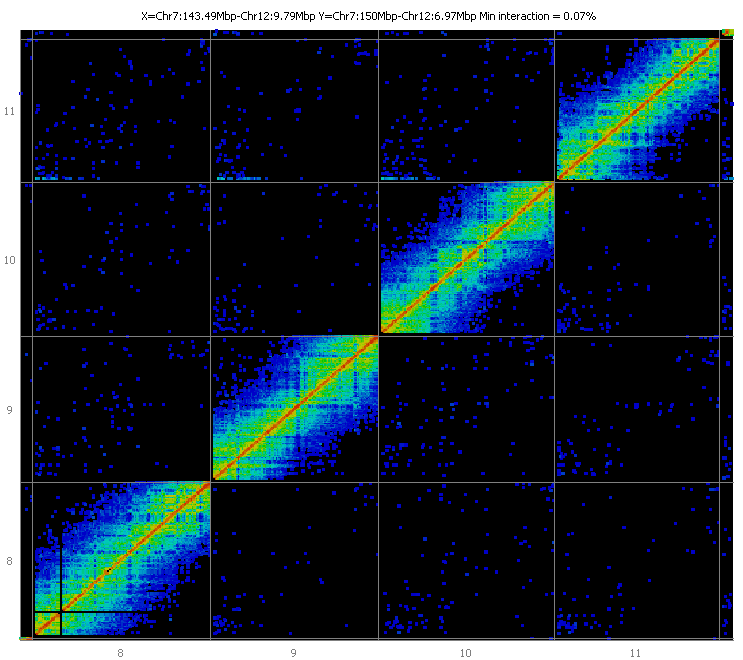
SeqMonk is a Java application for visualising and analysing mapped sequence data.
It’s designed for high throughput sequencing experiments and works with datasets that can be represented as genomic positions, letting users explore aligned reads against annotated genomes and carry out downstream quantitative and statistical analysis within the same program.
This is free and open source software.
Key Features
- Imports mapped sequence data from formats such as BAM, SAM, and Bowtie.
- Creates data groups to support visualisation and comparative analysis workflows.
- Quantitates mapped data flexibly so different datasets can be compared.
- Performs statistical analyses to identify regions of interest.
- Generates reports containing both experimental data and genome annotation.
- Some functionality can make use of a local R installation.
Website: www.bioinformatics.babraham.ac.uk/projects/seqmonk/
Support:
Developer: Babraham Bioinformatics / Simon Andrews
License: GNU General Public License v3.0
SeqMonk is written in Java. Learn Java with our recommended free books and free tutorials.
Related Software
| Desktop Genome Browsers | |
|---|---|
| IGV | High-performance visualization genome browser tool |
| IGB | Integrated Genome Browser |
| JBrowse | Fast, scalable genome browser |
| Tablet | Graphical viewer for sequence assemblies and alignments |
| UGENE | Set of integrated bioinformatics software |
| Artemis | Genome viewer and annotation tool |
| Apollo | Instantaneous, collaborative genomic annotation editor |
| SeqMonk | Visualise and analyse high throughput mapped sequence data |
| GW | Fast browser for genomic sequencing data |
| CutePeaks | Cross platform Sanger Trace file viewer |
| ASCIIGenome | Text only genome browser |
| Genome Workbench | Integrated tools for studying and analyzing genetic data |
Read our verdict in the software roundup.
 Explore our carefully curated directory of recommended free and open source software, covering every major software category. Explore our carefully curated directory of recommended free and open source software, covering every major software category.The directory forms part of our extensive collection of articles for Linux enthusiasts. It includes hundreds of detailed reviews, together with free and open source alternatives to proprietary software from companies such as Google, Microsoft, Apple, Adobe, IBM, Cisco, Oracle, and Autodesk. LinuxLinks also covers interesting projects worth exploring, Linux-compatible hardware, free programming books and tutorials, and much more. Know a useful free and open source Linux application that we haven’t covered? Tell us about it using our submission form. |
Please read our Comment Policy before commenting.