

Gapless playback is one of those terms that sounds more technical than it really is. It simply means that one track moves into the next without an unwanted pause. For albums where songs are intended to flow together, that small detail can make a huge difference.
It is often associated with classical music, but the issue extends far beyond that. Live albums, electronic music, concept albums and progressive rock can all lose their continuity when a music player inserts silence between tracks. A carefully constructed transition can suddenly sound clumsy and disjointed.
For me, gapless playback is not an optional extra. It is close to essential. A music player may have an attractive interface and a long list of features, but if it interrupts albums with artificial gaps, I am unlikely to keep using it.
When I originally reviewed mpz, the lack of gapless playback was one of the application’s most noticeable weaknesses. The developer has recently added the feature, which gave me a good reason to return to mpz and see how the player has developed.
This follow-up is intended to be read alongside my original LinuxLinks review of mpz.
Installation
The simplest way to install mpz is probably to use the developer’s AppImage. You may find your distro has a package. For example, there’s a PKGBUILD available in the Arch User Repository for Arch and Arch-based Linux distributions. As the software is open source, you can also compile the source code.
In Operation
The latest release has added some really useful functionality.
- Gapless playback for Qt 6 builds, with a configurable decoded-audio buffer.
- A 10-band and parametric equalizer, including support for AutoEq presets and per-output-device settings.
- A dedicated Radio library, HTTPS stream support and improved Icecast metadata handling.
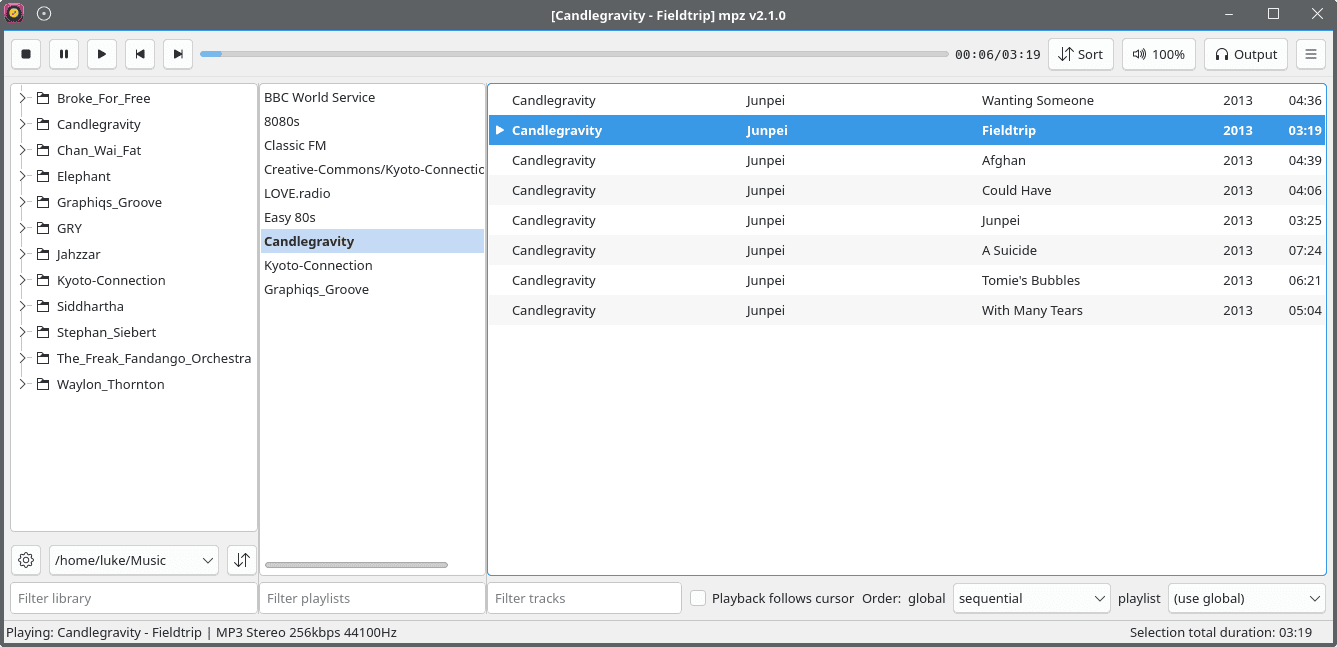
mpz’s gapless implementation is technically strong for normal album playback. It prebuffers the next track and feeds matching-format tracks through the same audio sink, so transitions are genuinely seamless rather than merely shortened.
The main caveat is that tracks with different sample rates, channel layouts or sample formats require the audio sink to restart, so those transitions may contain a small interruption. I would describe it as good gapless playback, provided adjacent tracks use compatible audio formats.
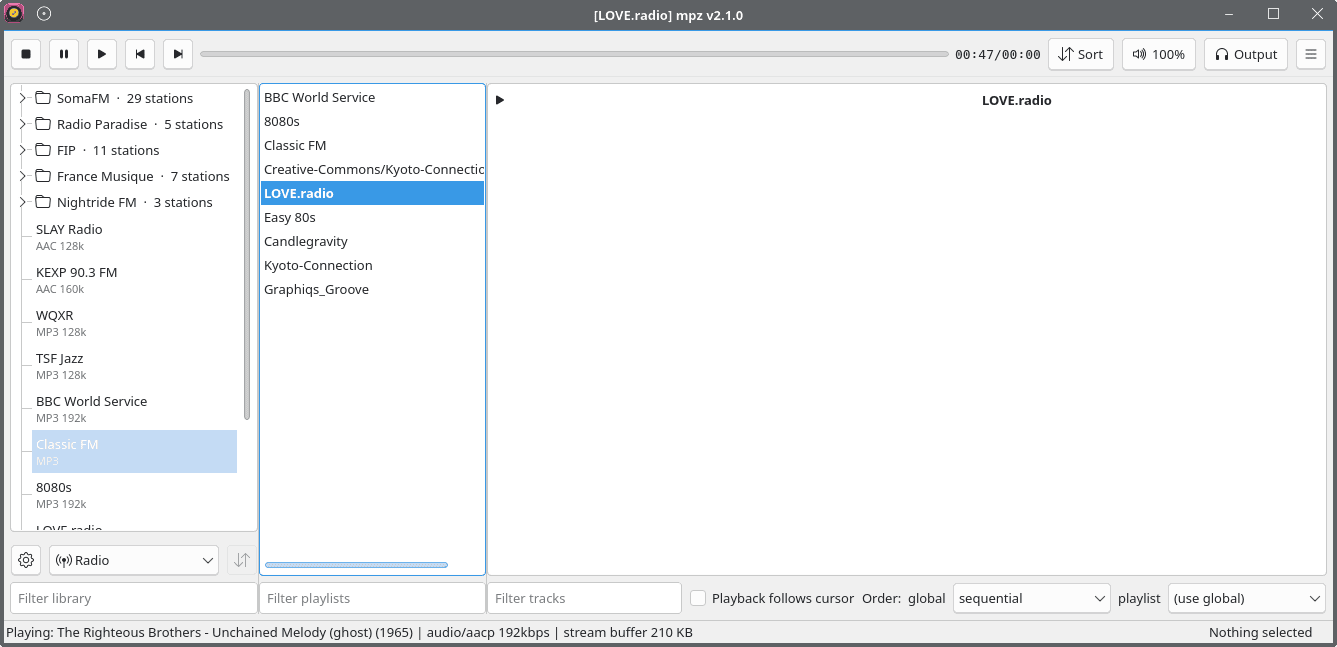
Internet radio support is another welcome addition. mpz’s internet radio functionality is good for a music player whose main focus is local collections, but it is not a complete radio-discovery platform.
Its strengths are substantial: it includes a built-in, grouped station catalogue; lets users add, edit and remove stations; accepts direct URLs and local or remote M3U/M3U8/PLS playlists; and displays ICY station and track metadata. Its custom streaming engine supports HTTP and HTTPS, configurable buffering, chunked transfers, authentication and sensible timeout handling.
The main weaknesses are that it lacks a searchable online station directory, resolves only the first usable stream in a playlist, and does not appear to reconnect automatically after a dropped connection. Instead, a failed stream is drained and playback advances or stops.
Overall, I would call it well implemented and more capable than a token radio feature, particularly for users who already know which stations they want. It falls short of specialist applications such as Shortwave or Tuner for discovering and browsing thousands of stations.
Summary
mpz has developed into a much stronger music player, with effective gapless playback, a capable equalizer and useful internet radio support.
Its gapless implementation works particularly well, while the radio features are solid but lack extensive station discovery. The best approach would be to add a Discover section alongside mpz’s existing Radio library, backed by the open Radio Browser directory.
mpz is now easy to recommend, especially for users with large locally stored music collections.
Website: github.com/olegantonyan/mpz
Support:
Developer: Oleg Antonyan
License: GNU General Public License Version 3.0
mpz is written in C++. Learn C++ with our recommended free books and free tutorials.
Please read our Comment Policy before commenting.