

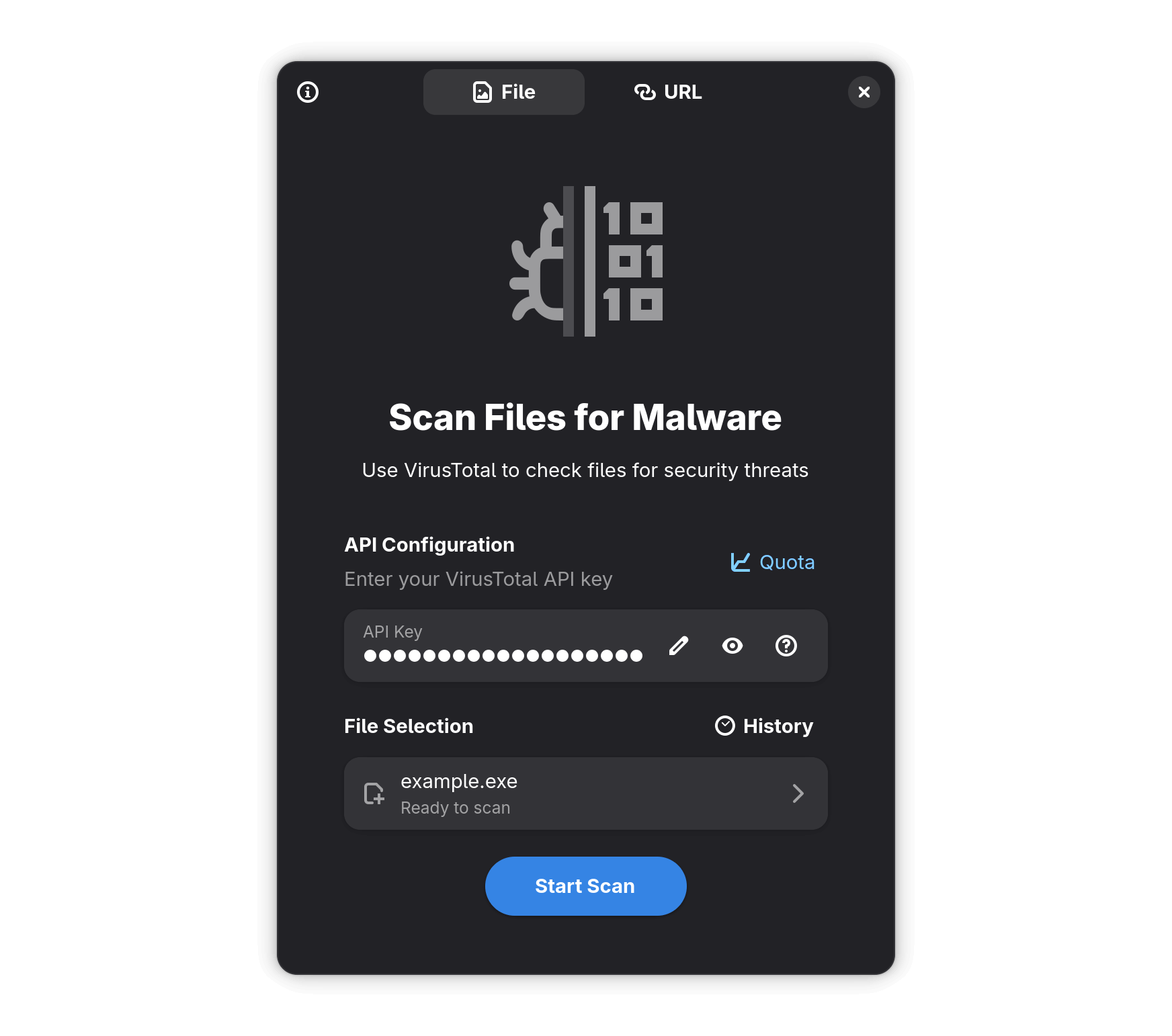
Lenspect is a graphical application for investigating suspicious files and URLs through VirusTotal. It presents results from the service in a GTK and libadwaita interface designed for the Linux desktop.
The application requires an internet connection and a VirusTotal API key. For file checks, it calculates a hash and looks for an existing analysis. If no report exists, it uploads the file for scanning. This distinction matters when checking confidential material: analysis is not confined to the local computer.
Lenspect provides on-demand investigation rather than continuous antivirus protection. Its results help users examine available evidence, including individual vendor detections, instead of relying solely on a single overall classification.
This is free and open source software.
Key Features
- Check web addresses as well as local files, with separate modes for each type of investigation.
- Select files through a file chooser, drag and drop, or desktop file-opening integration.
- Request fresh analysis of previously checked files and URLs.
- Display detection totals and results reported by individual security vendors.
- Inspect file properties, submission dates, community scores and available threat labels.
- View and copy file hashes for use in other investigation tools.
- Examine URL categories, HTTP response codes and redirect information where available.
- Display sandbox verdicts and additional analysis information returned by VirusTotal.
- Keep separate file and URL histories and reopen their reports.
- Export analysis reports as text files or open the corresponding VirusTotal report.
- Show API quota usage and notifications when usage thresholds are reached.
- Continue an ongoing scan in the background and provide result notifications.
- Store API credentials through the desktop secret service when available.
Website: github.com/vmkspv/lenspect
Support:
Developer: Vladimir Kosolapov
License: GNU General Public License v3.0
Lenspect is written in Python. Learn Python with our recommended free books and free tutorials.
Related Software
| Anti-Malware Tools | |
|---|---|
| ClamAV | Antivirus engine for detecting trojans, viruses, malware and other threats |
| YARA-X | Re-incarnation of YARA |
| YARA | Pattern matching swiss knife for malware researchers |
| Maltrail | Malicious traffic detection system |
| ClamTk | Graphical frontend for ClamAV |
| LMD | Malware scanner focusing on threats faced in shared hosted environments |
| phpMussel | PHP-based anti-virus anti-trojan anti-malware solution |
| Raspirus | Lightweight signature-based malware scanner |
| FastFinder | Fast suspicious file finder |
| chkrootkit | Locally checks for signs of a rootkit |
| Unhide | Forensic tool to find hidden processes and TCP/UDP ports |
| Atomdrift Scan | Malware and supply chain scanner for software security |
| paranoya | Malware scanner using indicators of compromise and YARA rules |
| decloaker | Security tool for revealing objects concealed by malware |
| Lenspect | Lightweight security threat scanner |
Read our verdict in the software roundup.
 Explore our carefully curated directory of recommended free and open source software, covering every major software category. The directory forms part of our extensive collection of articles for Linux enthusiasts. It includes hundreds of detailed reviews, together with free and open source alternatives to proprietary software from companies such as Google, Microsoft, Apple, Adobe, IBM, Cisco, Oracle, and Autodesk. LinuxLinks also covers interesting projects worth exploring, Linux-compatible hardware, free programming books and tutorials, and much more. Know a useful free and open source Linux application that we haven’t covered? Tell us about it using our submission form. |
Please read our Comment Policy before commenting.