

A news aggregator gathers news, blog posts, and other web content into one place, making it easier to follow updates from many different sources. Given the huge number of news sites and blogs online, these tools are invaluable for quickly spotting important developments and breaking stories.
They’re especially useful for people who follow lots of blogs, as they remove the hassle of checking each site individually. That’s particularly helpful when some blogs are updated only occasionally.
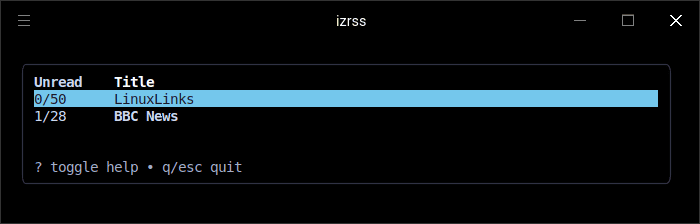
izrss is a terminal-based RSS feed reader written in Go. Its keyboard-driven interface presents subscribed feeds with their unread counts before letting you drill down into individual posts.
Installation and Configuration
Let’s build the program manually on CachyOS, a popular Arch-based distribution.
$ sudo pacman -S --needed base-devel git go
On my system, these packages are already installed.
Next, clone the project’s repository.
$ git clone --branch v0.4.0 --depth 1 https://github.com/isabelroses/izrss.git
Change into the newly created directory.
$ cd izrss
Build the software.
$ CGO_ENABLED=1 go build -trimpath -ldflags="-s -w -X main.Version=v0.4.0" -o izrss .
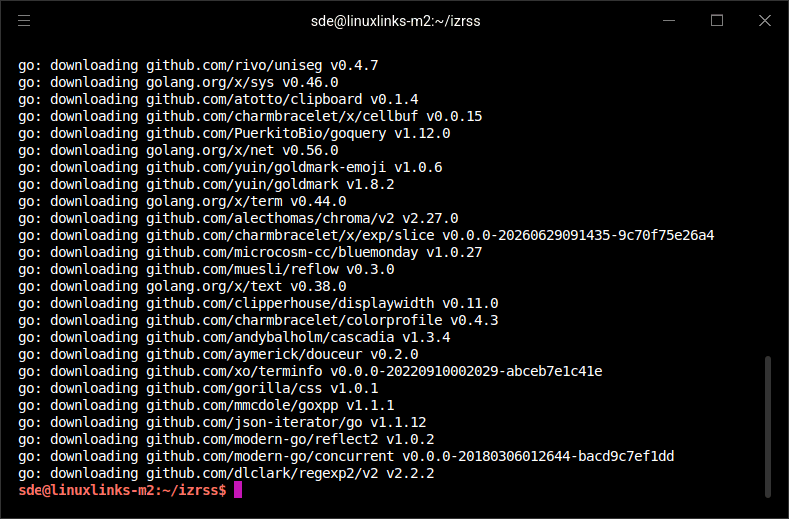
Install the program.
$ sudo install -Dm755 izrss /usr/local/bin/izrss
Configuration is handled through a TOML file.
urls = [

"https://www.linuxlinks.com/feed/",

"https://feeds.bbci.co.uk/news/rss.xml"

]
Launch the program with $ izrss.
In Operation
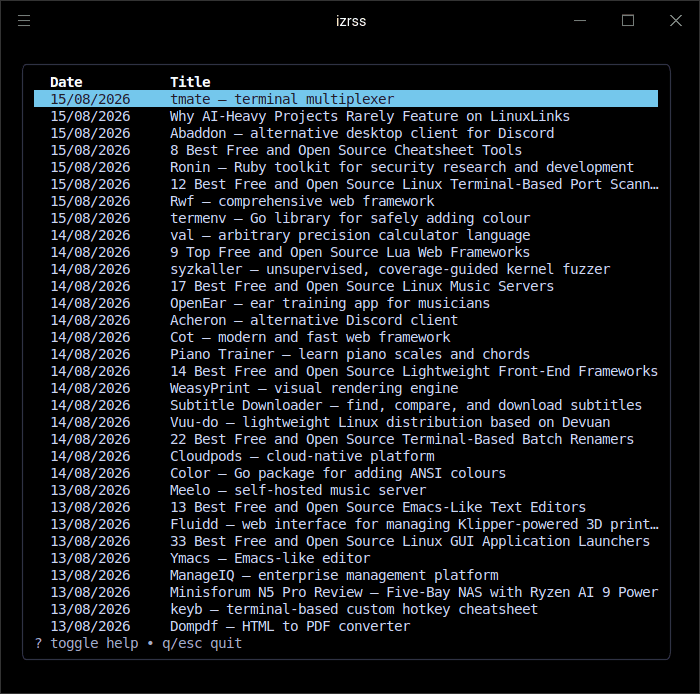
Articles are converted from HTML to Markdown and rendered directly in the terminal. They can also be opened in the system’s default web browser. izrss remembers read and unread status in a local SQLite database and caches feeds so the interface can open quickly while fresh content is retrieved in the background.
Key Features
- Keyboard-driven terminal interface.
- Displays unread and total post counts for each feed.
- Sorts posts with the newest entries first.
- Searches across article content.
- Marks individual posts or an entire feed as read.
- Persists read status using SQLite.
- Caches feeds for faster startup.
- Refreshes individual feeds or all subscriptions.
- Renders article content as styled Markdown.
- Opens posts in the default web browser.
- Configurable colours, article width, date format and reading threshold.
- Supports custom Glamour themes.
- Reports the total unread count from the command line.
- Vim-style and arrow-key navigation.
Summary
izrss is a straightforward and attractive terminal RSS reader. It is easy to navigate, starts quickly, and reliably remembers which articles have been read. Its feature set is fairly limited: feeds must be managed through the configuration file, with no OPML support, feed organisation or synchronization. But if you only want a simple, keyboard-driven reader, izrss does the job well.
Website: github.com/isabelroses/izrss
Support:
Developer: Isabel Roses
License: GNU General Public License v3.0
izrss is written in Go. Learn Go with our recommended free books and free tutorials.
Linux has lots of terminal-based news aggregators. If izrss doesn’t meet your requirements, try one of these.
| Terminal-Based News Aggregators | |
|---|---|
| Newsboat | Snazzy RSS feed reader |
| Feedr | Polished Linux terminal-based RSS/Atom feed reader |
| Elfeed | Extensible web feed reader for Emacs, supporting both Atom and RSS |
| goread | Go-based news feed reader |
| gorss | Simple RSS/Atom reader written in Golang |
| Snownews | Text mode reader for RSS and Atom feeds written in C |
| tuifeed | News feed reader with a fancy terminal user interface |
| nom | RSS reader for the terminal written in Go |
| eilmeldung | Based on the awesome news-flash library |
| Newsraft | Greatly inspired by Newsboat and tries to be its lightweight counterpart |
| syndicationd | Keyboard-driven RSS and Atom reader with a clean interface |
| moccasin | TUI feed reader for RSS, Atom, and (eventually) Podcasts |
| izrss | Lightweight RSS reader focused on simplicity and speed |
| bulletty | Fast RSS and Atom reader with an uncluttered interface |
| CAST-text | Full-text RSS terminal reader |
| hys | RSS reader for digital minimalists |
| Feedln | Simple interface to view, update, and categorize feed |
| srss | Simple command-line news feed reader |
| newsroom | Modern CLI to get your favorite news |
| blogtato | RSS and Atom feed reader |
| Rivulet | Focuses on usability for users who prefer keyboard-driven tools |
| NewsGoat | Written in Go using the Bubble Tea TUI framework |
| Canto | Crank through feeds using a minimal, yet information packed interface |
Read our verdict in the software roundup.
Please read our Comment Policy before commenting.