

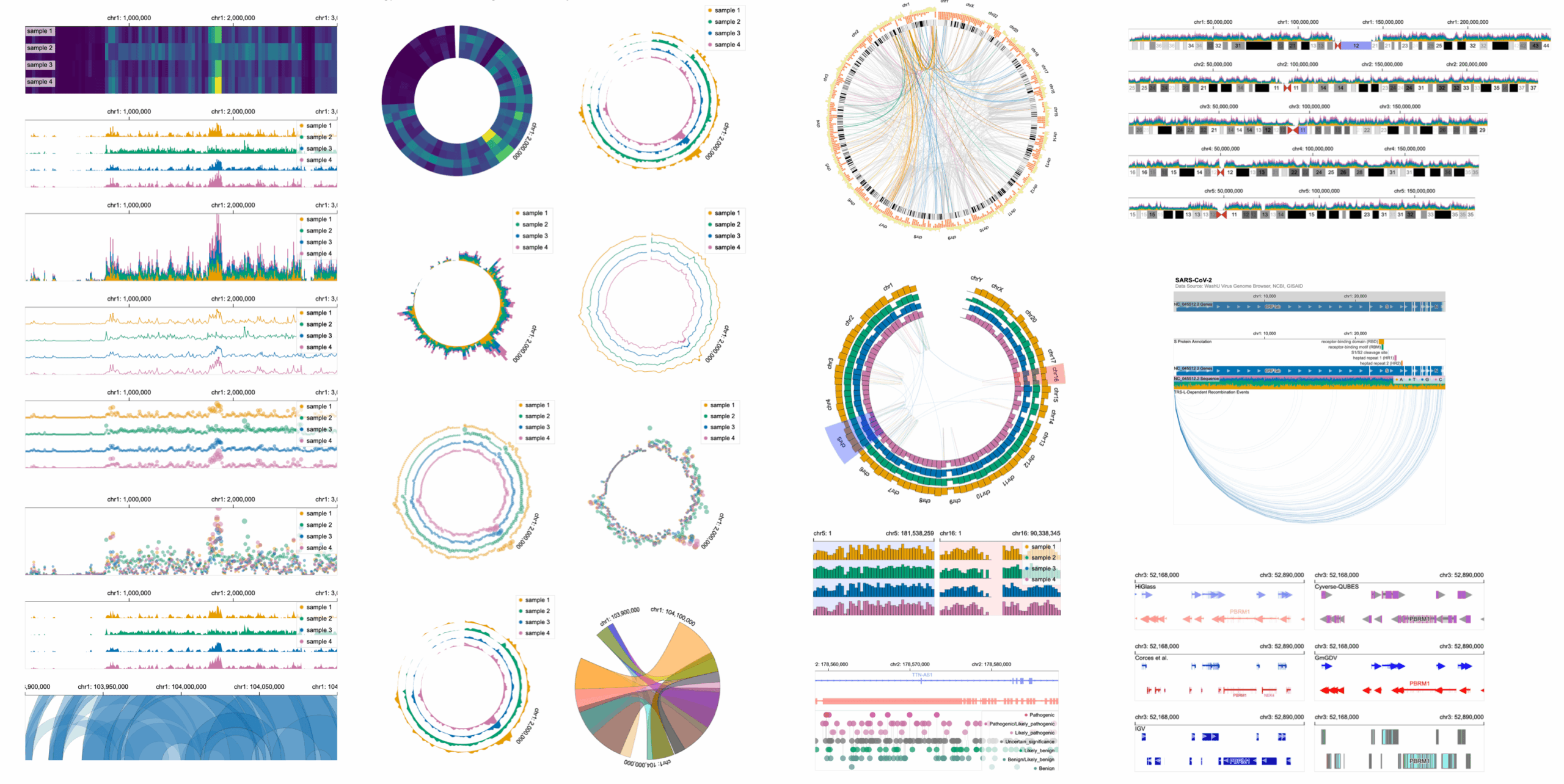
Gosling.js is a visualisation toolkit for genomic and epigenomic data. Rather than providing a fixed genome browser interface, it allows developers and researchers to describe the visualisations they want through a declarative specification.
The application is designed for situations where conventional genome browsers are too restrictive. Researchers may want to create unusual combinations of tracks, experiment with different graphical representations or build interactive views tailored to particular datasets.
Gosling.js uses rendering and data-access capabilities from HiGlass, allowing visualisations to handle large genomic datasets. Its approach makes it possible to describe complex displays without implementing every graphical component and interaction from scratch.
This is free and open source software.
Key Features
- Uses a declarative grammar to define genomic visualisations through structured specifications.
- Supports linear and circular genomic visualisations, including combinations of different track layouts.
- Maps genomic coordinates and data attributes to graphical properties such as position, colour, size and shape.
- Provides semantic zooming, adjusting visual encodings as users move between chromosome-scale and nucleotide-scale views.
- Allows multiple tracks to be combined into composite visualisations for comparing related datasets.
- Supports linked views, so navigation in one genomic region can update related displays.
- Includes interactive brushing for selecting regions and connecting overview and detailed views.
- Offers panning and zooming controls for exploring large genomic datasets.
- Supports a range of visual marks and encodings for displaying quantitative, categorical and interval-based genomic data.
- Builds on HiGlass for efficient rendering and access to multiresolution genomic datasets.
- Provides an online editor for experimenting with specifications and inspecting the resulting graphics.
- Can be embedded in web applications, allowing custom genomic visualisations to become part of larger research tools.
Website: github.com/gosling-lang/gosling.js
Support:
Developer: Sehi L’Yi, Qianwen Wang, Fritz Lekschas, Nils Gehlenborg and contributors
License: MIT License
Gosling.js is written in TypeScript. Learn TypeScript with our recommended free books and free tutorials.
Related Software
| Web-Based Desktop Genome Browsers | |
|---|---|
| Ensembl | Resource for geneticists, molecular biologists and other researchers |
| Genome Browser | Interactively visualize genomic data |
| GDV | Exploration and analysis of eukaryotic RefSeq genome assemblies |
| HiGlass | Explore and compare genomic contact matrices and tracks |
| igv.js | Embeddable genomic visualization |
| NGB | Web-based NGS data viewer |
| JBrowse 2 | Modern React-based genome browser |
| trackplot | Visualize various next-generation sequencing data |
| GIVE | Genomic Interactive Visualization Engine |
| Genoverse | HTML5 scrollable genome browser |
| Epigenome Browser | Visualization, integration and analysis tools for epigenomic datasets |
Read our verdict in the software roundup.
 Explore our carefully curated directory of recommended free and open source software, covering every major software category. Explore our carefully curated directory of recommended free and open source software, covering every major software category.The directory forms part of our extensive collection of articles for Linux enthusiasts. It includes hundreds of detailed reviews, together with free and open source alternatives to proprietary software from companies such as Google, Microsoft, Apple, Adobe, IBM, Cisco, Oracle, and Autodesk. LinuxLinks also covers interesting projects worth exploring, Linux-compatible hardware, free programming books and tutorials, and much more. Know a useful free and open source Linux application that we haven’t covered? Tell us about it using our submission form. |
Please read our Comment Policy before commenting.