

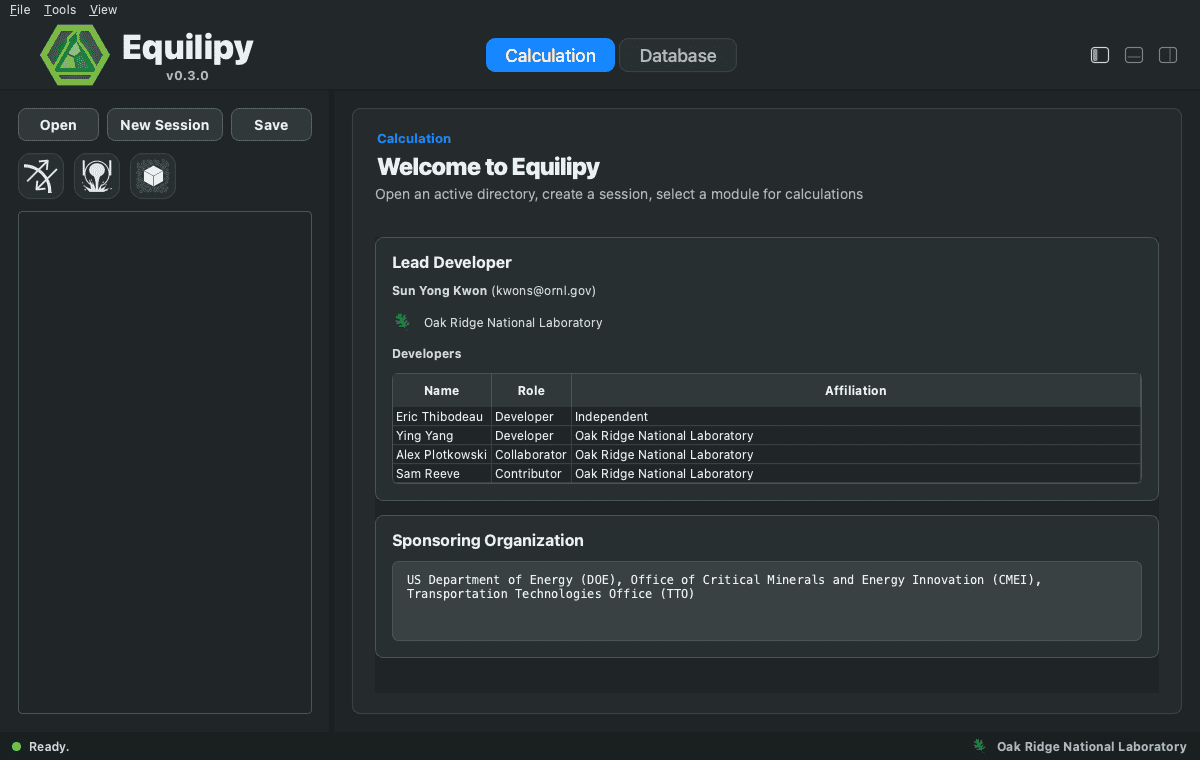
Equilipy is thermodynamic equilibrium software for calculating multicomponent and multiphase systems using the CALPHAD methodology. It is available both as a Python package and as a graphical desktop application, making it suitable for scripted workflows as well as interactive calculations.
Given a thermochemical database together with temperature, pressure and composition conditions, Equilipy determines the stable phases, their amounts and compositions, and associated thermodynamic properties. Its equilibrium solver uses Gibbs energy minimisation and thermodynamic descriptions based on the approach used by Thermochimica.
The software can read several forms of thermodynamic data. These include ChemSage and FactSage DAT databases as well as Thermo-Calc-style TDB files. This makes it possible to work with existing CALPHAD datasets rather than creating thermodynamic descriptions entirely from scratch.
Equilipy supports individual equilibrium calculations and batches covering many conditions. It can also perform Scheil-Gulliver solidification calculations and nucleation-dependent solidification modelling. Calculated properties include Gibbs energy, enthalpy, entropy and heat capacity.
The graphical interface provides workspaces for setting up calculations and working with thermochemical databases. Database facilities include inspection, editing, validation and export. For larger studies, the Python interface provides more direct control, while MPI helpers are available for distributing batch calculations across multiple nodes.
This is free and open source software.
Key Features
- Calculates multicomponent and multiphase thermodynamic equilibria.
- Reads ChemSage, FactSage and Thermo-Calc-style thermodynamic databases.
- Supports equilibrium, Scheil-Gulliver and nucleation-dependent solidification calculations.
- Calculates phase amounts, phase compositions and thermodynamic properties.
- Provides both a graphical desktop interface and a programmable Python interface.
- Perform equilibrium cooling and search for phase-transition temperatures.
- Select individual phases for equilibrium and solidification calculations.
- Export calculation results as CSV tables.
- Save and reload calculation results through the Python interface.
- Split thermodynamic database subsystems and export TDB data.
- Use an optional AI-assisted graphical panel to prepare calculations from natural-language requests.
- Cross-platform support – runs on Linux, macOS, and Windows.
Website: github.com/ORNL/Equilipy
Support:
Developer: Oak Ridge National Laboratory
License: BSD 3-Clause License
Equilipy is written in Python and Fortran. Learn Python with our recommended free books and free tutorials. Learn Fortran with our recommended free books and free tutorials.
Related Software
| Chemical Engineering, Kinetics & Thermodynamics | |
|---|---|
| pychemqt | Chemical engineering calculations and simulation |
| Cantera | Chemical kinetics and thermodynamic simulation |
| pycalphad | Compute phase diagrams and thermodynamic equilibria in materials |
| IDAES | Model and optimise complex chemical and industrial process systems |
| Reaktoro | Model chemical reactions, equilibrium and reactive transport systems |
| Equilipy | Calculate phase equilibria in multicomponent, multiphase systems |
Read our verdict in the software roundup.
 LinuxLinks helps you discover the best free and open source software for Linux. Explore our extensive collection of recommended applications, including alternatives to popular proprietary software. We also publish software reviews, Linux tutorials, hardware reviews, free programming books and articles covering the wider open source community. Browse our Linux resources to discover more. Know a useful free and open source Linux application we haven't covered? Suggest a program for inclusion. Has your software been featured on LinuxLinks? Display one of our Featured on LinuxLinks badges on your website or GitHub README. |
Please read our Comment Policy before commenting.