

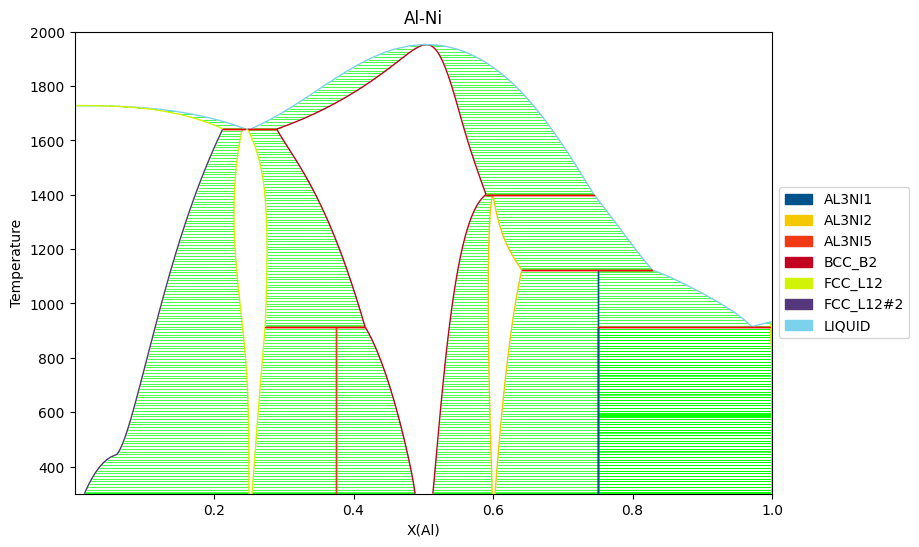
pycalphad is a Python framework for computational thermodynamics based on the CALPHAD method. It is designed for creating thermodynamic models, calculating phase equilibria and generating phase diagrams from thermodynamic database descriptions.
The software can read Thermo-Calc TDB databases and construct mathematical representations of the phases and thermodynamic models they contain. These models can then be evaluated across ranges of temperature, pressure and composition. pycalphad’s equilibrium routines determine the stable phases and their compositions by solving the multiphase Gibbs energy minimisation problem.
The package supports considerably more than producing conventional binary phase diagrams. It can calculate ternary diagrams, phase fractions, phase compositions, chemical potentials, activities, heat capacities and other properties derived from the underlying thermodynamic models. It also provides tools for studying metastable states, reference states, driving forces and Gibbs energy surfaces.
Calculations return structured data which can be processed using Python tools and used in larger automated workflows. This makes pycalphad particularly useful for high-throughput thermodynamic studies where many compositions or conditions need to be investigated programmatically.
The framework also exposes its thermodynamic model construction machinery. Researchers can therefore implement or modify models rather than treating the calculation engine as a black box. Plotting functionality is available for common phase-diagram tasks, while calculation results integrate with NumPy, xarray and other scientific Python software.
pycalphad is primarily a Python library rather than a standalone graphical application.
This is free and open source software.
Key Features
- Calculates multiphase equilibrium using CALPHAD thermodynamic models.
- Reads Thermo-Calc TDB thermodynamic database files.
- Generates binary, ternary and other phase-equilibrium calculations.
- Calculates phase fractions, compositions, activities and thermodynamic properties.
- Provides programmable thermodynamic models for custom and high-throughput studies.
- Cross-platform support – runs on Linux, macOS, and Windows.
Website: github.com/pycalphad/pycalphad
Support:
Developer: Richard Otis and Brandon Bocklund
License: MIT License
pycalphad is written in Python. Learn Python with our recommended free books and free tutorials.
Related Software
| Chemical Engineering, Kinetics & Thermodynamics | |
|---|---|
| pychemqt | Chemical engineering calculations and simulation |
| Cantera | Chemical kinetics and thermodynamic simulation |
| pycalphad | Compute phase diagrams and thermodynamic equilibria in materials |
| IDAES | Model and optimise complex chemical and industrial process systems |
| Reaktoro | Model chemical reactions, equilibrium and reactive transport systems |
| Equilipy | Calculate phase equilibria in multicomponent, multiphase systems |
Read our verdict in the software roundup.
 LinuxLinks helps you discover the best free and open source software for Linux. Explore our extensive collection of recommended applications, including alternatives to popular proprietary software. We also publish software reviews, Linux tutorials, hardware reviews, free programming books and articles covering the wider open source community. Browse our Linux resources to discover more. Know a useful free and open source Linux application we haven't covered? Suggest a program for inclusion. Has your software been featured on LinuxLinks? Display one of our Featured on LinuxLinks badges on your website or GitHub README. |
Please read our Comment Policy before commenting.