

Cytoscape is a desktop application for visualising and analysing complex networks. It was originally developed for biological research, particularly the study of molecular interactions, regulatory relationships and biological pathways, but its network analysis capabilities are applicable to many other disciplines.
The software represents biological entities as nodes and their relationships as edges. Researchers can combine network structures with experimental measurements, annotations and other data to investigate how individual components interact within larger biological systems.
Cytoscape is particularly useful for examining protein-protein interaction networks, gene expression relationships and signalling pathways. Its interactive environment enables researchers to examine patterns, investigate subsets of networks and prepare visualisations suitable for scientific publications.
This is free and open source software.
Key Features
- Interactive network viewer with zooming, panning and navigation through large collections of nodes and edges.
- Multiple network layout algorithms, including force-directed, circular, hierarchical and other arrangements.
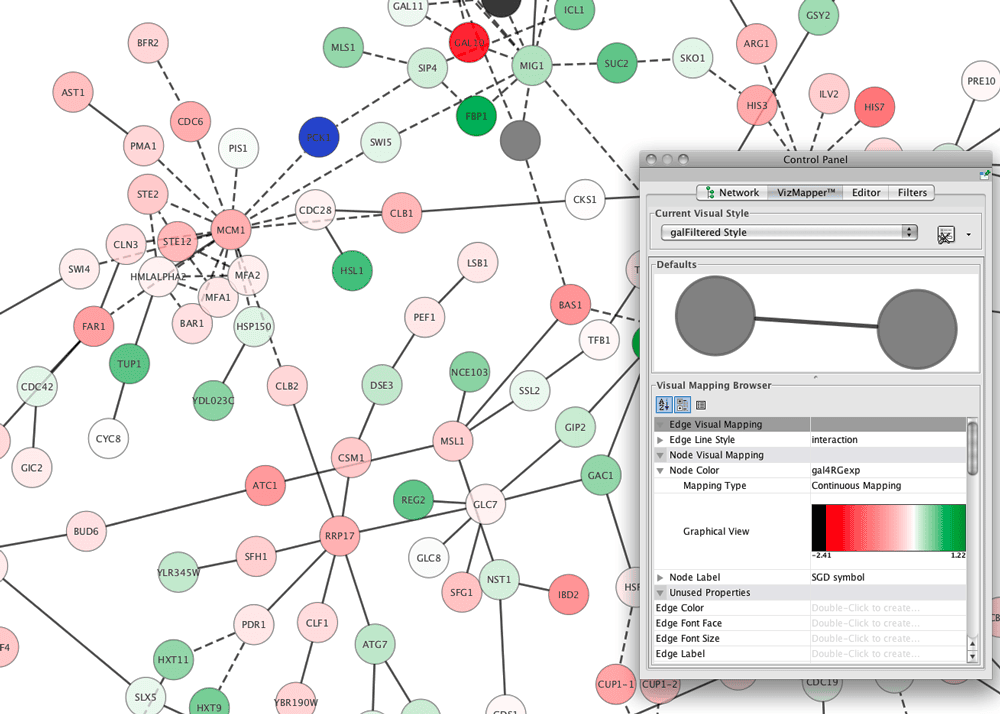
- Visual Styles system for mapping numerical and categorical data to node colours, sizes, labels, shapes and edge properties.
- Import network structures and associated node or edge attributes from supported files and external data sources.
- Network filtering and selection tools for identifying subsets of nodes and interactions that meet specified conditions.
- Search facilities for locating network elements using names, identifiers and attribute values.
- Network analysis tools for examining topological characteristics and relationships between connected components.
- Manage multiple networks within a session and organise their associated data tables.
- Export network diagrams in raster and vector formats suitable for reports and scientific publications.
- Extensible through the Cytoscape App Store, which provides additional tools for clustering, enrichment analysis, pathway exploration and data integration.
- Automation interface for controlling Cytoscape from external programs and constructing reproducible analysis workflows.
- Integration with NDEx for exchanging and sharing biological network data.
- Cross-platform support – runs on Linux, macOS, and Windows.
Website: github.com/cytoscape/cytoscape.js
Support:
Developer: Cytoscape Consortium
License: GNU Lesser General Public License v2.1
Related Software
| Biology Tools | |
|---|---|
| EMBOSS | The European Molecular Biology Open Software Suite |
| NAMD | Parallel, object-oriented molecular dynamics |
| GROMACS | Molecular dynamics simulator, with building and analysis tools |
| VMD | Displays, animates, and analyzes large biomolecular systems 3-D graphics |
| simuPOP | Forward-time population genetics simulation environment |
| MUSCLE | MUltiple Sequence Comparison by Log-Expectation |
| SeaView | Graphical user interface for molecular phyologeny |
| SeqViz | DNA, RNA, and protein sequence viewer |
| TREE-PUZZLE | Reconstruction of phylogenetic trees by maximum likelihood |
| TreeView X | Displays and prints phylogenetic trees |
| CellProfiler | Image analysis application for researchers |
| napari | Python-based image viewer |
| COPASI | Biochemical systems simulator |
| VCell | Modeling and simulation framework |
| NEURON | Build and run biophysically detailed models |
| NEST | Simulator for spiking neural network models |
Read our verdict in the software roundup.
 LinuxLinks helps you discover the best free and open source software for Linux. Explore our extensive collection of recommended applications, including alternatives to popular proprietary software. We also publish software reviews, Linux tutorials, hardware reviews, free programming books and articles covering the wider open source community. Browse our Linux resources to discover more. Know a useful free and open source Linux application we haven't covered? Suggest a program for inclusion. Has your software been featured on LinuxLinks? Display one of our Featured on LinuxLinks badges on your website or GitHub README. |
Please read our Comment Policy before commenting.