

CapivaraOS is a family of Brazilian Linux distributions based on Fedora.
The project provides a desktop Linux experience with its own visual identity, Brazilian Portuguese configured out of the box, ABNT2 keyboard layout, localization packages, and a set of preinstalled everyday applications.
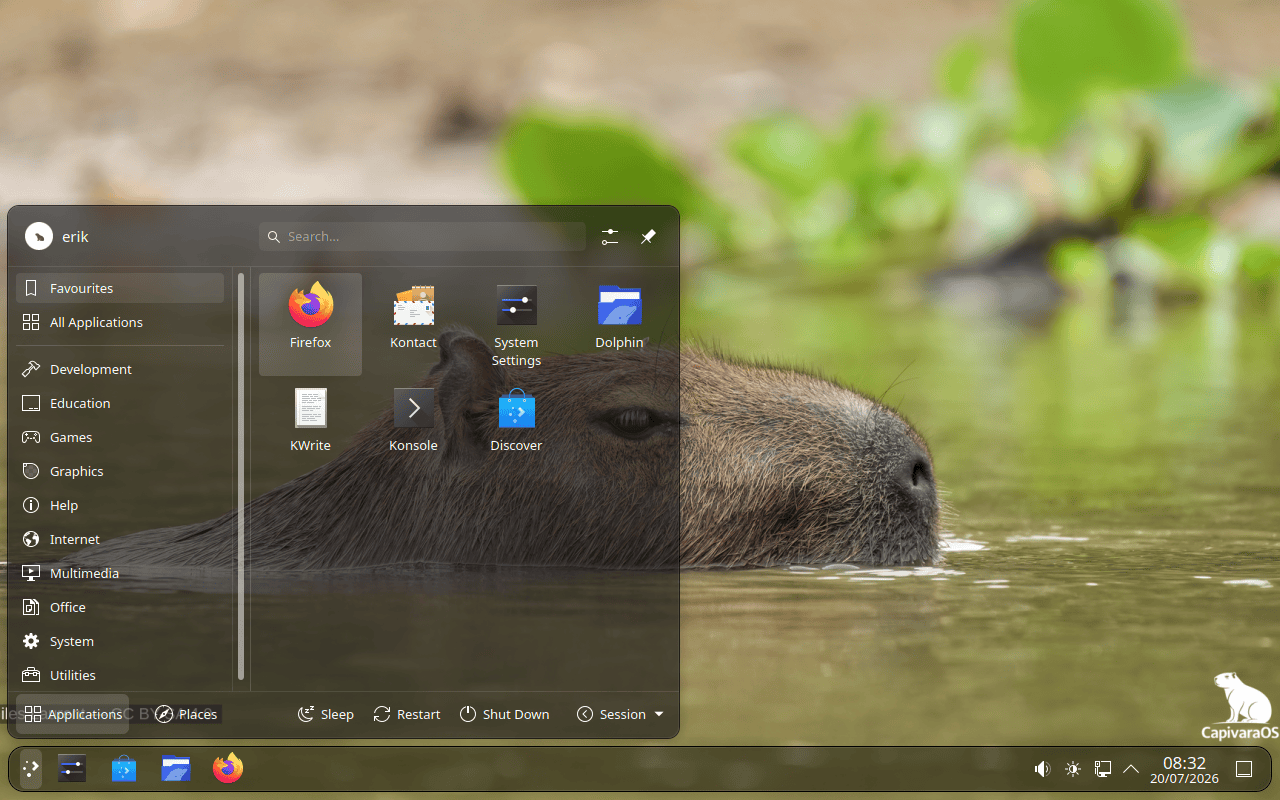
The family currently comprises three Fedora 44-based editions. Marsh uses KDE Plasma and is available as a public beta. Pup is an Xfce edition aimed at lighter systems with at least 4GB of RAM. Snout uses Fedora Workstation’s standard GNOME desktop with CapivaraOS branding applied.
This is free and open source software.
Key Features
- Brazilian Linux distribution family based on Fedora.
- Built with Fedora tooling including kickstart, lorax, livemedia-creator, and Anaconda.
- Marsh edition offers KDE Plasma with a top global menu, bottom dock, and CapivaraOS visual theme.
- Pup edition uses Xfce and targets lighter systems with at least 4GB of RAM.
- Snout edition uses the stock GNOME desktop from Fedora Workstation with CapivaraOS branding.
- Brazilian Portuguese, ABNT2 keyboard layout, and localization packages are configured by default.
- Includes wallpapers, boot theme, login screen, logo, and a consistent visual identity across editions.
- Ships with LibreOffice, Firefox, and the main applications for each desktop environment.
- Uses the Anaconda installer for guided installation.
- Keeps Fedora’s official repositories as the base and does not enable non-free package sources by default.
| Working state: | Active |
| Desktop: | KDE Plasma, Xfce, GNOME |
| Init Software: | systemd |
| Package Management: | RPM |
| Release Model: | Fixed |
| Platforms: | x86_64 |
| Home Page: | capivaraos.org |
| Developer: | CapivaraOS Project |
| This article is part of our Big List of Active Linux Distributions and Open Source Operating Systems. |
What's a Linux distribution ("distro")? |
| A distro provides the user with a desktop environment, preloaded applications, and ways to update and maintain the system. Each distro makes different choices, deciding which open source projects to install and provides custom written programs. They can have different philosophies. Some distros are intended for desktop computers, some for servers without a graphical interface, and others for special uses. Because Linux is an open source operating system, combinations of software vary between Linux distros. |
Please read our Comment Policy before commenting.