

A pastebin or text storage site is a type of online content-hosting service where users can store plain text (e.g. source code snippets for code review).
Pastebins developed in the late 1990s to support IRC chatrooms dedicated to computing, where users naturally need to share large blocks of computer input or output in a line-oriented medium
Pastebins are popular with developers for a number of reasons including support for syntax highlighting, temporary storage, ease of use, as well as anonymity. They can also store configuration information.
It’s worth noting that pastebins are not only useful for developers. Anyone can use a pastebin to paste and share any type of text.
This article focuses on the finest self-hosted pastebin tools. Only free and open source software is eligible for inclusion here.
Here’s our verdict captured in a legendary LinuxLinks-style ratings chart.
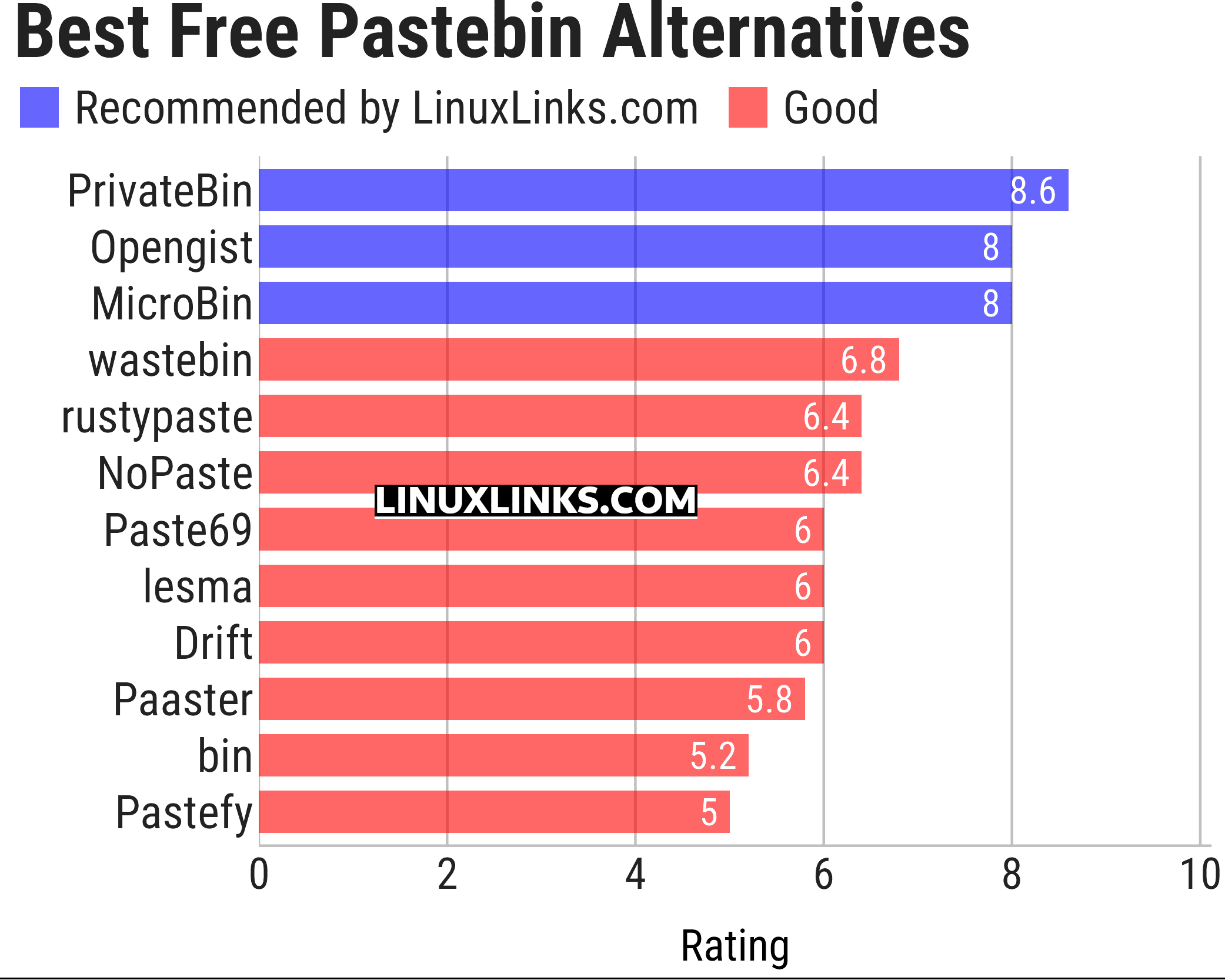
Click the links in the table below to learn more about each client.
| Self-Hosted Pastebin Alternatives | |
|---|---|
| PrivateBin | Minimalist, online pastebin |
| Opengist | Self-hosted pastebin powered by Git |
| MicroBin | Super tiny, feature rich, configurable, and self-contained |
| wastebin | Minimal pastebin |
| rustypaste | Minimal file upload and text-sharing service written in Rust |
| NoPaste | Client-side paste service |
| Paste69 | Go-based pastebin service |
| lesma | Simple paste app, friendly with browser and command line |
| Drift | Self-hostable Gist and paste service |
| Paaster | Secure, user-friendly service for sharing text and code snippets |
| bin | Minimal pastebin |
| Pastefy | Self-hosted web app for securely sharing text snippets and files |
This article has been updated to reflect the changes outlined in our recent announcement.
 Explore our carefully curated directory of recommended free and open source software, covering every major software category. Explore our carefully curated directory of recommended free and open source software, covering every major software category.The directory forms part of our extensive collection of articles for Linux enthusiasts. It includes hundreds of detailed reviews, together with free and open source alternatives to proprietary software from companies such as Google, Microsoft, Apple, Adobe, IBM, Cisco, Oracle, and Autodesk. LinuxLinks also covers interesting projects worth exploring, Linux-compatible hardware, free programming books and tutorials, and much more. Know a useful free and open source Linux application that we haven’t covered? Tell us about it using our submission form. |
Please read our Comment Policy before commenting.
Article updated to include MicroBin.
I personally prefer MicroBin over PrivateBin for personal use. It’s opensource and self hostable.
Thanks Sansbyte. We’ll evaluate MicroBin and still what it’s like.
MicroBin does have some security concerns around access rights – which hopefully gets sorted out first. Otherwise a very nice service.
Um PrivateBin is definitely self-hostable, I self-host it myself in a Docker container. It is open source too, so neither of those points should count against it at all. As a plus is has discussions which can be useful, but frankly moderation could be a problem.
That said, what I do like about MicroBin is snippets can be editable which can be a major plus, and has its own URL shortening.
I don’t think Sansbyte was trying to imply that PrivateBin isn’t self-hostable, but rather that we hadn’t included MicroBin even though it meets the criteria for inclusion.
We will be updating this roundup with MicroBin in the next day or so.
Have you checked textShareNow, it is fast and 5 digit code or QR code based website to share text.
No, it doesn’t appear to be open source, so off-topic.