

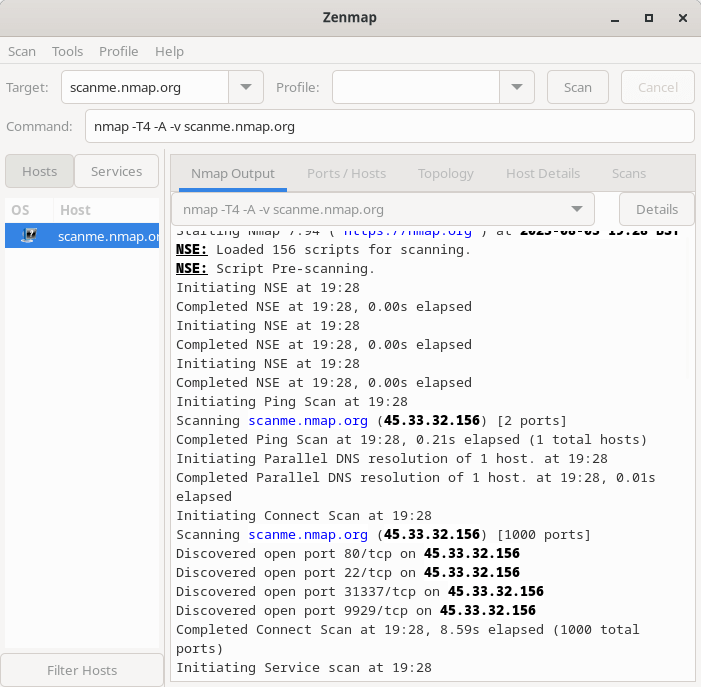
Zenmap is an Nmap frontend. It is meant to be useful for advanced users and to make Nmap easy to use by beginners.
The purpose of Zenmap is not to replace Nmap, but to make Nmap more useful. Nmap has literally hundreds of options, which can be daunting for beginners. Zenmap’s interface is designed to always show the command that will be run, whether it comes from a profile or was built up by choosing options from a menu.
Zenmap was originally derived from Umit, an Nmap GUI created as part of the Google Summer of Code.
Key Features
- Intuitive graphical user interface.
- Interactive and graphical results viewing.
- Supports dozens of advanced techniques for mapping out networks filled with IP filters, firewalls, routers, and other obstacles. This includes many port scanning mechanisms (both TCP & UDP), OS detection, version detection, ping sweeps, and more. See the documentation page.
- Scan huge networks of literally hundreds of thousands of machines.
- Frequently used scans can be saved as profiles to make them easy to run repeatedly
- Topology mapping.
- Command creator allows interactive creation of Nmap command lines.
- Scan results can be saved and viewed later.
- Default scan profiles.
- Uses ping and traceroute.
Website: nmap.org/zenmap
Support: Users’ Guide
Developer: Insecure.com LLC
License: GNU General Public License
Zenmap is written in Python. Learn Python with our recommended free books and free tutorials.
Related Software
| Graphical Port Scanners | |
|---|---|
| Zenmap | The Network Mapper Front End |
| IVRE | Network recon framework written in Python |
| Angry IP Scan | Scans IP addresses and ports |
| NmapSI4 | Qt5-based GUI for Nmap |
| NetPeek | Discover devices on your local network |
| Umit | Network tool and port scanner developed in PyGTK. |
| GNOME Nettool | GNOME interface for various networking tools |
Read our verdict in the software roundup.
 Explore our carefully curated directory of recommended free and open source software, covering every major software category. Explore our carefully curated directory of recommended free and open source software, covering every major software category.The directory forms part of our extensive collection of articles for Linux enthusiasts. It includes hundreds of detailed reviews, together with free and open source alternatives to proprietary software from companies such as Google, Microsoft, Apple, Adobe, IBM, Cisco, Oracle, and Autodesk. LinuxLinks also covers interesting projects worth exploring, Linux-compatible hardware, free programming books and tutorials, and much more. Know a useful free and open source Linux application that we haven’t covered? Tell us about it using our submission form. |
Please read our Comment Policy before commenting.