

Pidgin is a desktop instant messaging client that allows users to communicate through several chat networks from one application. Accounts belonging to different services can remain connected simultaneously, with conversations organised into tabs and contacts managed through a unified interface. It is particularly useful for users who need both private messaging and group conversations without running a separate application for every supported protocol.
The software uses the libpurple messaging library, which separates protocol handling from the graphical interface. This also enables the Finch terminal client to provide access to supported messaging networks. Pidgin has an extensive plugin architecture for extending messaging behaviour, modifying notifications and integrating additional communication services. Its established desktop application supports IRC, XMPP and a range of other protocols, although individual network availability depends on the continued operation of those services.
This is free and open source software.
Key Features
- Connect to multiple messaging accounts simultaneously.
- Support for IRC, XMPP, Bonjour and other supported messaging protocols.
- Additional network support through plugins.
- Tabbed windows for managing multiple conversations.
- Combine several identities belonging to one person into a single contact.
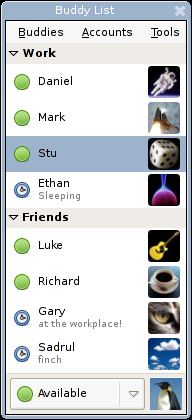
- Buddy lists with configurable aliases and groups.
- Buddy Pounces for triggering actions when contact status changes.
- Presence information and custom away messages.
- Conversation and chat-room logging.
- File transfers on supported protocols.
- Buddy icons, custom smileys and typing notifications.
- Spell checking while composing messages.
- Notification-area integration and desktop alerts.
- Automatic reconnection to supported services.
- Extensible plugin system for additional messaging functionality.
- Shared messaging library with the Finch terminal client.
- Cross-platform support – runs on Linux and Windows.
Website: pidgin.im
Support:
Developer: Pidgin development team
License: GNU General Public License v2.0
Pidgin is written in C. Learn C with our recommended free books and free tutorials.
Related Software
| IRC Clients | |
|---|---|
| Konversation | User friendly client for KDE Plasma |
| Smuxi | Smart MUltipleXed Irc - the IRC client for sophisticated users |
| Pidgin | Easy to use and free chat client supporting lots of protocols |
| KVIrc | KDE based next generation IRC client with module support |
| Quassel IRC | Distributed, KDE4/Qt based |
| Halloy | IRC client written in Rust |
| Polari | Simple to use IRC Client |
| MERK | Cross-platform graphical IRC client |
| Srain | Modern IRC client written in GTK |
| HexChat | Multi-network IRC client based on XChat |
| dxirc | Simple yet capable cross-platform IRC client |
| Grumpy | Advanced IRC client |
| Tithon | Modern, cross-platform IRC client |
| Communi | Simple and elegant cross-platform IRC client |
Read our verdict in the software roundup.
| Graphical XMPP Clients | |
|---|---|
| Gajim | Full featured and easy to use XMPP client |
| Pidgin | Multi-protocol instant messaging client |
| Dino | Jabber/XMPP experience while having your privacy in mind |
| Kaidan | Simple, user-friendly and modern chat client |
| Psi | Cross-platform XMPP instant messaging client |
| Fluux Messenger | Modern, cross-platform XMPP client |
| Swift | Clean design and comprehensive feature set |
Read our verdict in the software roundup.
 LinuxLinks helps you discover the best free and open source software for Linux. Explore our extensive collection of recommended applications, including alternatives to popular proprietary software. We also publish software reviews, Linux tutorials, hardware reviews, free programming books and articles covering the wider open source community. Browse our Linux resources to discover more. Know a useful free and open source Linux application we haven't covered? Suggest a program for inclusion. Has your software been featured on LinuxLinks? Display one of our Featured on LinuxLinks badges on your website or GitHub README. |
Please read our Comment Policy before commenting.
I’m glad to see this blast from the past being developed again.