

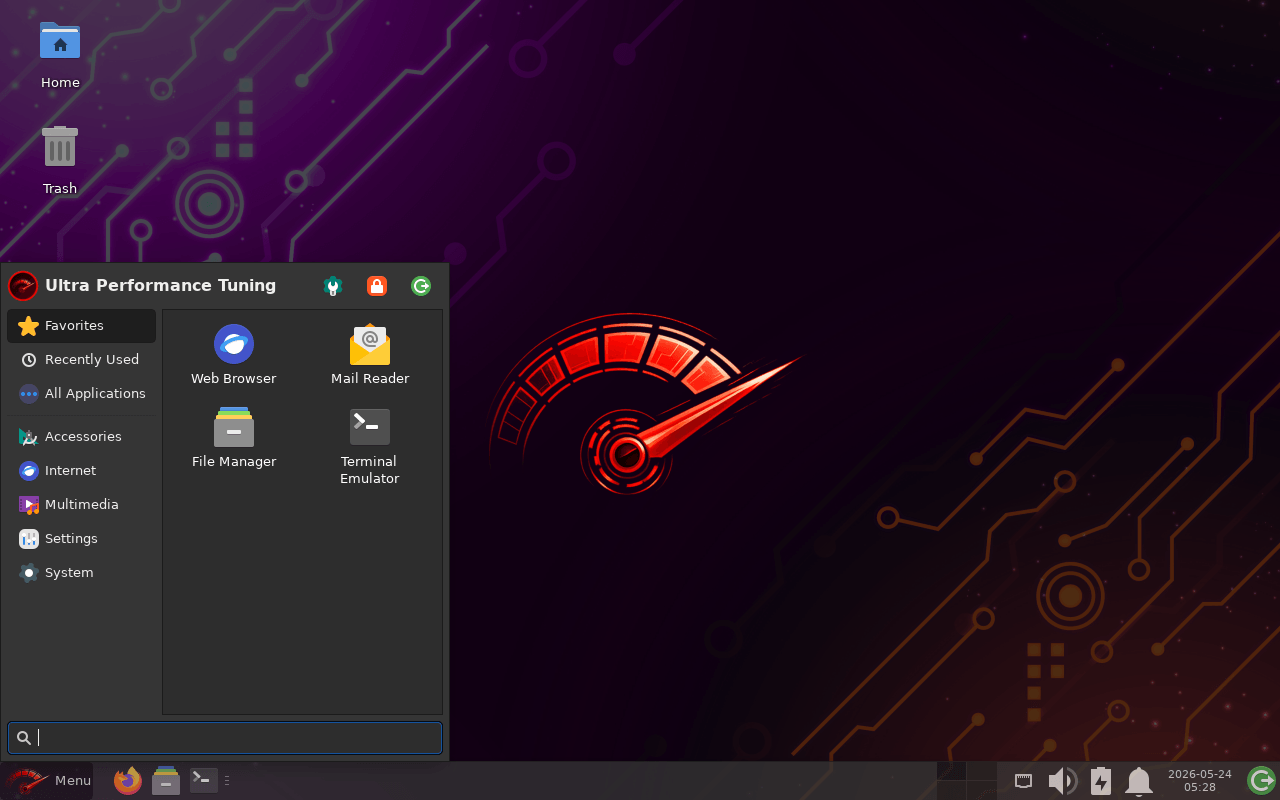
Ultra Performance Tuning is a Debian-based Linux distribution designed for deterministic, low-latency workloads. It uses a fully preemptive real-time kernel, aggressive scheduler tuning, IRQ affinity steering, virtual memory adjustments, and a stripped-down XFCE4 desktop.
The distribution is aimed at specialist environments such as digital audio workstations, robotics, industrial automation, and real-time data streaming, rather than general home computing.
Key Features
- Ships with a PREEMPT_RT real-time kernel for deterministic scheduling.
- Uses IRQ affinity steering to reduce interruptions for real-time workloads.
- Includes scheduler, virtual memory, storage, and network tuning for low latency operation.
- Provides a lightweight XFCE4 desktop environment.
- Locks the CPU governor to performance mode for consistent responsiveness.
- Targets DAW, robotics, automation, and high-throughput streaming workloads.
- Disables CPU security mitigations and power-saving features, so it’s unsuitable for general-purpose systems.
| Working state: | Active |
| Desktop: | XFCE |
| Init Software: | systemd |
| Package Management: | APT |
| Release Model: | Fixed |
| Platforms: | x86_64 |
| Home Page: | nixovena.org/ultra-performance-tuning |
| Developer: | nixovena |
| This article is part of our Big List of Active Linux Distributions and Open Source Operating Systems. |
What's a Linux distribution ("distro")? |
| A distro provides the user with a desktop environment, preloaded applications, and ways to update and maintain the system. Each distro makes different choices, deciding which open source projects to install and provides custom written programs. They can have different philosophies. Some distros are intended for desktop computers, some for servers without a graphical interface, and others for special uses. Because Linux is an open source operating system, combinations of software vary between Linux distros. |
Please read our Comment Policy before commenting.
This distro sounds very promising. But I hope they change from the current name of, Ultra Performance Tuning.
I agree, maybe they’ll choose a different name. Even UPT would be better IMO.
I’m waiting to see a project named Linux Distribution to sink to rock bottom in naming terms.