

Shadowfetch Linux is a Debian testing derivative aimed at creative workstation users.
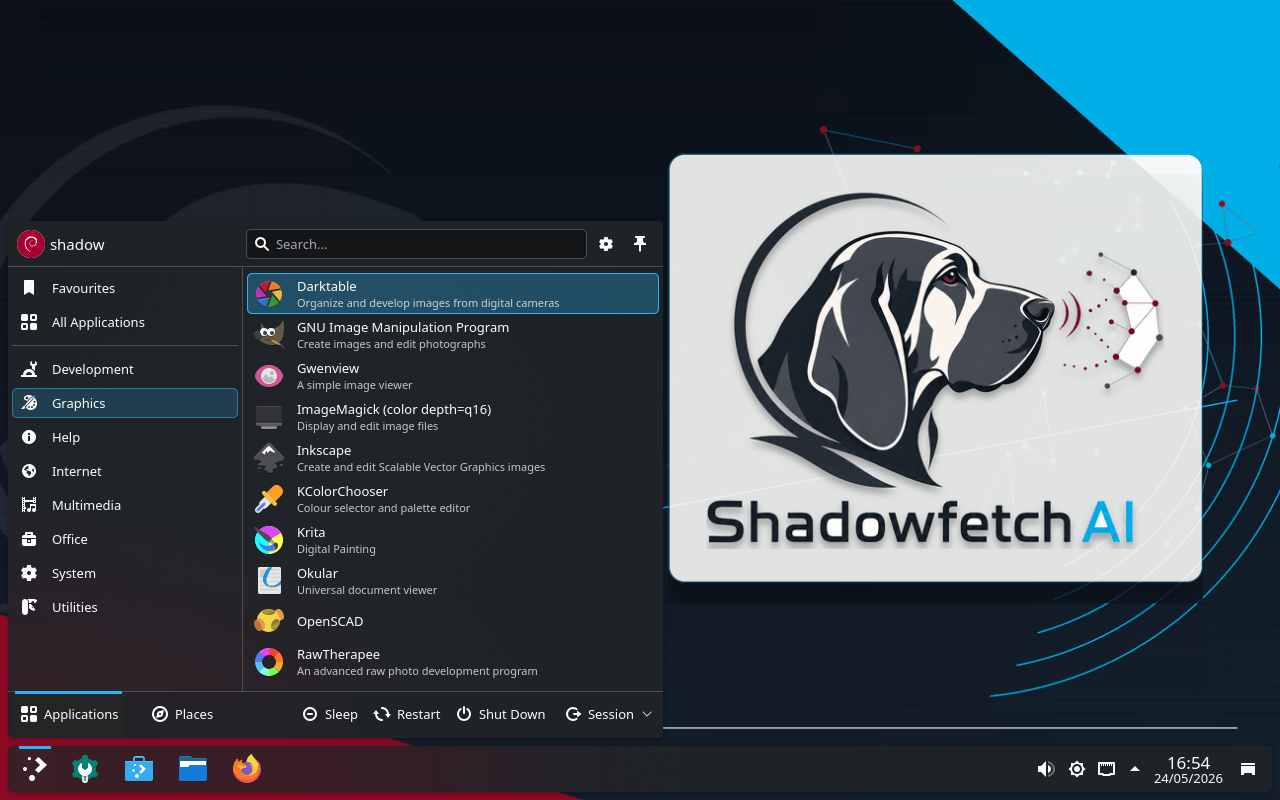
It ships with KDE Plasma 6 and a wide range of graphics, photography, audio, video, streaming, 3D, CAD, and colour-management applications already installed. The distribution is designed to provide a ready-to-use creative desktop while retaining Debian’s familiar package management tools and software ecosystem.
Shadowfetch adds a curated default stack, a dark visual theme, a first-boot welcome wizard, PipeWire audio, zram, earlyoom, tuned, Flatpak with Flathub pre-configured, and an APT repository for Shadowfetch updates. The ISO also includes the proprietary NVIDIA driver and CUDA stack, which is removed automatically on first boot if no NVIDIA hardware is detected.
Key Features
- Based on Debian testing with access to the wider Debian package archive.
- Includes creative applications such as GIMP, Krita, Inkscape, Blender, darktable, Ardour, Kdenlive, OBS Studio, FreeCAD, OpenSCAD, and MeshLab.
- Ships with PipeWire audio and a full LV2 plugin baseline for audio production.
- Provides Flatpak support with Flathub pre-configured.
- Includes a first-boot welcome wizard for choosing accent colours and installing optional Flatpak extras.
- Uses Calamares for the graphical installer.
- Supports both UEFI and legacy BIOS boot on amd64 systems.
- Includes signed ISO downloads with SHA-256 checksums and a GPG signing key.
| Working state: | Active |
| Desktop: | KDE Plasma |
| Init Software: | systemd |
| Package Management: | APT |
| Release Model: | Fixed |
| Platforms: | x86_64 |
| Home Page: | www.shadowfetch.org |
| Developer: | Robert Corbin |
| This article is part of our Big List of Active Linux Distributions and Open Source Operating Systems. |
What's a Linux distribution ("distro")? |
| A distro provides the user with a desktop environment, preloaded applications, and ways to update and maintain the system. Each distro makes different choices, deciding which open source projects to install and provides custom written programs. They can have different philosophies. Some distros are intended for desktop computers, some for servers without a graphical interface, and others for special uses. Because Linux is an open source operating system, combinations of software vary between Linux distros. |
Please read our Comment Policy before commenting.