
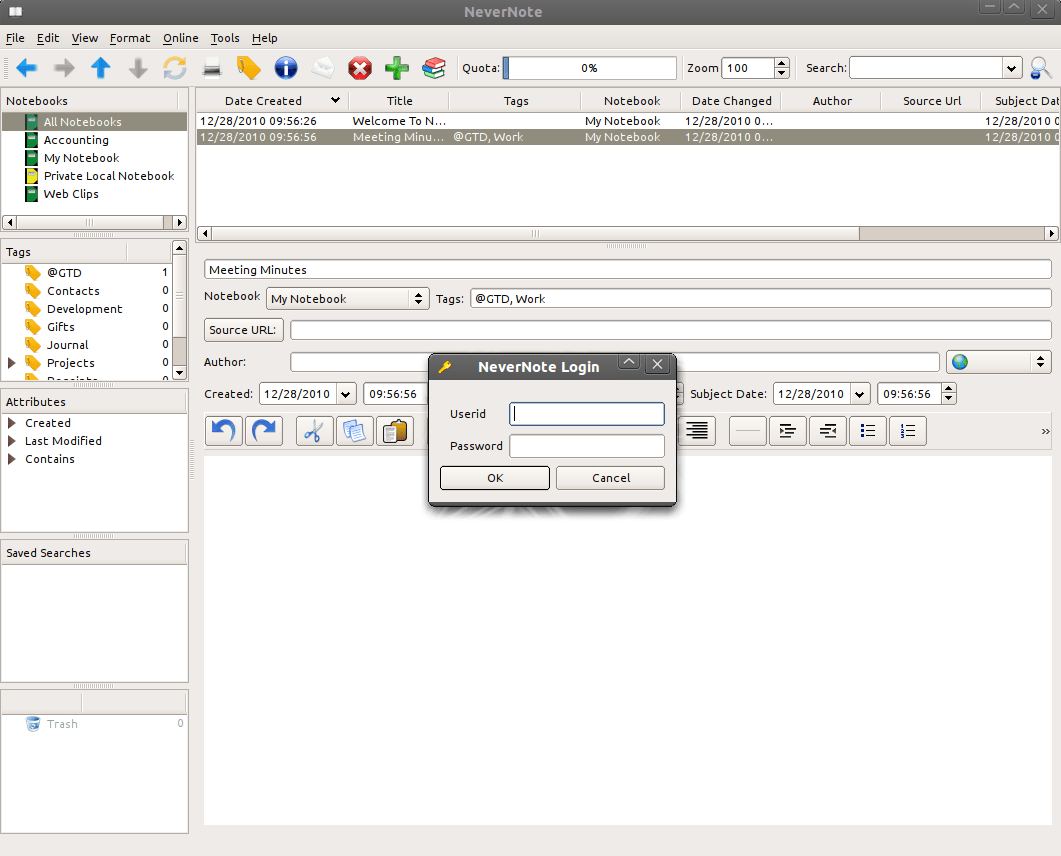
NixNote (formerly known as Nevernote) is a clone of Evernote, a cross-platform, freemium app designed for note taking, organizing, and archiving.
Unlike Evernote, NixNote is open source software.
NixNote is cross-platform.
Features include:
- Synchronizes with Evernote servers.
- Local data caching.
- Cross platform.
- Local-only and synchronized notebooks supported.
- Database may be encrypted locally.
- Keyboard shortcuts.
Website: sourceforge.net/projects/nevernote
Support:
Developer: Randy Baumgarte
License: GNU GPL v2
NixNote is written in Java. Learn Java with our recommended free books and free tutorials.
| Explore Linux | |
|---|---|
 | Best Free and Open Source Software - A huge collection of recommended free and open source software covering every major category. |
 | In-depth Linux Software Reviews - Detailed assessments of Linux software covering features, usability and overall quality. |
 | The Big List of Active Linux Distros - An extensive collection of actively developed Linux distributions. |
 | Open Source Alternatives - Alternatives to software and services from Google, Microsoft, Apple, Adobe, IBM, Autodesk, Oracle and others. |
 | Essential Linux System Tools - Indispensable utilities for monitoring, maintaining and managing Linux systems. |
 | Linux Productivity Tools - Useful utilities for improving productivity and streamlining everyday tasks. |
 | Alternatives to Popular CLI Tools - Modern alternatives to familiar command-line utilities supplied with Linux systems. |
 | Awesome Free Linux Game Tools - Tools, utilities and companion software that improve gaming on Linux. |
 | Machine Learning on Linux - Machine learning and deep learning software, self-hosted applications and practical tools. |
 | Saving Money with Linux - Practical ways to reduce electricity consumption and lower computing costs with Linux. |
 | Linux Candy - Fun, entertaining and sometimes delightfully quirky software from the lighter side of Linux. |
Please read our Comment Policy before commenting.
While I know the info page on GitHub says it’s in Java, I believe that was only true for the 1.x releases, he went to C++ for 2.x releases. Note the language use analysis at the bottom of the right column