

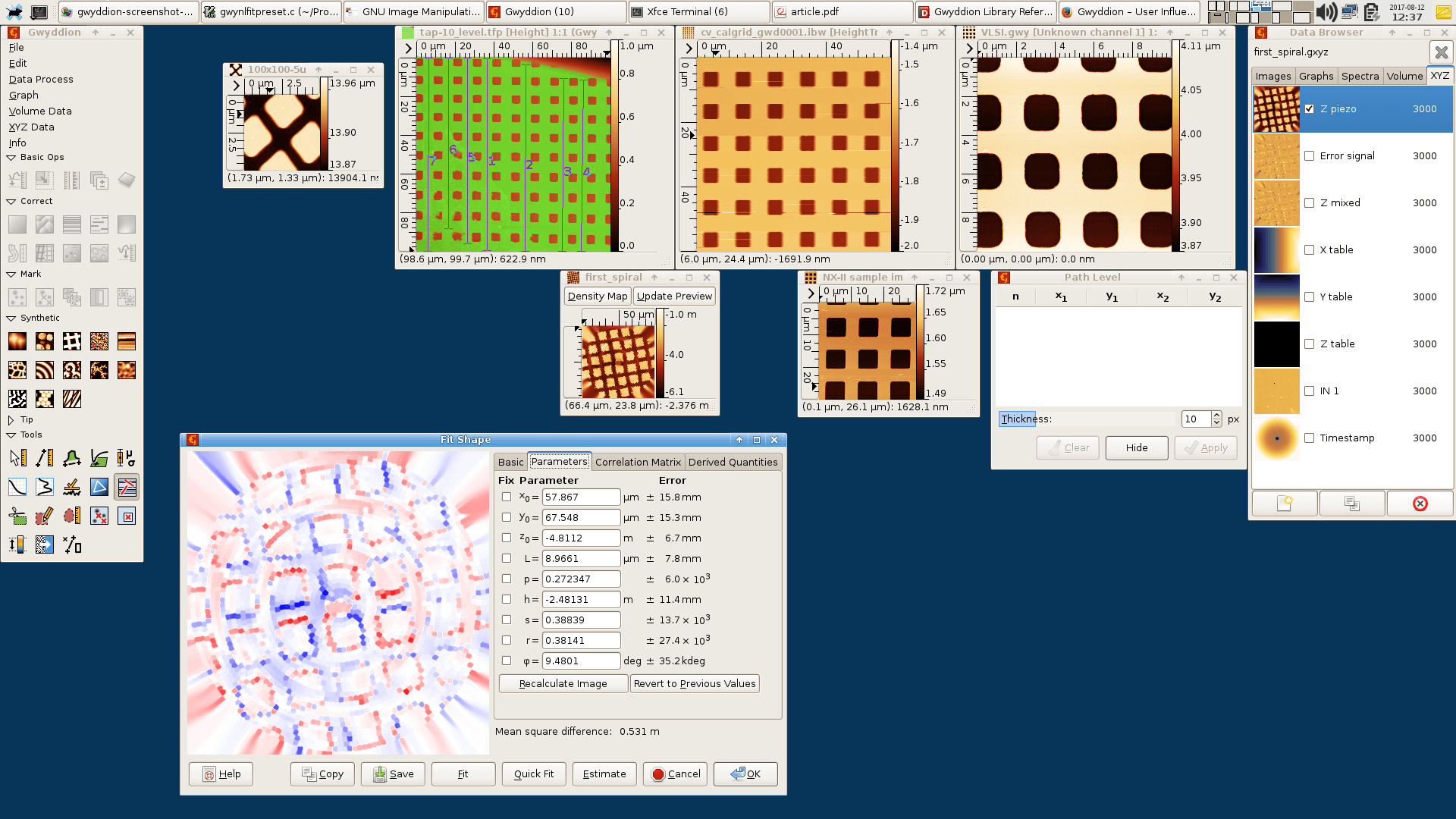
Gwyddion is a modular program for SPM (scanning probe microscopy) data visualization and analysis. Primarily it is intended for the analysis of height fields obtained by scanning probe microscopy techniques (AFM, MFM, STM, SNOM/NSOM) and it supports a lot of SPM data formats. However, it can be used for general height field and (greyscale) image processing, for instance for the analysis of profilometry data or thickness maps from imaging spectrophotometry.
Gwyddion provides a large number of data processing functions, including all the standard statistical characterization, levelling and data correction, filtering or grain marking functions. And since the developers are active SPM users, the program also contains a number of specific, uncommon, odd and experimental data processing methods they found useful.
This is free and open source software.
Features include:
- Large set of visualization and processing functions including:
- Visualization: false colour representation with different types of mapping.
- Shaded, logarithmical, gradient, edge-detected, and local contrast representation, local rank transformation, Canny lines, zero crossing.
- OpenGL 3D data display: false colour or material representation.
- User-editable false colour gradients and OpenGL materials.
- Basic operations: rotation, flipping, inversion, data arithmetic, cropping, resampling, binning, thresholding, wraping, extending
- 2D levelling: plane, three-point, facet, polynomial background removal, plane
- Scan line corrections: mean, median, trimmed mean, median difference, matching of flat segments, polynomial, levelling along user-defined lines.
- Value reading: local value reading with slope and curvature measurement, distance and angle measurement.
- Profile extraction with possible averaging in the orthogonal direction: along scanning axes and along arbitrary lines.
- Extraction of angularly averaged profiles with automated centring, profiles from multiple images simultaneously, good mean profile from repeated scanning of the same feature.
- Filtering: mean, median, trimmed mean, conservative denoise, Kuwahara, minimum, maximum, Gaussian, simple sharpening, k-th rank, checker pattern removal.
- Alternative sequential filters: opening, closing.
- Statistical characteristics: basic quantities Sa, Sq, mean, median, range, skew and kurtosis, projected and surface area, quick correlation length estimation, entropy.
- Statistical distributions and histograms: height and angle distributions, 2D slope distribution, 2D angle distribution, Minkowski functionals, area scale graph, local range.
- Correlation functions and spectral densities: 1D autocorrelation, 2D autocorrelation, 1D height-height correlation (structure function), 1D power spectral density, radial spectral density, 2D spectral density.
- Facet orientation analysis and measurement.
- Statistical characterisation of areas under arbitrary masks.
- Row/column statistical quantities.
- ISO roughness parameter evaluation.
- Grain marking: threshold-based, Otsu’s threshold, watershed, segmentation, logistic regression, based on edge detection.
- Grain measurement: boundary, surface, volume, equivalent ellipses, inscribed and circumscribed circles, Martin diameter and more, individual grain measurement.
- Grain property statistics: summarisation, statistics, distributions, parameter correlations.
- Grain filtering: touching edges, by arbitrary properties.
- Mask editing: adding, removing and intersecting with rectangles and ellipses, growing and shrinking, filling holes, extraction, inversion.
- Mask combination using logical operations.
- Basic morphological operations with masks: erosion, dilation, opening, closing, thinning.
- Alternative sequential filters of masks: opening, closing.
- Euclidean distance transform with masks.
- Integral transforms: 2D fast Fourier transform (FFT), log-φ FFT representation, 2D continuous wavelet transform (CWT), 2D discrete wavelet transform (DWT).
- Corrections based on integral transforms: DWT denoising, 1D FFT filtering, 2D FFT filtering, 2D frequency splitting, XY denoising.
- Fractal dimension analysis.
- Local data correction by interpolation of bad spots, individual masked regions.
- Marking of global outliers and local outliers.
- Laplace and fractal interpolation.
- Marking of scars (strokes) and inverted lines.
- Mutual cropping of non-intersecting parts of images.
- Automatic XY plane rotation correction.
- Affine distortion correction.
- Arbitrary polynomial deformation in XY plane.
- Deformation using a general displacement-field.
- Fast scan axis drift correction.
- Extraction of data along a spline path.
- Measurement of lattice parameters, step height in amphitheare/terrace structures, global curvature.
- General convolution filter with user-defined kernel.
- Image convolution and deconvolution.
- Merging, immersion, and stitching of images.
- Tip modelling, blind estimation, dilation and erosion, certainty map.
- Magnetic force microscopy (MFM) data recalculation/conversion, simulation, field shifting.
- Transfer function estimation and fitting.
- Measurement simulation: PID loop, lateral force.
- Data processing using neural networks.
- Simple SEM image simulation.
- Artificial data generation using: Fourier (frequency space) synthesis, object placement, fibre placement, dynamic spherical particle simulation, dynamic elongated particle simulation, pileup of 3D shapes, predefined patterns (ridges, holes, steps, amphitheatre), columnar film growth simulation, classic ballistic deposition, wave interference, randomized Voronoi/Delaunay lattices, non-equilibrium Ising model, diffusion-limited aggregation, solution of coupled non-linear PDEs, annealing of multi-component mixture, fractional brownian motion, approximation of phase separated structures, tiling with avoidance.
- Addition of artificial point and line noise.
- Data modification to enforce given statistical distribution.
- Finding relation between two images.
- Graph curve function fitting, critical dimension determination.
- Manual measurements on graph curves.
- Graph curve cutting, alignment, levelling, logscale transformation.
- Location of peaks in graph curves.
- Force-distance curve fitting.
- Statistical quantities and distributions for graph curves.
- Single point spectroscopy support.
- Volume data support, summarization and extraction of lower-dimensional data.
- Volume force-distance curve fitting.
- XYZ data as native data.
- Regularisation of XYZ data to images and some rudimentary XYZ data processing.
- Curve maps, representing a set of curves in each pixel.
- Axis scale calibration
- All calculations are performed in double precision, and Gwyddion native data format (.gwy) stores data in double precision too. Under normal circumstances, no information is ever lost due to the limited precision or range of values. The Gwyddion data format can contain an arbitrary number of images, graphs, spectra or volume data.
- Uses a fairly general physical unit system, there are no built-in limitations on the types of physical quantities data (and lateral dimensions) can represent. Units of slopes, areas, volumes, and other derived quantities are correctly calculated. SI unit system is used whenever possible.
- Tools and other dialogues remember their parameters, not only between tool invocations within one session, but also across sessions. Gwyddion native file format (.gwy) supports saving all data specific settings: false colour palette, masks, presentations, selections, associated 3D view parameters, graphs associated with that data and their settings, etc.
- Most Gwyddion library functions are available in the Python interface pygwy. Gwyddion can be extended by file and processing modules written in Python.
- Gwyddion is well integrated to free desktop environments such as GNOME, XFce or KDE, including e.g. menus, file type associations and automated SPM file thumbnailing. Certain integration to other desktop environments also exists, although not to such level.
- Many functions support OpenMP parallelisation and can utilise multithreaded processing. This is the default in the program and can be enabled when utilising Gwyddion libraries.
- Supports about 140 microscopy and image formats, namely for reading. Several formats can be also written.
Website: gwyddion.net
Support:
Developer: David Nečas and many others
License: GNU General Public License v2.0
Gwyddion is written in C. Learn C with our recommended free books and free tutorials.
| Explore Linux | |
|---|---|
 | Best Free and Open Source Software - A huge collection of recommended free and open source software covering every major category. |
 | In-depth Linux Software Reviews - Detailed assessments of Linux software covering features, usability and overall quality. |
 | The Big List of Active Linux Distros - An extensive collection of actively developed Linux distributions. |
 | Open Source Alternatives - Alternatives to software and services from Google, Microsoft, Apple, Adobe, IBM, Autodesk, Oracle and others. |
 | Essential Linux System Tools - Indispensable utilities for monitoring, maintaining and managing Linux systems. |
 | Linux Productivity Tools - Useful utilities for improving productivity and streamlining everyday tasks. |
 | Alternatives to Popular CLI Tools - Modern alternatives to familiar command-line utilities supplied with Linux systems. |
 | Awesome Free Linux Game Tools - Tools, utilities and companion software that improve gaming on Linux. |
 | Machine Learning on Linux - Machine learning and deep learning software, self-hosted applications and practical tools. |
 | Saving Money with Linux - Practical ways to reduce electricity consumption and lower computing costs with Linux. |
 | Linux Candy - Fun, entertaining and sometimes delightfully quirky software from the lighter side of Linux. |
Please read our Comment Policy before commenting.