
Last Updated on July 10, 2021
GNU Emacs is an extensible, customizable, self-documenting text editor.
Emacs is a highly advanced text editor, providing users with much more than simple insertion and deletion. This large, complex application does everything from editing text to functioning as a complete development environment.
It can control subprocesses, indent programs automatically, show two or more files at once, and edit formatted text. Emacs editing commands operate in terms of characters, words, lines, sentences, paragraphs, and pages, as well as expressions and comments in various programming languages.
The software has been in development for more than 30 years.
Features include:
- Content-sensitive editing modes, including syntax coloring, for a wide variety of file types including plain text, source code, and HTML.
- Highly customizable, using Emacs Lisp code or a graphical customization interface.
- Multiple buffers.
- Support for Drag-and-drop.
- Unicode support.
- Images, toolbar, tooltips.
- Complete built-in documentation, including a tutorial for new users.
- A large number of extensions that add additional functionality. Many of these extensions are distributed with Emacs; others are available separately. They include:
- Calc, a powerful RPN numerical calculator.
- Calendar-mode, for keeping appointment calendars and diaries.
- Dunnet, a text adventure originally coded in 1983.
- Ediff, for working with diff files interactively.
- Eliza, a computerized psychiatrist.
- Emerge, for comparing files and combining them.
- ERC, an IRC client.
- Gnus, a full-featured newsreader and email client.
- VM (or ‘View Mail’), a full-featured email client.
- MULE, MultiLingual extensions to Emacs, allowing editing text written in multiple languages.
- Info, an online help-browser.
- Planner, a personal information manager.
- SES, a spreadsheet.
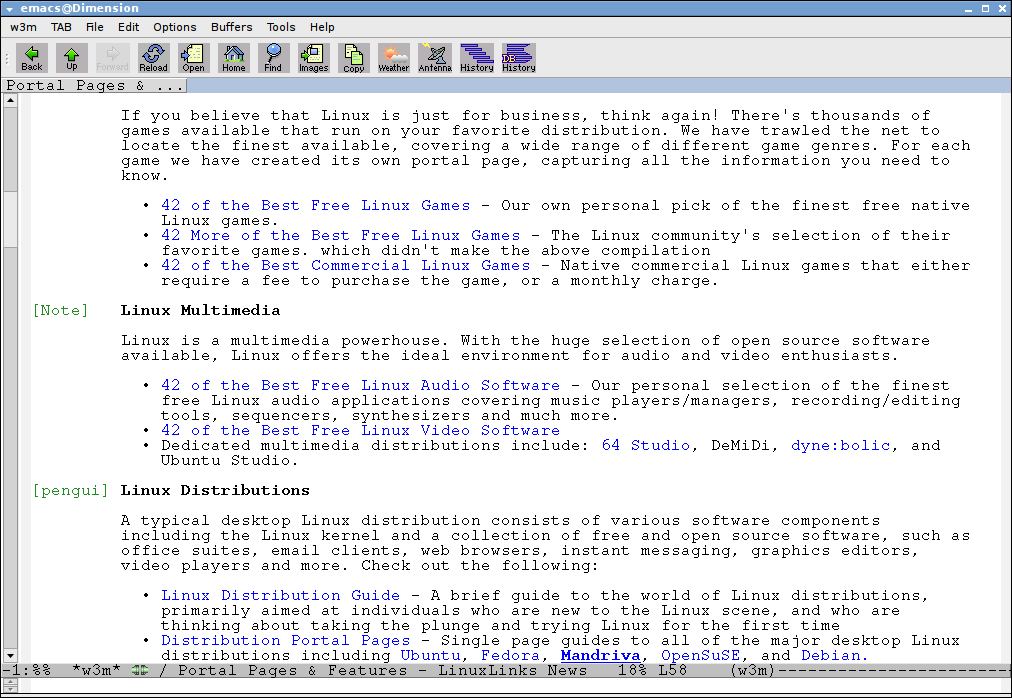
- w3m, a web browser with support for tables, frames, SSL connections, color and even inline images on suitable terminals; Emacs also has a native web browser (Emacs/W3).
- Support for using X displays and text terminals in one session, and for running as a daemon.
- Support for multi-file commits in distributed version-control systems (VC-dir).
- Strong multi-lingual support, including all the European “Latin” scripts, Russian, Greek, Japanese, Chinese, Korean, Thai, Vietnamese, Lao, Ethiopian, and some Indian scripts.
Website: www.gnu.org/software/emacs
Support: Manuals
Developer: XEmacs community
License: GNU GPL v2
Emacs is written in C and Lisp. Learn C with our recommended free books and free tutorials. Learn Lisp with our recommended free books and free tutorials.
| Explore Linux | |
|---|---|
 | Best Free and Open Source Software - A huge collection of recommended free and open source software covering every major category. |
 | In-depth Linux Software Reviews - Detailed assessments of Linux software covering features, usability and overall quality. |
 | The Big List of Active Linux Distros - An extensive collection of actively developed Linux distributions. |
 | Open Source Alternatives - Alternatives to software and services from Google, Microsoft, Apple, Adobe, IBM, Autodesk, Oracle and others. |
 | Essential Linux System Tools - Indispensable utilities for monitoring, maintaining and managing Linux systems. |
 | Linux Productivity Tools - Useful utilities for improving productivity and streamlining everyday tasks. |
 | Alternatives to Popular CLI Tools - Modern alternatives to familiar command-line utilities supplied with Linux systems. |
 | Awesome Free Linux Game Tools - Tools, utilities and companion software that improve gaming on Linux. |
 | Machine Learning on Linux - Machine learning and deep learning software, self-hosted applications and practical tools. |
 | Saving Money with Linux - Practical ways to reduce electricity consumption and lower computing costs with Linux. |
 | Linux Candy - Fun, entertaining and sometimes delightfully quirky software from the lighter side of Linux. |
Please read our Comment Policy before commenting.