

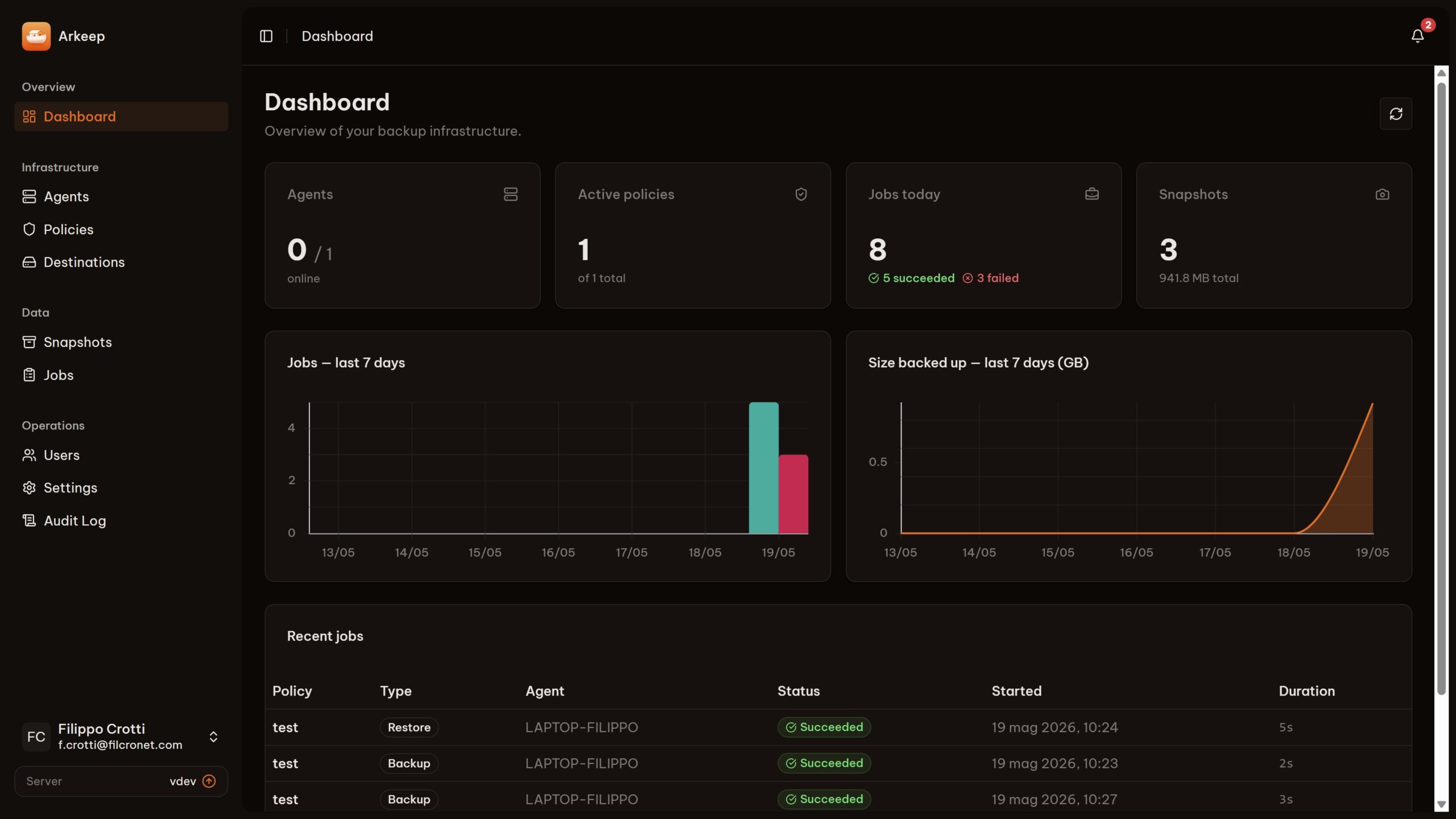
Arkeep is an infrastructure backup management platform built on Restic and Rclone. It uses a central server and lightweight agents to manage backups and recovery across multiple machines from a web interface.
This is free and open source software.
Key Features
- Centralises backup management across multiple machines.
- Uses a server and lightweight agent architecture.
- Provides a mobile-friendly progressive web application.
- Automatically discovers Docker containers and volumes.
- Supports multiple destinations for each backup policy.
- Works with local filesystems, S3-compatible storage and SFTP servers.
- Supports Restic REST Server and more than 40 Rclone backends.
- Encrypts backups on the client side.
- Provides configurable retention policies.
- Runs pre-backup and post-backup commands.
- Performs backup integrity verification.
- Restores files and runs recovery tests.
- Displays live logs and backup status updates.
- Sends notifications by email and webhook.
- Supports local authentication and OpenID Connect.
- Uses SQLite or PostgreSQL for storing application data.
- Secures agent communication with mutual TLS.
- Exports Prometheus metrics and health endpoints.
- Deploys with Docker Compose, standalone binaries or Helm.
Website: github.com/arkeep-io/arkeep
Support:
Developer: Filippo Crotti
License: Apache License 2.0
Arkeep is written in Go. Learn Go with our recommended free books and free tutorials.
Related Software
| Restic Front-ends | |
|---|---|
| Déjà Dup | Hides the complexity of doing backups the Right Way |
| Backrest | Web UI and orchestrator for restic backup |
| Zerobyte | Backup automation for your remote storage |
| Restic Browser | Simple restic backup GUI built with Tauri |
| resticterm | Terminal-based UI written in C# |
| kubackup | Web UI written in Go |
| Pluton | Self-hosted backup management platform |
| Resticity | Cross-platform UI for restic, built with Wails |
| Restic Backup GX | Simple GUI built with Electron and Vue3 |
Read our verdict in the software roundup.
 Explore our carefully curated directory of recommended free and open source software, covering every major software category. Explore our carefully curated directory of recommended free and open source software, covering every major software category.The directory forms part of our extensive collection of articles for Linux enthusiasts. It includes hundreds of detailed reviews, together with free and open source alternatives to proprietary software from companies such as Google, Microsoft, Apple, Adobe, IBM, Cisco, Oracle, and Autodesk. LinuxLinks also covers interesting projects worth exploring, Linux-compatible hardware, free programming books and tutorials, and much more. Know a useful free and open source Linux application that we haven’t covered? Tell us about it using our submission form. |
Please read our Comment Policy before commenting.