

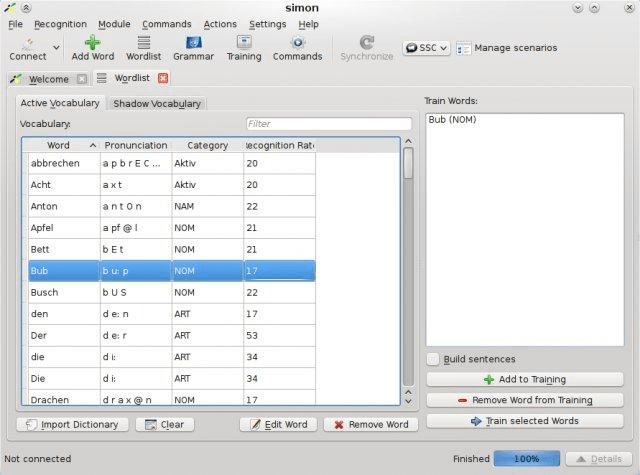
Simon is a speech recognition and voice control application designed to let users operate a computer through spoken commands. Rather than relying exclusively on a fixed collection of predefined commands, it provides facilities for creating speech models and configuring actions that correspond to recognized words and phrases.
The program uses a client-server architecture in which the Simon graphical interface manages recognition settings and command scenarios, while the Simond server performs speech recognition. Users can define vocabulary, associate spoken phrases with actions and configure recognition models for particular tasks. This approach was intended to support different languages, pronunciation patterns and specialist vocabularies without requiring every user to adopt the same voice-command system. Simon was particularly relevant to accessibility, allowing users with limited keyboard or mouse access to launch applications, enter predefined text and interact with desktop controls through speech.
This is free and open source software.
Key Features
- Voice commands – performs desktop actions in response to recognized spoken words and phrases.
- Custom speech models – allows users to create and manage vocabulary and acoustic models for their requirements.
- Scenario system – organizes recognition commands into task-specific configurations.
- Application launching – starts configured programs through spoken commands.
- Keyboard control – generates keyboard shortcuts and predefined text from recognized phrases.
- Mouse control – provides voice-driven mouse and pointer operations.
- Speech modelling – includes facilities for managing language models, grammars and pronunciation information.
- Recognition training – supports recording training samples for user-defined speech models.
- Recognition server – uses the Simond service for processing spoken input.
- Recognition engine integration – uses Julius-based speech recognition components.
- Shared scenarios – supports exchanging configured voice-control scenarios with other users.
- Accessibility tools – provides speech-driven controls for desktop applications and common computer operations.
Website: apps.kde.org/simon
Support:
Developer: Peter Grasch and contributors
License: GNU General Public License v2.0
Related Software
| Speech Recognition Tools | |
|---|---|
| Whisper | Automatic speech recognition (system trained on 680,000 hours of data |
| whisper.cpp | Run Whisper locally with fast, efficient C/C++ speech recognition |
| Flashlight | Fast, flexible machine learning library written entirely in C++. |
| sherpa-onnx | Offline speech recognition for many platforms and languages |
| Kaldi | C++ toolkit designed for speech recognition researchers. |
| FunASR | Versatile speech recognition toolkit for real-world audio |
| faster-whisper | Faster Whisper transcription with reduced memory use |
| SpeechBrain | All-in-one conversational AI toolkit based on PyTorch |
| Handy | Offline speech-to-text application |
| ESPnet | End-to-End speech processing toolkit |
| PocketSphinx | Lightweight speech recognition for embedded and mobile use |
| deepspeech.pytorch | Implementation of DeepSpeech2 using Baidu Warp-CTC. |
| Epicenter | Transcription application with global speech-to-text functionality |
| Julius | Two-pass large vocabulary continuous speech recognition engine |
| Speech Note | Write notes, transcribe speech, translate text and read content aloud |
| aTrain | Private local transcription of recorded speech through a polished GUI |
| hyprwhspr | Native speech-to-text designed for Arch / Omarchy |
| Vocalinux | Local voice dictation through a clean desktop interface |
| ostt | Open Speech-to-Text |
| Simon | Flexible speech recognition software |
Read our verdict in the software roundup.
| Universal Access Tools | |
|---|---|
| Orca Screen Reader | Scriptable screen reader |
| Liblouis | Braille translator, back-translator and formatter |
| Florence Virtual Keyboard | Extensible scalable virtual keyboard |
| Speakup | Kernel-based speech synthesizer driver suite |
| BRLTTY | Gives a braille user access to the text consoles |
| Maliit | Virtual keyboard implemented as a plug-in for Maliit Framework |
| keymapper | Context-aware key remapping with layers, shortcuts and macros |
| Julius | Two-pass large vocabulary continuous speech recognition engine |
| Emacspeak | Emacs extension that provides spoken output |
| Mouse actions | Execute commands from mouse events |
| squeekboard | Keyboard-shaped input method supporting Wayland |
| GOK | GNOME On Screen Keyboard |
| CoreKeyboard | Simple virtual keyboard with word suggestions |
| Dasher | Graphical predictive text input system |
| borse | Practice braille, Morse, semaphore |
| KMouseTool | Clicks automatically when the mouse pointer pauses |
| KMouth | Speech aid that turns typed text into spoken words and phrases |
Read our verdict in the software roundup.
 LinuxLinks helps you discover the best free and open source software for Linux. Explore our extensive collection of recommended applications, including alternatives to popular proprietary software. We also publish software reviews, Linux tutorials, hardware reviews, free programming books and articles covering the wider open source community. Browse our Linux resources to discover more. Know a useful free and open source Linux application we haven't covered? Suggest a program for inclusion. Has your software been featured on LinuxLinks? Display one of our Featured on LinuxLinks badges on your website or GitHub README. |
Please read our Comment Policy before commenting.