

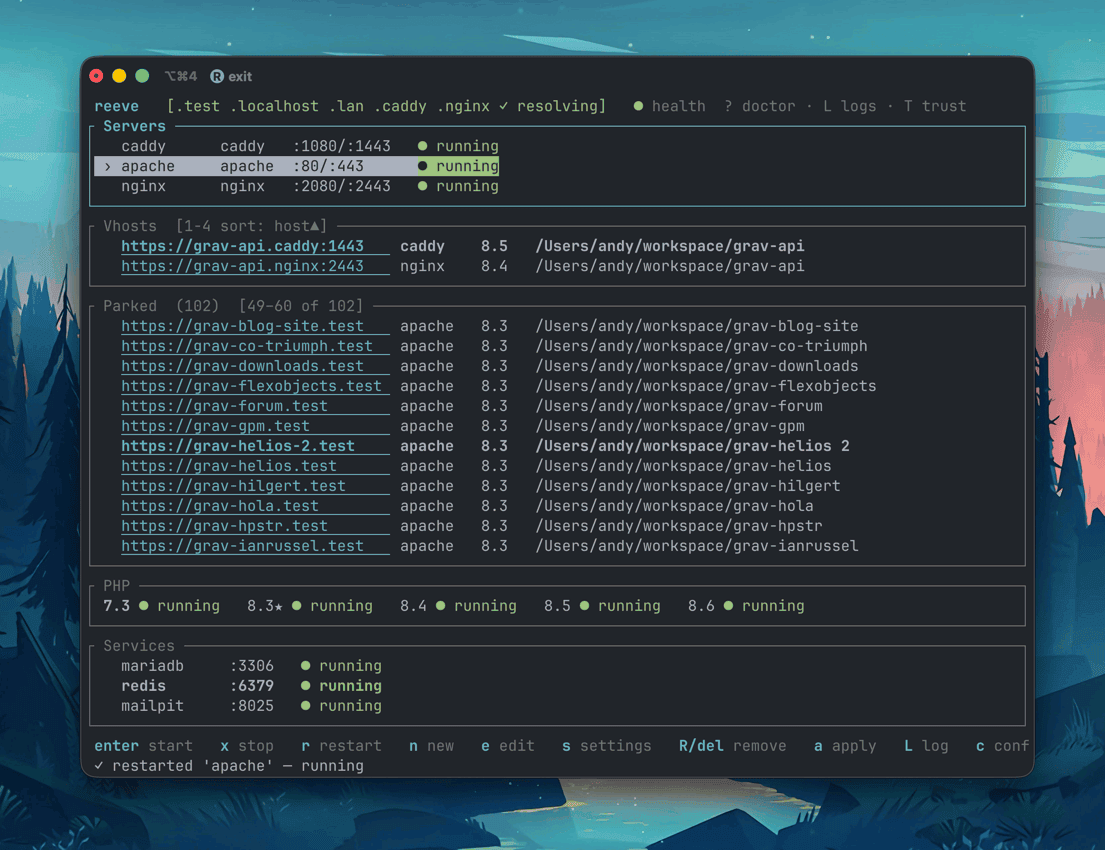
reeve is a local web development stack manager for Linux and macOS. It provides a common TUI and command-line interface for orchestrating web servers, PHP-FPM, supporting services, local DNS, and HTTPS.
Rather than bundling its own copies of these components, reeve manages software already installed on the host. On Linux, services are run through per-user systemd units.
One of its main design goals is letting different local sites use different PHP installations simultaneously. This avoids the usual constraint of switching a single globally active PHP installation whenever a project requires a different environment.
This is free and open source software.
Key Features
- Manages Caddy, Apache, and nginx through a common interface.
- Assigns different PHP installations to individual virtual hosts using PHP-FPM.
- Configures PHP memory limits, upload limits, OPcache, FPM pools, timezone, and Xdebug.
- Can run several independently configured web servers on different ports.
- Manages MySQL, MariaDB, PostgreSQL, Redis, memcached, and Mailpit.
- Provides presets for Laravel, WordPress, Symfony, Grav, Drupal, and other project layouts.
- Supports Valet-style directory parking with automatic project discovery.
- Allows per-project document-root, preset, and environment-variable overrides.
- Creates trusted local HTTPS certificates using mkcert.
- Configures wildcard DNS for local development domains.
- Supports reverse-proxy virtual hosts for separate development servers.
- Offers a catch-all default site for unmatched local requests.
- Includes configuration validation, log viewing, and stack health diagnostics.
- Provides port-aware status reporting and detects processes occupying required ports.
- Includes a live traffic monitor showing request rates, status classes, latency, hosts, paths, and recent requests.
Website: github.com/yetidevworks/reeve
Support:
Developer: Andy Miller
License: MIT License
reeve is written in Rust. Learn Rust with our recommended free books and free tutorials.
 Explore our carefully curated directory of recommended free and open source software, covering every major software category. Explore our carefully curated directory of recommended free and open source software, covering every major software category.The directory forms part of our extensive collection of articles for Linux enthusiasts. It includes hundreds of detailed reviews, together with free and open source alternatives to proprietary software from companies such as Google, Microsoft, Apple, Adobe, IBM, Cisco, Oracle, and Autodesk. LinuxLinks also covers interesting projects worth exploring, Linux-compatible hardware, free programming books and tutorials, and much more. Know a useful free and open source Linux application that we haven’t covered? Tell us about it using our submission form. |
Please read our Comment Policy before commenting.