

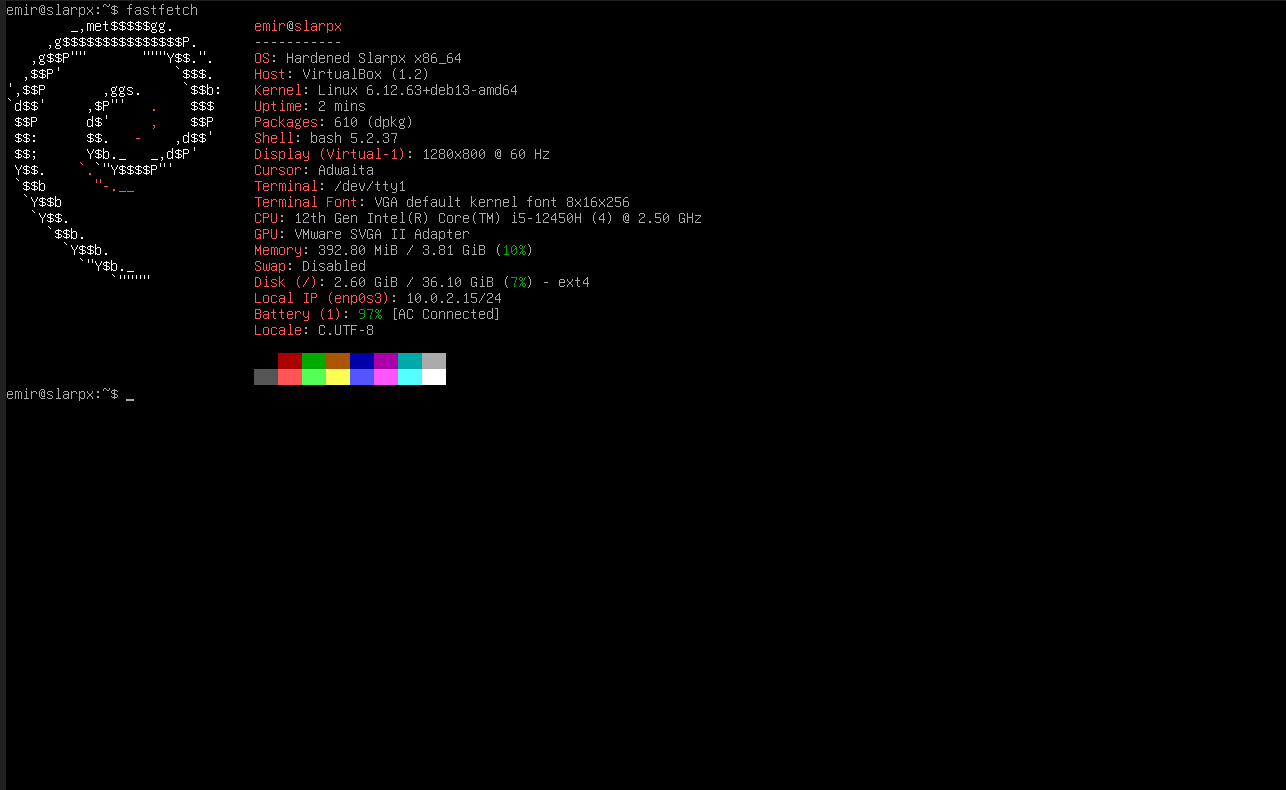
Hardened OS is a Debian-based Linux distribution designed for hostile environments where security takes priority over convenience.
It applies extensive kernel and memory hardening, strict network controls, and several custom security mechanisms intended to disrupt suspicious activity, detect malicious behavior, and enforce a tightly restricted operating environment. The project is aimed at security-focused and research use rather than general desktop computing.
Key Features
- Uses custom runtime security modules including Poison, Xennytsu, and Silencer.
- Implements aggressive kernel and memory hardening measures, including strict ASLR and extensive CPU side-channel mitigations.
- Employs a default-drop nftables firewall policy for both inbound and outbound traffic.
- Enforces immutable DNS settings with trusted resolver restrictions.
- Includes anti-spoofing, flood mitigation, and SSH brute-force protection.
- Restricts privilege escalation and reconnaissance through process isolation and sysctl tamper-guarding.
- Blocks or limits tools and subsystems that increase attack surface, including unprivileged BPF, legacy emulation, and selected debugging utilities.
- Designed as a CLI-only environment rather than a conventional desktop distribution.
- Intended for experimental, high-security, or research-oriented deployments rather than daily desktop use.
| Working state: | Active |
| Desktop: | - |
| Init Software: | systemd |
| Package Management: | APT |
| Release Model: | Fixed |
| Platforms: | x86_64 |
| Home Page: | nixovena.org/slarpx |
| Developer: | Nixovena Labs |
| This article is part of our Big List of Active Linux Distributions and Open Source Operating Systems. |
What's a Linux distribution ("distro")? |
| A distro provides the user with a desktop environment, preloaded applications, and ways to update and maintain the system. Each distro makes different choices, deciding which open source projects to install and provides custom written programs. They can have different philosophies. Some distros are intended for desktop computers, some for servers without a graphical interface, and others for special uses. Because Linux is an open source operating system, combinations of software vary between Linux distros. |
Please read our Comment Policy before commenting.